



RELIABILITY THROUGH SUPERIOR TECHNOLOGY
Superior hardware can fix all problems
Injecting life into system with modern networking system
What is the secret of success of Minecraft server hosting? What is the reason that they are not threatened by their competition? What is the reason that they are always coming on top of the competition? As a customer these are questions that one becomes most curious about. You may want to learn and explore how this service provider will provide the best services for the amount that you are going to invest in them. As a customer you would be excepting the best value for my every penny spent. I want to call that money well spent.
 The answer to all the above questions is superior hardware. Where others try to fiddle with their obsolete and old age technology, here the whole concept has been modernized. State of the art hardware is imported and is fitted in supervision of professionals, professionals that will scavenge for faults. The results are amazing; the server housing complexes are state of the art too. A certain temperature is always maintained to avoid excessive moisture and excessive temperatures that can become a threat if left unchecked. The servers are kept in a secured environment and no unauthorized people are allowed.
Purchasing expansive hardware is not the whole story. Sometimes connecting the whole system can be a challenge too. Though it sounds easy to understand, but in reality it is not. If someone faces a technical problem of any hardware as small as a computer printer, it can also easily drive that person crazy. One can now easily imagine the amount of tools and cables that would be used to put this complex system together. This particular service provider has made sure that quality of the whole system will not be compromised. This is exactly what a customer like us wants, a system which is flawless and always working perfectly.
Latest data centers were obtained by Minecraft server hosting, that are brand new and work absolutely wonders for gamers. If you have been looking for a service provider to explore the latest data centers then it is the right place. It is also to be noted that the data centers scattered around the world are interconnected together via state of the art communication system. As a game hosting server it is the ultimate goal that the game can be accessed and enjoyed online without any lag or other technical defects. The globe has been conquered by this service provider via creation of Global Network Access Points.
Network latency is another important element that has haunted a number of service providers. This factor alone can be a sole cause of failure of a game; therefore customers like us have to wait for the right service provider to come. Here the company has done a magical job. They have been able to connect their whole network of servers together with advance fiber cables. The results are staggering; it’s a 100% fiber network so, there is no copper involved. This means low resistance and absolutely free flow of data and better rendering of the game, making it an attractive feature.
Hosting a game that is owned by someone else is a tricky business and it can turn ugly any time if the data center security is breached and files are copied. Such an action is a nightmare for customers who work day and night to get the perfect game designed. One of the main concerns for us is the datacenter security. You will never go for a service provider who has a poorly secured system. Data centers here are guarded with elements like level access cards, biometrics access control, man traps, security cameras, locking server cabinets and a number of other checks to secure the data that are stored on the servers.

Tin Man Games releases Sultans of Rema, its ninth Gamebook Adventures Title
 After releasing a follow-on story to its very first Gamebook Adventures title, Tin Man Games has decided to continue making sequels to some of its most popular stories, this time coming out with a gamebook that continues the story of its third Gamebook Adventures title, Slaves of Rema. Featuring the amazing work of Gaetano Abbondanza, Andrew Drage and Joshua Wright, Sultans of Rema picks up where Slaves left off and “takes players further east to The Emirates of Akbir” and delve into the political turmoil and magic that is causing unrest in the area.
 Like its previous Gamebook Adventures titles, Sultans of Rema utilizes Tin Man Games’ gamebook engine to create an immersive environment of both story and RPG-like gameplay. If you want to get a better idea of how one of these gamebooks plays out, you can take a look at a review of one here. To commemorate the launch of Sultans of Rema, Tin Man Games is offering a discount for its predecessor, Slaves of Rema, for a limited time; Play Store links for both below.
Game: Sultans of Rema
Price: $5.99
Game: Slaves of Rema
Price: $0.99

Google Play Books v3.1.31 brings back the ability to upload PDFs
 Google Play Books version 3.1.17 appeared to answer everyone’s prayers by finally enabling users to upload both PDF and EPUB files to the app to read, but not two weeks later, the ability to upload PDFs was stripped out in version 3.1.23. The official line for taking out this ability was that PDF uploading was only included as a trial and that they would likely reinstate the function in a later update. Well, that ‘later update’ has finally happened with Google Play Books v3.1.31 rolling out and the ability to upload PDFs has indeed returned in all its glory.
This update makes Google Play Books a much more complete package as reluctant users have often complained about the lack of uploading abilities to the reader app. As for the full list of improvements in this update:
- Upload PDF or EPUB files to your library. Enable PDF support in Settings, then touch a file in email or Downloads and choose Upload to Play Books.
- Settings and Help have moved to the main navigation menu.
- Performance improvements and bug fixes, including a fix to prevent the screen from sleeping while the app is reading aloud.
The update should be rolling to your device very soon, however if you can’t wait that long to get uploading your PDFs, we have the apk for the file right down below. Enjoy:
Source: Android Police

Nintendo is making smartphone apps, says Satoru Iwata, with a chance of Games
 Nintendo has been sending some very mixed messages over the last few days regarding its stance on making apps, specifically games, for smartphones. First they were said to be looking into it, then a Nintendo official denied that it was an eventuality. Thankfully, Nintendo’s President, Satoru Iwata has today put an end to all doubt regarding this issue; he announced that Nintendo is officially making smartphones apps to show “the value of our entertainment offerings, this encouraging more people to participate in Nintendo platforms”.
This is a pretty round-about way of saying that these apps could range from anything from demos to catalogues of trailers, or basically any advertising material that Nintendo deems enlightening. While Iwata didn’t directly address the issue of Nintendo games appearing on smartphones, he did add that “I have not given any restrictions to the development team, even not ruling out the possibility of making games or using our game characters. However, if you report that we will release Mario on smart devices, it would be a completely misleading statement” which I’m reading as ‘don’t get your hopes up’.
Even so, it is exciting to think that Nintendo is finally turning some of its attention to the mobile platform, but for Nintendo purists everywhere, it’s almost depressing to see the state of affairs that Nintendo has gotten itself into that has led it to this point. What do you think about Nintendo opening up development for smartphone apps? Let us know in the comments below.
Source: Nintendo via Kotaku Australia
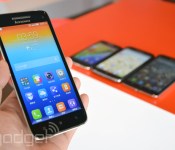
Lenovo doesn’t need Motorola in China, but it may revitalize the local mobile market

You may struggle to take Lenovo seriously after Ashton Kutcher, its new “product engineer,” knelt before CEO Yang Yuanqing at the Yoga Tablet launch in Beijing. But this is the same Chinese company who’s making a second-round purchase from IBM — previously for its PC division with $1.75 billion, and this time for its x86 server business with $2.3 billion. Merely a week later (and just in time for Chinese New Year), Lenovo announced that it’s also snapping up Motorola’s smartphone business from Google for $2.9 billion, with the intention to crack the North American, Latin American and Western European mobile markets.
When combined, Lenovo and Motorola leap from fifth place to third in terms of worldwide smartphone shipments between Q4 2012 and Q3 2013, placing them before LG, Sony and Nokia, but they still trail far behind Samsung and Apple. Looking at its home turf, though, will the deal do much to help Lenovo maintain its number two position in the increasingly competitive market in China? Or perhaps even knock Samsung off the top of the chart? Not directly, no.
The last time Motorola launched a phone in China was in November 2012.
You see, what Lenovo is gaining from this deal is the “legendary” Motorola brand and its product roadmap, but while Moto had a strong presence in China back in the day, it’s quite the opposite ever since Google took over. Leaving behind a tiny team in Beijing, any R&D talent it had at that point soon moved on to other local establishments like Xiaomi, Smartisan and, ironically, Lenovo. The last time Motorola launched a phone in China was in November 2012 for its RAZR i MT788; and about a month later, it sold its Tianjin factory to Flextronics. Nowadays, it’s as if this American company is merely maintaining its customer service and social media presence in China — including the occasional promotion of the Moto X, a phone that isn’t even available there.

From that perspective, Lenovo’s China division won’t benefit directly from Motorola’s assets. If anything, it’d be the Motorola team taking advantage of Lenovo to make a comeback there, assuming there’s still such a plan after yesterday’s announcement. At the moment, the Chinese market is torn between big high-end phones and very affordable devices. It could be interesting to see how consumers react to the relatively mid-range — albeit well-designed — Moto X, along with some of its software features that put many Chinese manufacturers to shame. The cheaper dual-SIM Moto G and the more powerful Droid Ultra series may stand a better chance, unless Lenovo’s own vast range of phones get in the way, of course.
Either way, Yang already promised that he plans to “protect the Motorola brand and make it even stronger,” so it’s likely that Motorola will return to the Chinese market, rather than skip the country completely. A bit like how Lenovo’s IdeaPads have been co-existing with the ThinkPads in the same regions. What it’ll need is some sort of special niche, and in a market where Nike’s been offering its NIKEiD shoe customization service since 2008, surely there’s space for Motorola’s Moto Maker as well? With the ever-increasing appetite amongst Chinese consumers, Lenovo should have the manufacturing and marketing prowess to adapt Moto Maker, in order to lure those buyers with their own custom Motorola smartphone, or simply just one with a wooden patterned back.
That’d be bad news for the other local manufacturers: only Taiwan’s HTC has made a similar attempt with the E1 back in April, but the response to the poor execution was, unsurprisingly, weak. The closest you can get right now is choosing a different back cover, case or stickers while ordering from Xiaomi (provided that you can even snag one before they sell out in a matter of seconds) or other Chinese e-tailers. That’s hardly an authentic customization experience when compared to Motorola’s service.

This Lenovo-Google deal isn’t just about products. While Google is keeping the majority of Motorola Mobility’s patents (about 8,000 registered in the US and about 15,000 overseas), Lenovo will take ownership of over 2,000 of those assets, as well as a license that grants access to the remainder. To put that into perspective, Lenovo already owned “more than 6,500 globally recognized patents” prior to today’s announcement; whereas Coolpad of Yulong, the number three phone vendor in China, has only obtained over 4,000 patents so far. While ZTE and Huawei have sold fewer smartphones in China, they have been granted a lot more patents — over 13,000 and 30,240, respectively — due to their broader range of products and services.
On top of that, there’s also Motorola’s engineers, with 2,800 of them joining the Chinese company, assuming the buyer sticks to its promise of keeping all employees. The only notable part that Lenovo’s missing out on is the funky Advanced Technology and Projects division (the folks behind the modular smartphone project); but hey, you get what you pay for — there’s a reason why Google’s selling Motorola for a fraction of the $12.5 billion it paid back in May 2012 (though let’s not forget the extra $2.2 billion it got back from selling Motorola Home last year).
EIther it’s hard to imagine what these future phones will look like, but we’re already interested in the results. The faster that Lenovo is able to put the pieces all together, the harder it will make it for the rest of the Chinese competition to catch up.
Filed under: Cellphones, Mobile, Lenovo

Judge Declines to Sanction Samsung for Role in Apple-Nokia Patent License Leaks [iOS Blog]
 Last October, Apple filed a motion seeking sanctions against Samsung and its outside lawyers, accusing both of unlawfully obtaining sensitive data about Apple’s 2011 patent license agreement with Nokia. Samsung responded to the allegations by filing three motions intended to slow the investigation. However, those motions were denied by Judge Lucy Koh, who also proceeded to call Samsung’s lack of information about the alleged violation “inexcusable.”
Now, FOSS Patents reports that Judge Paul S. Grewal yesterday ruled against imposing sanctions on Samsung, instead choosing to solely penalize its law firm, Quinn Emanuel. By Judge Grewal’s order, Quinn Emanuel will be required to reimburse Apple, Nokia, and their legal counsel for all costs and fees incurred during the litigation.
Judge Grewal also explained why some further-reaching and more dramatic sanctions proposed by Apple and Nokia were not appropriate:
The vast majority of these are ludicrously overbroad, such as the suggestion that both Samsung and Quinn Emanuel should be banned from any situation in which they might make use of licensing information for the next two years. Although the evidence has shown Quinn Emanuel failed to notify the relevant parties at the relevant times, and that [Samsung in-house lawyer Daniel] Shim made use of the information, there has been insufficient evidence that this failure to notify or misuse ultimately implicated any issue in this or any other litigation or negotiation.
The decision by Judge Grewal can be appealed to Judge Koh and then on to the Federal Circuit if necessary, where Apple or Nokia could attempt to win additional sanctions. Samsung cannot appeal any part of the decision further as it was not sanctioned.
The ruling comes as a second patent infringement lawsuit between Apple and Samsung is set to begin on March 31, 2014. Notably, Samsung will only have four patents claims to bring to the upcoming trial, as Judge Koh invalidated two of its patent claims last week. Both companies will also partake in a trial centered around Apple’s new call for a U.S. ban on Samsung products set for January 30.
</iframe 
     |

Nokia X benchmarked on BrowserMark 2, shows predictable Performance
 When the Nokia X’s hardware specs were leaked earlier this week, many people had to do a double take just to make sure they weren’t dreaming; although we knew the device wasn’t going to be flagship quality, many of us did not quite expect the pedestrian nature of the specs and I think it’s fair to say the Android-powered Nokia phone has lost a bit of interest since then. Regardless, the leaks are still coming in fast and thick as someone has had the Nokia X benchmarked on BrowserMark 2 and uploaded the results giving one of our first looks at the device’s abilities.
Unsurprisingly, the Nokia X (which has been given the model number of RM-980) comes in quite close to the end of the pack, though I would say despite only packing what is likely a dual-core Snapdragon 200, it performs quite admirably, finding itself in the midst of budget quad-core phones. While the hardware is definitely one sticking point for Android enthusiasts, the other elephant in the room would definitely be the lack of Google certification, meaning that the Google Play Store will be present on the phone, though someone will likely figure out how to flash the device shortly after its expected release at MWC 2014.
What do you think about the Nokia X’s performance in the BrowserMark 2 benchmark: still think it’s a bit too underpowered? Let us know what you think in the comments below.

This smart handbag could stop you from overspending

If you’re the sort who overspends at the mall, you may need a firm reminder to watch your budget. How does an ever-vigilant handbag sound? Finder.com.au could soon make one: meet the iBag, a prototype carryall that locks you out if it believes you’re going to splurge. The Arduino-powered bag automatically shuts tight at those times you’re most likely to shop. Outside of those moments, it uses GPS to warn you when you get too close to favorite stores; ignore the alert and it will both record when you take out your wallet as well as send a text message to a trusted partner. iBag is primarily a publicity stunt meant to highlight the dangers of credit card debt, but it might become a reality. The site is asking potential customers to register their interest, and it may sell both men’s and women’s versions of the bag for $199 AUD ($173 US) if there’s enough demand.

Sony’s slimmer PlayStation Vita coming to the UK for around £180, pre-orders start today

Alright, so perhaps we took Sony’s invite to its London PlayStation event a little too seriously when we speculated Vita TV news was on the agenda. Although it’s not technically the “slimmest” PS device, Sony’s brought us here to welcome the late-2013 PlayStation Vita iteration (aka the PCH-2000) to UK shores. Thinner, lighter and generally better than it’s predecessor, this is the first trip for the new Vita outside of Asia. That plane ride ain’t free, though, as the circa £180 price tag (around $300) is a significant mark-up on the cost of the handheld in its homeland (18,980 yen; around $185). Pre-orders for the device start today, with the proper launch penned in for February 7th.

Korea remembers to fine Google for unauthorized data-gathering in 2010

South Korea’s communications regulator has fined Google $196,000 (or the more impressive-sounding 210 million won) for sucking up personal data during a Street View mapping project back in 2010. These “payload data” fragments apparently included details on unprotected WiFi networks — the same stuff you heard about when both Germany and France fined the company. The regulator has ordered Google to delete all collected private data and to keep the public updated as this deletion progresses. Given the pace at which this case has moved so far, we’ll give ‘em four years.
Via: TNW
Source: Korea Herald
 AIVAnet
