


Waze seeks beta testers
Waze is in need of beta testers! Go to the link here to become an official beta tester for Waze. The following requirements below are needed in order to become a beta tester.
Requirements:
– Android OS 2.2 and up
– Device resolution 320X480 and up
– Ongoing participation and responsiveness
– Technical sense
– Ability to provide feedback in English
If you don’t know what Waze is, the recently acquired company by Google, here is a simple breakdown from their play store app description:
Waze is a fun, community based mapping, traffic & navigation app, 70 million strong. Join forces with other drivers nearby to outsmart traffic, save time & gas money, and improve everyone’s daily commute.
Grab the official release below and tell us what you think!
The post Waze seeks beta testers appeared first on AndroidGuys.

SwiftKey’s new iOS note-taking app syncs with Evernote

Will Apple ever open up its mobile platform to allow the use of third-party keyboards? Y’know, customizable boards that have features like clever word prediction algorithms and finger-swiping gestures? Despite CEO Tim Cook’s suggestion last May that we might see iOS open up more in the future, we’ve seen no strong indication that alternative keyboards are even on the drawing board at present time. Fortunately, some developers are finding small workarounds to this dilemma: even though they aren’t allowed to change the keyboard on the platform level, it’s possible to do so within third-party applications. Fleksy is a prime example of a company that’s thinking outside the box, opening up a developer kit allowing third parties to incorporate the Fleksy keyboard into their own app.
SwiftKey is also making the jump to iOS, but it’s taking a different approach: the keyboard maker just announced SwiftKey Note, a note-taking app that’s integrated with your Evernote account. This is great news for current Evernote users, and it may even be enough of an incentive for newbies to try it out. Using the new Note app, you’ll be able to create notes that sync up with the account on your desktop or other mobile app. But what’s more important is that you’ll have the help of SwiftKey’s trusty and faithful word prediction engine combined with the look of the default iOS 7 keyboard. We’ve got a gallery, video and additional impressions after the break.
However, this version of SwiftKey is much more minimal than what you can currently get on Android — essentially, you’re looking at an iOS 7 keyboard with an extra bar on top for word predictions and a few formatting options (if you swipe to the left on that bar, you’ll find a set of buttons for bold, underline, italics, indent and bullet points). We found that we could type faster on this keyboard than the standard iOS version, so it’s off to a decent start, but long-time fans of the Android version may be frustrated by the limited number of features. No swipe gestures, customizable themes, adjustable sizes or anything of the sort, at least not yet; this is the first version, after all, so we’re hopeful that SwiftKey will continue pouring more features into the project.
Still, for all that it’s missing, some of the key ingredients of a good note-taking keyboard are there. Not only do you get to enjoy the same word prediction engine found on the Android platform, the keyboard also gets smarter as you type; the more you do it, the more it’ll be able to figure out your patterns. (Again, this has been done on Android for a long time, but it’s refreshing to see on a platform like iOS.) To take it a step further, it also looks at your Evernote archive to get an idea of your personal writing style, and even keeps track of stats like how many keystrokes you’ve saved and how efficient SwiftKey makes you. Five languages are also currently supported: English, French, Spanish, German and Italian. The app is free and available on the App Store starting today on iPhones and iPads. It’ll work on devices running iOS 6 or higher, but the formatting options are only available for iOS 7. And who knows — perhaps the app will be enough to grab Sir Jony Ive’s attention.
Filed under: Cellphones, Wireless, Mobile, Apple

Facebook Unveils News Creation and Curation App ‘Paper’ [iOS Blog]
Facebook today announced Paper, a news creation and curation tool that ties into a user’s Facebook account. The app is the first product to come out of Facebook Creative Labs, a division within Facebook made of small teams who are dedicated to startup-style projects.

Paper is split into a news reader that pulls its content from both a user’s Facebook News Feed and from well-known online publications, featuring a magazine-style layout with sections that range from technology news to animals. Facebook will also reportedly assign a team of editors to curate the best and most popular online content for users, and a composition tool that allows users to create their own status updates rich with media will be available as well.
Speaking to Re/code, Michael Matas, product design lead for Paper, explained why the company moved beyond a visual newsreader like Flipboard [Direct Link] and created both a news reading and creating tool.
“As you start changing the way you’re displaying this content, we hope that it will change the way people think about posting content,” Michael Matas, Paper’s product design lead, said in an interview. “Because the two are obviously really connected.”
But just as important, as Matas explains it, “It’s no fun to make a bunch of great stuff if no one ever sees it.”
Paper by Facebook will be available from the iOS App Store in the US starting February 3rd, with international availability to be determined. A visual walkthrough of the app is available on Facebook’s website.
     |

‘SwiftKey Note’ Brings Contextual Word Suggestions and Autocorrect to iOS with Evernote Integration
Last week, an image was posted on Twitter by noted leaker @evleaks appearing to show a “SwiftKey Note” app for iOS from the company behind the popular alternative Android keyboard that ranked as the top-selling paid app on Google Play last year.
SwiftKey Note is indeed real and it launches today as a note-taking app that optionally integrates with Evernote’s popular suite of apps. The app offers several features to allow for faster and easier note-taking, including automatic word suggestions based on context and personalized auto-correction. SwiftKey’s suggestion and autocorrect features learn over time based on context from previous text entries, and can tap directly into a user’s Evernote archive to assist with predictions.
SwiftKey’s Chief Marketing Officer Joe Braidwood told MacRumors that his firm was approached by Evernote early last year about the possibility of developing a SwiftKey app to integrate with Evernote, and the two companies have worked closely together and with Apple to bring that vision to reality.
The new SwiftKey Note app supports seamless backup and two-way syncing, both with other instances of SwiftKey Note and with Evernote, allowing for easy note entry and editing in the app while notes propagate to other instances of Evernote. While SwiftKey Note does support some text formatting through easy swipe access to a toolbar, it does not support syncing of more sophisticated Evernote features such as advanced text formatting and embedded images.
With Apple so far refusing to allow developers to create systemwide alternative keyboards for iOS, SwiftKey is limited to bringing its keyboard functionality to its own apps and releasing tools to allow other developers to offer it in their own apps on a case-by-case basis. As such, SwiftKey Note also serves as an example and marketing tool as the company looks to partner with select third-party developers going forward before opening up broader access through an open SDK.

Apple’s prohibition of alternative systemwide keyboards has also contributed to SwiftKey’s decision to not include support for the gesture-based typing found in its Android keyboard. For the time being, SwiftKey Note includes only the standard iOS keyboard to ensure familiarity for users, augmented with word suggestions appearing by default in a narrow bar above the keyboard, although the “tap to dismiss” interface familiar to iOS autocorrect users is also an option. Gesture input may, however, also be added in the future depending on user feedback.
One final key feature of SwiftKey Note is multilingual support, with the app able to offer contextual word suggestions in up to three languages simultaneously. Initial language support includes English (US and UK), German, Spanish (Spain and US), French (France and Canada), and Italian.
Unlike the SwiftKey Keyboard app for Android, SwiftKey Note for iOS arrives as a free app for iPhone, iPad, and iPod touch, giving the company the opportunity to test the waters of iOS with a useful but still lightweight app accessible to all users. The app requires a minimum of iOS 6, although text formatting is currently only supported on iOS 7. [Direct Link]
| |

Facebook announces Paper: a ‘distraction-free’ news reading app for iOS

Facebook is making its own play in the news app category, going up against incumbents like Flipboard and Google’s own Currents service. It’s called Paper and it promises a “full-screen” distraction-free layout, with the app separating out your own Facebook News feed to begin with. You can then add to that, picking from Facebook’s curated themes that’ll include photography, sports, food, science and design. If you feared this would be populated exclusively by giant media corps, Facebook is promising that articles will come from from well-known sites as well as “emerging voices,” although it says it’ll also ensure that trusted publications will be easy to spot within the mix.
Navigation from article to article is done through swipes. and you’ll be able to tilt the phone and arch across bigger panoramic pictures. From the early screens that Facebook’s been sharing, the social network is going heavy on the visual appeal: pictures dominate the navigation, with soft white icons laid on top of pictures for navigation — there’s certainly flashes of iOS 7 in places. Videos, full-screen, will also auto-play (we’re hoping there will be a toggle for that). The app launches February 3rd and marks the premier release for the social network’s Creative Labs department: more apps are promised from the team going forward.
Filed under: Cellphones, Tablets, Internet, Software, Mobile, Facebook

Samsung escapes penalty after its lawyers leaked secret Apple documents

Late last year, Samsung found itself in trouble over claims it had secretly spied on Apple and Nokia documents to gain a better position in patent deals. It denied any wrongdoing, saying it hadn’t done so wilfully, and now US judge Paul S. Grewal has finally drawn the same conclusion. PCWorld reports that the US District Court for the Northern District of California ruled Wednesday that the Korean company could not have used confidential information for its patent licensing talks with Nokia, a deal that was extended in November, because it already knew all of the terms ahead of the leak.
The court considered sanctions against Samsung after the company’s legal negotiator, Dr. Seungho Ahn, had reportedly told Nokia that its terms with Apple “were known to him,” even though they were marked “highly confidential — attorneys’ eyes only.” Up to 50 Samsung employees were said to have been given non-redacted copies of Apple documents by its external counsel Quinn Emanuel, which included patent deals with Nokia, but also Ericsson, Sharp and Philips. While Samsung has escaped further action, the court will force its legal representatives to cover both Apple and Nokia’s legal fees, effectively making the “junior associate working late one night” pay for underusing that big black marker.
Filed under: Cellphones, Mobile, Apple, Samsung, Nokia
Source: PCWorld

Sky will be the only place to watch ‘Game of Thrones’ and other HBO shows until 2020

It’s a big day for Sky as the outfit announces that it’s keeping hold of its premium drama jewels for at least six more years. The broadcaster has extended its exclusive deal with HBO, with first-run rights to shows like Game of Thrones, True Blood and Girls staying on the network until 2020. The pact also bolsters the co-production agreement signed at the time, so expect more co-funded dramas like Strike Back to appear on your screens in the near future. At the same time, Sky is celebrating the fact that it controls the UK’s biggest connected TV platform, with 4.4 million on-demand customers. As such, it’s planning to revamp the Sky HD electronic program guide to give on-demand content equal standing with live TV, just like the picture above. Meanwhile, the broadcaster’s sports arm, still smarting from the loss of the Champions League, has snagged the exclusive rights to plenty of other events, including England Cricket, the Lions tour of New Zealand and Super League matches until 2021.
Filed under: Home Entertainment, HD
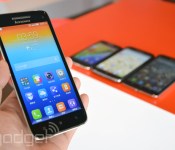
Under Lenovo, will Motorola have better luck with Chinese smartphone buyers?

You may struggle to take Lenovo seriously after Ashton Kutcher, its new “product engineer,” knelt before CEO Yang Yuanqing at the Yoga Tablet launch in Beijing. But this is the same Chinese company who’s making a second-round purchase from IBM — previously for its PC division with $1.75 billion, and this time for its x86 server business with $2.3 billion. Merely a week later (and just in time for Chinese New Year), Lenovo announced that it’s also snapping up Motorola’s smartphone business from Google for $2.9 billion, with the intention to crack the North American, Latin American and Western European mobile markets.
When combined, Lenovo and Motorola (“LenoMo?” “Lenola?”) will leap from fifth place to third in terms of worldwide smartphone shipments between Q4 2012 and Q3 2013, placing them ahead of LG, Sony and Nokia, but they still trail far behind Samsung and Apple. Looking at its home turf, though, will the deal do much to help Lenovo maintain its number two position in the increasingly competitive market in China? Or perhaps even knock Samsung off the top of the chart? Not directly, no.
The last time Motorola launched a phone in China was in November 2012.
You see, what Lenovo is gaining from this deal are the “legendary” Motorola brand and its product roadmap, but while Moto had a strong presence in China back in the day, it’s quite the opposite ever since Google took over. Leaving behind a tiny team in Beijing, any R&D talent it had at that point soon moved on to other local establishments like Xiaomi, Smartisan and, ironically, Lenovo. The last time Motorola launched a phone in China was in November 2012 for its RAZR i MT788; and about a month later, it sold its Tianjin factory to Flextronics. Nowadays, it’s as if this American company is merely maintaining its customer service and social media presence in China — including the occasional promotion of the Moto X, a phone that isn’t even available there.

From that perspective, Lenovo’s China division won’t benefit directly from Motorola’s assets. If anything, it’d be the Motorola team taking advantage of Lenovo to make a comeback there, assuming there’s still such a plan after yesterday’s announcement. At the moment, the Chinese market is torn between big high-end phones and very affordable devices. It could be interesting to see how consumers react to the relatively mid-range — albeit well-designed — Moto X, along with some of its software features that put many Chinese manufacturers to shame. The cheaper dual-SIM Moto G and the more powerful Droid Ultra series may stand a better chance, unless Lenovo’s own vast range of phones get in the way, depending on the retail channel.
Lenovo should have the manufacturing and marketing prowess to localize Motorola’s custom phone service.
Either way, Yang already promised that he plans to “protect the Motorola brand and make it even stronger,” so it’s likely that Motorola will return to the Chinese market, rather than skip the country completely. A bit like how Lenovo’s IdeaPads have been co-existing with the ThinkPads in the same regions. What it’ll need is some sort of special niche, and in a market where Nike’s been offering its NIKEiD shoe customization service since 2008, surely there’s space for Motorola’s Moto Maker as well? With the ever-increasing appetite amongst Chinese consumers, Lenovo should have the manufacturing and marketing prowess to localize Motorola’s custom phone service, in order to lure those who want to take uniqueness to the next level — be it a phone with various fluorescent colors, or simply just one with a wooden patterned back.
That’d be bad news for the other local manufacturers: only Taiwan’s HTC has made a similar attempt with the E1 back in April, but the response to the poor execution was, unsurprisingly, weak. The closest you can get right now is choosing a different back cover, case or stickers while ordering from Xiaomi (provided that you can even snag one before they sell out in a matter of seconds) or other Chinese e-tailers. That’s hardly an authentic customization experience when compared to Motorola’s service, and Chinese mobile consumers are ready for something classier.

This Lenovo-Google deal isn’t just about products. While Google is keeping the majority of Motorola Mobility’s patents (about 8,000 registered in the US and about 15,000 overseas), Lenovo will take ownership of over 2,000 of those assets, as well as a license that grants access to the remainder. To put that into perspective, Lenovo already owned “more than 6,500 globally recognized patents” prior to today’s announcement; whereas Coolpad of Yulong, the number three phone vendor in China, has only obtained over 4,000 patents so far. While ZTE and Huawei have sold fewer smartphones in China, they have been granted a lot more patents — over 13,000 and 30,240, respectively — due to their broader range of products and services.
On top of that, there’s also Motorola’s engineers, with Lenovo claiming that it’ll be taking in all 2,800 of them as a result of this deal. The only notable part that Lenovo’s missing out on is the funky Advanced Technology and Projects division (the folks behind the modular smartphone project); but hey, you get what you pay for — there’s a reason why Google’s selling Motorola for a fraction of the $12.5 billion it paid back in May 2012 (though let’s not forget the $2.2 billion it also got back from selling Motorola Home last year).
It’s hard to imagine what these future phones and their business model will look like, but we’re already interested in the results. And with Lenovo’s strong foundation in China, it’d know how to give Motorola its glorious return to the country, without cannibalizing its own product line. The faster that these two companies are able to put the pieces all together, the harder they will make it for the rest of the Chinese competition to catch up.
Mat Smith contributed to this report.
Filed under: Cellphones, Mobile, Lenovo

[VIDEO] Yet another Samsung Galaxy S5 concept video, looks eerily Possible
 Sometimes there are concept videos that look a bit too good to be true, and then there are concept videos that look so eerie they might actually be possible. This latest Samsung Galaxy S5 concept video falls in the latter category and comes to us courtesy of SET Solution. Apart from giving us a visual tour of the virtual handset, and a really nice one at that, the video does work along the lines of the rumours that we have been hearing over the last few months. Check it out:
Most notably, the video features something called “S Scan” which is SET Solution’s take on the eye-scanner technology that we have been hearing might make its way into the S5 come release day. Additional to this, the video also makes light of the rumour that the S5 will potentially opt for a metal body this time around instead of plastic, and also suggests that the device itself will be smaller, but with a larger screen. Who knows if this is what the S5 will eventually look like, but somehow I feel it’s probably not far from the truth.
What do you think about this Samsung Galaxy S5 concept video? Think it’s got it right? Let us know in the comments below.
Source: YouTube via Android Ice Cream Sandwich

Apple Details Pressure-Sensitive Touchscreen in New Patent Application
An Apple patent detailing pressure-sensitive touchscreens was published today by the United States Patent and Trademark Office, reports AppleInsider. Entitled “Gesture and touch input detection through force sensing,” the application describes a system in which a traditional touchscreen is complimented by multiple force-sensors in order to better log unique gestures and more complex input.

The patent application introduces itself by describing the problems with current touchscreens found in devices, noting that some gestures such as those involving a swipe or pinch from a screen’s edge are not recognized properly, or result in unintended action. Apple suggests that by deploying three or more force sensors in a touchscreen, a device can determine specific central pressure points and take appropriate action.
The touch screen is configured to detect a touch signal corresponding to a user finger approaching or contacting the touch screen. The at least three pressure sensors are configured to detect a pressure signal corresponding to an object proving pressure on a surface. In response to the pressure signal the processor determines a centroid location relative to the surface and the touch signal is processed by the processor by analyzing the centroid location.

Apple also states that central points determined by force sensors can determine if one or more touches are accidental, which is slightly similar to the current palm rejection technology found on the iPad Air and iPad mini. The illustration above shows a user resting the right thumb on one side of an iPad’s screen while continuing to use the tablet with the left thumb. Currently, this input combination cannot be performed on iOS devices, and would potentially allow for new interactions if enabled.
Furthermore, the patent notes that the force sensors can be positioned outside of an active touch region, which could allow for users to interact with user interface elements such as menu options that extend well beyond the immediate area of a touchscreen. This would allow a device the option to render more elements onscreen while retaining key touch elements needed offscreen, offering a secondary mode of input.
Currently, it is unknown whether Apple plans to create such a touchscreen for its products or not, but the company has shown an interest in pressure sensitive technology before. An Apple patent detailing the integration of a pressure sensitive button in a touchscreen was published last November, and a patent that described pressure-sensitive device casings was awarded to Apple in March 2013.
The patent application, which was originally filed on January 30, 2012 and published today, also lists Nima Parivar and Wayne C. Westerman as its inventors.
| |
 AIVAnet
