


Motorola announces multitude of updates, including “KitKat sweetness” for Canada and Australia
Motorola took to its blog yesterday to announce that despite the chilly weather, it’s not preventing its engineers from churning out software updates.
Among the updates are a new “Motorola Gallery”, offering an enhanced UI with faster navigation, a streamlined album drawer and bigger/boulder thumbnails, and an update to “Motorola Migrate,” making it easier to migrate from from an iPhone with the ability to transfer iCloud contacts and calendar events right from the app and not just in the MotoMaker web tool.
The latest version of Android 4.4.2 KitKat is also coming to more devices. Moto started releasing KitKat to the Boost Mobile Moto G in the U.S. and Australia and to the Moto X on Rogers and Fido in Canada.
All this being said, the new Google-owned Moto is definitely keeping its word in delivering timely software updates worldwide.
Please note that while “Motorola Migrate” can be used on any Android smartphone to migrate to a new Moto smartphone, “Motorola Gallery” can only be installed on supported devices, the Moto G and X, and Verizon’s Droid Ultra, Mini and Maxx.
via Motorola
The post Motorola announces multitude of updates, including “KitKat sweetness” for Canada and Australia appeared first on AndroidGuys.
AT&T dangles $100 credit to attract new lines
AT&T on Wednesday introduced a limited-time promotion which gives both new and existing customers an account credit of $100 should they activate a new line (post-paid) of service. The deal works for any type of line, including smartphone, tablet, hotspot, and more. If you’re looking to take advantage of the promo you’ll need to sign up by March 31. Note that your account will need to be in good standing for at least 45 days before you earn the credit and that it shows up within three billing cycles.
Learn more at AT&T’s dedicated landing page.
The post AT&T dangles $100 credit to attract new lines appeared first on AndroidGuys.

Now all Last.fm tracks are playable through Spotify

Spotify may not have the massive marketing muscle behind it like that of new entrant Beats Music, but the small streaming service is looking to expand its reach in other ways. Today, the company announced a partnership that’ll see the entirety of its music catalog made available for playback on Last.fm. Now, when Last.fm users click play on a track, Spotify will be launched in the background, with a convenient bar for playback controls appearing at the bottom of the screen. Additionally, any grouping of tracks on a particular Last.fm page will appear as a playlist within Spotify. The integration is pretty straightforward to get set up, as all you’ll need to connect your Last.fm and Spotify accounts, whether free or premium, is to click on a track and initiate playback. There’s not much else to it beyond that. Just don’t expect this Spotify and Last.fm integration to work on your smartphone or tablet, as it’s not currently supported on mobile browsers. There are also a few known bugs for the service to work out, like unavailable tracks showing play buttons and only the first 70 displayed tracks on page being made available for playback. Oh, and it should go without saying that if you’re in a territory where Spotify’s not yet available, well, you’ll have to sit this one out.
Filed under: Internet

Scribd takes on Amazon, brings its subscription e-book service to Kindle Fire tablets

The whole point of owning an Amazon tablet is that you’re eventually gonna buy stuff. Want movies? Amazon’s got you covered. Music? Time to check out Amazon’s MP3 store. And then, of course, there’s books: Amazon expects you to buy lots and lots of reading material through the built-in Kindle app. Now, though, another company is trying to get in on the action. Scribd, which already runs a $9-a-month e-book subscription service, is opening up shop on Kindle Fire tablets. As on the existing apps (Android, iOS and a web version), the Kindle version offers unlimited monthly access, allowing readers to share what they’re reading and embed books onto websites. The catch? Scribd only has a deal with one major publishing house, HarperCollins, with the rest of the catalog comprised of titles from independent publishers. So, while you’ll enjoy authors like Michael Chabon and classics like Sh*t My Dad Says, you’ll be missing out on things like the Game of Thrones series. Then again, if you read even two books a month, that $9 fee could pay for itself.
Filed under: Software
Source: Mashable

Apple’s Share of Tablet Market Sees Slight Holiday Quarter Boost
Following its mobile phone report earlier this week, research firm IDC has published its estimates of tablet shipments for the fourth quarter of 2013, showing that Apple continues to lead the market with roughly one-third of all shipments.
 Worldwide tablet shipments in 4Q13 in millions of units (Source: IDC)
Apple’s share of the market has generally declined over the past two years amid the proliferation of low-cost Android tablets, particularly unbranded “whitebox” devices in the Chinese market. The holiday quarter with refreshed iPads did, however, allow Apple to raise its share of the market to 33.8 percent from 29.7 percent in the previous quarter.
Apple once again led the worldwide market for tablets, shipping 26 million units during the quarter, up from 14.1 million the previous quarter and 22.9 million in 4Q12. While the quarter represented the company’s most successful on record, its year-over-year growth of 13.5% was well below the industry average. The numbers bring into focus the challenges the company faces as it attempts to grow its tablet business in markets outside of its traditional mature-market strongholds and in the face of continued success from competitors both large and small.
Apple saw its worldwide tablet market share for the quarter grow to 33.8%, up from 29.7% in the third quarter but down from its 38.2% share in the fourth quarter of 2012.
 Apple’s iPad shipments (red) and share of worldwide tablet shipments (blue) for 2Q11–4Q13 (Source: IDC)
As always, it is important to note that IDC’s numbers track shipments instead of sales, and thus how many shipped devices are making their way into consumers’ hands remains unclear. IDC’s figures are also estimates, as most companies do not release their exact tablet shipment data and thus research firms must rely on supply chain data and calculations from information that is made public by manufacturers to build their estimates.
     |

Stock Prices of Japanese Suppliers Slip in Response to Apple’s Earnings [iOS Blog]
Negative reactions to Apple’s Q1 2014 earnings report extended overseas to Japanese component manufacturers, says Reuters. Suppliers such as Taiyo Yuden, TDK, Sharp and Nitto Denko saw their stock prices fall by as much as 3.9 percent following the release of Apple’s quarterly financial results.

Stock prices of these Japanese suppliers are expected to rebound because of their broad client base, but Japanese analysts believe Apple will remain stagnant.
“The company is unlikely to expect profit growth from now on as the iPhone market has been saturated,” a fund manager at a Japanese asset management firm said. “In order to sell in China and emerging countries, the company needs to cut prices more aggressively, so there is also pressure on parts makers.”
Despite these negative global projections, demand for Apple products in Japan remains strong. During Apple’s earning conference call, Tim Cook said iPhone sales rose 40% in Japan, due to a new distribution deal with the country’s largest mobile operator NTT Docomo.
| |
Gmail Bug Mislabeled Some Messages as Spam or Trash [iOS Blog]
A Gmail glitch earlier this month resulted in some users accidentally deleting emails and unintentionally reporting others as spam (via The Verge). The bug occurred when users were managing their inboxes, and the system inadvertently applied these actions to the wrong email messages.
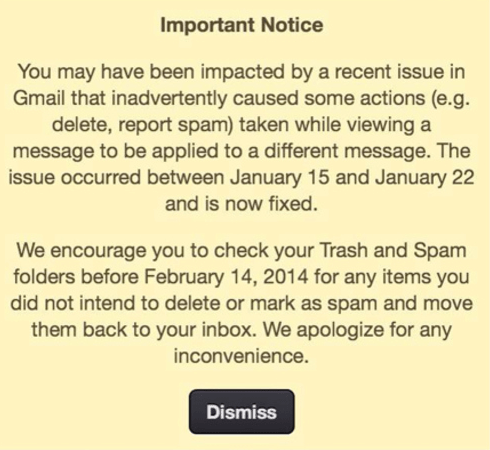
In a notice appearing for some Gmail users, Google confirmed this issue occurred between January 15 and 22 and is now fixed. It only affected users who accessed Gmail via the iOS app, a mobile browser, or offline in a desktop browser. Google advises users to check their spam folder and trash for emails that were marked incorrectly.
The issue is the second round of technical difficulties for Google’s Gmail service in less than a week. Late last week, Google’s cloud services went offline for approximately an hour. The Friday afternoon outage affected Gmail, Google Calendar, Google Talk, Google Drive, Google Groups and other services.
| |

Leaked LG G Pro 2 images show rear-mounted buttons
A pair of images surfacing over at Korean site DC Inside are giving us our first peeks at the upcoming LG G Pro 2. Like the G2 and G Flex, this guy appears to have rear-mounted navigation buttons. Set to be offered white with chrome accents, the G Pro 2 is expected to debut at Mobile World Congress in the next few weeks. Among other details, specifications for the LG G Pro 2 are reported to include a 6-inch 1080p HD display, a quad-core Snapdragon 800 CPU, and LTE/LTE-A data networks. In terms of software we should anticipate Android 4.3 Jelly Bean or later, with LG’s custom UI features and enhancements.

The post Leaked LG G Pro 2 images show rear-mounted buttons appeared first on AndroidGuys.

Hands-on with Sixense’s MakeVR, a motion controlled 3D modeling suite bound for Kickstarter (video)

The last time we saw Sixense’s Stem motion controller, it was little more than a collection of prototypes. The company showed us a gaggle of plexiglass boxes containing reference hardware and a 3D printed shell representing the final product’s design. A more functional third unit (a developer kit, actually) allowed us to play with the controller’s electromagnetic tracking technology, but the overall experience was fragmented and incomplete. Now the company has finally pulled these disparate elements together, revealing the final Sixense Stem System at CES earlier this month.
We caught up with the company earlier this month to take a look at the revised controller, and found a solid, lightweight controller modeled very closely after the 3D printed mockup we saw last year. In fact, the only major difference we found was the revised button layout: we were originally told the device would utilize a modular faceplate system, but the final version wears a symmetrical button configuration reminiscent of the Razer Hydra. Sixense hadn’t met up with us merely to show us the completed Stem System, however — it was rearing to show us MakeVR, the firm’s homegrown virtual reality 3D modeling software.
The MakeVR project has actually been around about as long as the Stem, but its development hasn’t been nearly as public. Sixense sells the program as an evolution in 3D modeling interfaces, a chance to step back from the complicated, menu-laden CAD programs modelers use today and replace them with a more natural interface. By casting the modeling program in a virtual environment with 1:1 motion controls (provided by Sixense’s own Stem, naturally), MakeVR hopes to make digital modeling as easy as playing with Legos, shallowing the learning curve to make it palatable to a consumer market.
Picking up the Stem System for the first time, we saw first hand how easy it was to manipulate shapes and objects. By mirroring the position of the user’s hands, MakeVR creates a workspace that’s more like working on a shop bench than in a CAD program. Objects can be lifted, twisted and observed as if they were held in your palm, lending a tactile element to a digital experience. The program even attempts to integrate its option menus in a natural way, placing settings, import, export and data saving options on a virtual tablet. On a computer monitor, this seems a little strange, but it’s the kind of interface that shines in virtual reality. In fact, it meshes quite well with Oculus’ best practices documentation.

This much we already knew — Sixense has been quietly shopping around the modeling interface for awhile now — but the company did have a few new things to show us. The latest build of the program features a collaborative mode, a multiplayer workspace that allows up to five modelers or observers to interact in the same virtual environment. Users can pass objects between each other, work on the same model simultaneously, or simply observe, point, gesture or talk to each other as if they were in the same room. This collaborative modeling experience is designed to foster a more personal work environment, allowing partners to work together in a virtual space over the internet or through locally connected machines. Sixense’s demo setup also showed off one of the Stem System’s more convenient features: base sharing. Two PCs, each using their a pair of Stem controllers were able to use the same Stem System base unit as the reference point for tracking motion, meaning that offices using MakeVR and Stem controllers would need to invest in fewer bases than workstations.
Although MakeVR has the precision tools and ability to build high resolution models, Sixense told us that it’s geared more for consumers and hobbyist makers than the professional arena — but why would the average consumer want to fiddle around in 3D modeling software? Well, it turns out the company has an answer for that too: 3D printing. Sixense has partnered with Shapeways to allow the users to export their work to the 3D printing service from within MakeVR, providing consumers with an easy to use, streamlined suite for visualizing, creating and ordering objects of their own design. Sending objects off to the printer is easy too; MakeVR provides a trio of cubes recommending 12cm, 6cm and 3cm. Fit your object in the desired box, and you’re ready to print. As we watched our hosts create a toy fire hydrant and a coffee mug in mere minutes and send them to the printer, it was easy to visualize the utility of the integration. Can’t find the perfect gift for your Grandmother’s birthday? Just make it.

MakeVR might not be the perfect program for everybody, but the shallow learning curve and stellar 1:1 motion control integration certainly makes it appealing to anyone picking up Sixense’s Stem system. The early build we saw wasn’t quite ready for primetime, but the potential for a creative virtual reality playground is certainly there. Unfortunately, Sixense hasn’t announced the software’s price or release date, and only told Engadget to stay tuned — a Kickstarter campaign for the program is launching on February 5th.
Filed under: Gaming, Peripherals, Software

Verizon demonstrating LTE Multicast during Super Bowl XLVIII

As part of its massive Super Bowl sponsorship, Verizon has taken over a good chunk of Manhattan’s Bryant Park. We’re at the Verizon Power House this morning, a heated oasis in the otherwise frigid city center, where reps are detailing the carrier’s LTE Multicast service, which enables transmitting live content directly to a variety of VZ devices using the existing network infrastructure. Unlike basic LTE streaming, however, Multicast allows for an uninterrupted video feed regardless of the number of devices currently using the service in any particular area.
We first heard about Verizon’s implementation at CES 2013, and it looks like Big Red’s planning to flip the switch during the first half of this year, though a pricing model, precise availability and device compatibility haven’t been detailed. If you’re in NYC this week, however, you’ll be able to snag a sneak peek of Multicast running on a Sequans-powered tablet and a Galaxy Note 3. The service is currently live at a demo room in Verizon’s Bryant Park booth.
Update: We had an opportunity to check out the service on both the tablet (which was developed in cooperation with Sequans for the purpose of this demo) and a Galaxy Note 3, and the feed looked fantastic. Verizon is currently broadcasting video content at 1.8 Mbps and a data feed at 750 Kbps, both in a full-screen format and a four-panel mosaic, but both options most likely won’t count against an established data cap. In other words, assuming you have a subscription in place, you should be able to access Multicast independent of bandwidth restrictions.
 AIVAnet