


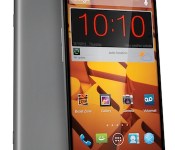
ZTE’s Iconic Phablet comes to Boost Mobile as the Max, available today for $300

ZTE’s Iconic Phablet may have been the worst-named product of CES 2014, but fortunately the company has told us it was merely a placeholder name. Despite it only having been unveiled three weeks ago, it’s already making its way stateside under a much more reasonable (though predictable) name of Boost Max for Boost Mobile, one of Sprint’s prepaid legs. The 5.7-inch 720p device is available starting today sans contract for $300, and it appears that the phone didn’t lose its Multi-Window feature (which works with virtually every app on your device) on its way across the Pacific. It did, however, get bumped down to Android 4.1, two versions lower than the one we played with at CES. On top of this, you’ll also get an 8MP rear camera with 1MP front-facing cam, LTE support, 3,200mAh battery and a 1.2GHz dual-core Snapdragon processor. If you’re disappointed by the name change for some reason, don’t worry — it can forever be an iconic phablet in your heart.
Filed under: Cellphones, Wireless, Mobile, Google, Sprint
Source: Boost Mobile

GetGlue and i.TV combine to create tvtag for iPhone, focus on real-time updates about live TV

After powering second screen connected TV experiences for other companies including DirecTV and Nintendo’s TVii app, i.tv acquired TV check-in service GetGlue last year to pull those experiences together. Now, GetGlue is relaunching as tvtag, an advertising-supported one-stop information and social network centered around television watching, full of information from broadcast partners, augmented in real-time by a team of live curators and TV viewers. At launch, the reworked app is available only on the iPhone, but CEO Brad Pelo tells us a version for Android is due in a few days, with a web experience and iPad-ready version launching shortly after that. The i.TV app is sticking around for now, but will be updated in the future, while DirecTV and Nintendo are already lined up for integration with the new platform.
The check-in and sharing features — and built-in user base — from GetGlue remain, but it’s the curated info that the company expects will separate it from other services. The “taglines” are built by over 50 employees creating high level tags for live TV (covering the majority of what viewers are watching, on any channel), which users then fill in with additional captures, comments and reactions. It’s also why tvtag thinks users will choose to open this app over Twitter and Facebook while they’re watching TV, with the ability to search info from sources like IMDB and Google, or add to the tagline with their own notes and doodles. Those taglines are available for browsing later for DVR viewing, but this experience is about live TV. For events like last weekend’s Grammys or Pro Bowl, and the upcoming Super Bowl, it can push play-by-play updates, as well as constantly refreshed stats and field positions.
Other than the big social networks, competition to provide synced TV info on other screens like your phone, tablet or PC is fierce, with everyone from Google Now, Dijit’s recent acquisition Miso and Yahoo’s IntoNow offering similar features. IntoNow is one of the most similar, adding the ability to ID TV content via audio and a complete feed of images from live TV channels to the mix. tvtag is more than an app however, and since it can open up access as an SDK or API, we may see its features and content pop up in other apps and on other devices soon. Still, given the following GetGlue has been able to attract we expect to see plenty of tvtag shares popping up in our timelines — we’ll see if its exclusive information and tight TV-focused environment is enough to keep its audience coming back.


Filed under: Home Entertainment, HD, Mobile, Nintendo

Nintendo denies smartphone software rumor, says it has ‘no plans’ to offer mini-games on rival hardware

Nintendo? Making games for other hardware? Not so fast. Nikkei’s widely reported tale of Mario et al. coming to a smartphone near you is unlikely to happen — at least in the way we were all half-hoping for. The company has told Engadget that it has no plans to offer “mini-games” on smartphone platforms, reiterating its CEO’s statements in prior financial reports that touched on using smart devices to better promote its games, characters and hardware. You’ll just have to wait for that briefing from Iwata-san, later this week, to discover exactly how the company plans to grab a few more coins. The full statement follows below:
“Nikkei’s article contains information previously stated by Mr Iwata during past press conferences, including statements which relate to Nintendo’s willingness to make use of smart devices to promote our products.
However during such past announcements Mr Iwata has also stated that Nintendo’s intention is not to make Nintendo software available on smart devices and as such, we can confirm that there are no plans to offer minigames on smartphone devices. “
Broadwell CPU Delay and iPad Competition May Reduce 2014 Notebook Shipments [Mac Blog]
Industry-wide notebook shipments will continue to decline in 2014, claims NPD DisplaySearch. Revised estimates predict shipments from all vendors, including Apple, will reach 134 million units, down from an earlier estimate of 152 million unit.

One factor contributing to this decline is the expected Q3 2014 launch of Intel’s upcoming Broadwell CPU. Intel confirmed in its latest earnings conference call that its Broadwell chipset will enter production in Q1 2014 and become available in the second half of 2014. Slowing PC demand and yield issues forced Intel to delay Broadwell by at least a quarter from its original timetable, with that delay likely contributing further weakness in the PC market. Intel’s Haswell processor line, the company’s current CPU family and predecessor to Broadwell, was released in June 2013 and landed in the MacBook Air during the same month.
DisplaySearch also cites the rumored 12.9-inch iPad, wearables and the convergence of mobile and desktop operating systems as market forces that could shift consumers away from notebook PCs.
At the same time, the expected launch of a 12.9” iPad from Apple could trigger growth in larger tablet PC screen sizes, leading to even more competition for potential notebook PC buyers. In addition, wearable devices and other new concepts are expected to compete for consumer spending during the holiday season and beyond. Finally, the trend toward user-interface fusion and operating-system integration will offer a more seamless working platform between mobile devices and PCs, which would further extend mobile device advantages for businesses.
Despite a declining market, Mac sales in the just-ending quarter were strong, increasing from 4.06 million units in Q1 2013 to 4.8 million in Q1 2014. Mac net sales accounted for 11% of the company’s revenue for the quarter, up slightly from 10% a year ago.
     |

Rovio Denies Any Role in NSA Spying on Angry Birds Users [iOS Blog]
 Documents leaked by former NSA contractor Edward Snowden and made public yesterday claim U.S. and UK intelligence agencies are retrieving personal data sent by mobile apps during mass surveillance sweeps.
Rovio’s Angry Birds was one of the apps targeted by intelligence agencies for key profile data such as age, location and gender, and the company has now defended itself against these allegations, denying any voluntary cooperation with government agencies.
Rovio Entertainment Ltd, which is headquartered in Finland, does not share data, collaborate or collude with any government spy agencies such as NSA or GCHQ anywhere in the world.
There has been speculation in the media that NSA targets Angry Birds to collect end user data. The speculation is based on information from documents leaked by Edward Snowden.
The alleged surveillance may be conducted through third party advertising networks used by millions of commercial web sites and mobile applications across all industries. If advertising networks are indeed targeted, it would appear that no internet-enabled device that visits ad-enabled web sites or uses ad-enabled applications is immune to such surveillance. Rovio does not allow any third party network to use or hand over personal end-user data from Rovio’s apps.
Apple last year faced similar allegations it and other technology companies provided the NSA with backdoor access to its servers. Apple CEO Tim Cook denied these reports, saying last week the NSA “would have to cart us out in a box” in order to gain access to Apple’s servers. Cook also has been vocal about increased transparency, asking the government for permission to talk about information requests from federal and law enforcement agencies.
Note: Due to the political nature of the discussion regarding this topic, the discussion thread is located in our Politics, Religion, Social Issues forum. All forum members and site visitors are welcome to read and follow the thread, but posting is limited to forum members with at least 100 posts.
| |
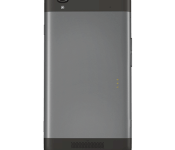
Boost Mobile debuts 5.7-inch Boost MAX
The $300 device is the no-contract carrier’s first crack at the so-called phablet form factor
 Boost Mobile on Tuesday introduced its first plus-sized smartphone, the 5.7-inch Boost MAX. Powered by Android 4.1 Jelly Bean, the handset features a 1.2GHz dual-core processor, 8-megapixel rear camera, and 4G LTE support. Additionally, the device offers 1GB RAM, 8GB internal storage, Bluetooth 4.0, Dolby Digital Plus audio technology, and a 3200mAh battery.
The Boost MAX retails for $299.99 and can be paired with the carrier’s $55 Monthly Unlimited Plan with Shrinking Payments. For every six on-time payments (consecutive or not), the rate plan drops by $5; ultimately, it results in a $40 plan. Included in the plan is unlimited talk, text, and 2.5GB data.
Boost Max is available now at Boost Mobile’s exclusive retail stores, select independent wireless dealer locations nationwide and at www.boostmobile.com/max with free shipping.
The post Boost Mobile debuts 5.7-inch Boost MAX appeared first on AndroidGuys.
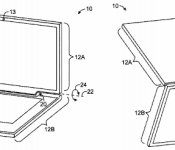
Solar-Powered Laptop with Dual-Sided Display Detailed in Apple Patent
Apple has been awarded a patent by the U.S. Patent and Trademark Office (via AppleInsider) detailing an “electronic device display module” for a laptop that would include the ability to act as a secondary rear display featuring touch controls. The patent also details a photovoltaic system located in the display unit which could power the device with solar energy.
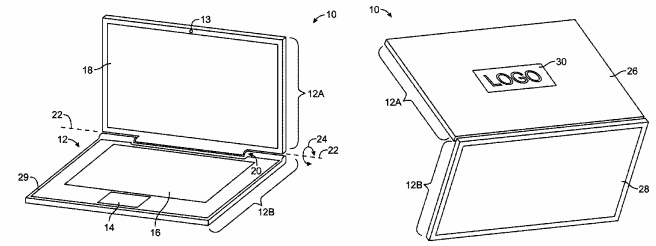
The patent, which was originally filed in 2012, details a portable computer that would encompass both upper and lower housings, consisting of materials such as metal, ceramic, carbon fiber, and glass. The rear housing of the computer would feature a logo similar to Apple’s current line of MacBooks, but would be made of a patterned ink layer instead of a plastic material.
The electrochromic glass that could be integrated into the rear display is also detailed, as the glass would receive signals from light sources with the ability make itself opaque or translucent depending on user input. In theory, this would allow the rear display to remain hidden from view when not in use, which would assist in preserving battery life and privacy.
The display may be controlled using timing and control circuitry on a display driver board. The driver board may be mounted within a clutch barrel that contains the hinges. The driver board may be mounted within the clutch barrel so that it lies perpendicular to the plane of the display or may be oriented at other orientations such as orientations that are within plus or minus 10.degree. or 20.degree. from perpendicular, orientations that are parallel to the plane of the display, or other orientations.

Furthermore, Apple also proposes that the computer include photovoltaic cells located under the rear panel, with the cells producing power when activated by an external light source. The cells could also have the option to store the power or use it immediately, and would receive energy from light when the display and electrochromic glass are in the translucent mode. 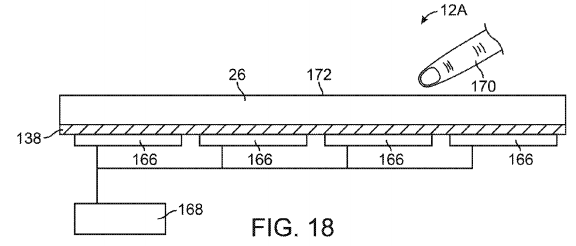
Lastly, the touch controls found on the rear display would allow the user to do a number of things, including the ability to input passcodes, control media playback, and unlock the magnetic latch of the computer by touching a certain region. The patent also states that the touch sensors may include capacitive, acoustic, optical, or pressure-sensitive properties to allow different methods of input, and could be located on a centralized rear structure.
It is unknown whether Apple plans to create such a product or not, but the company has researched similar technology before. A patent in August 2012 detailed significantly enhanced iPad Smart Covers with secondary displays and solar cells, and a patent in 2008 showed the company’s interest in producing solar LCD powered iPods, iPhones, and laptops.
Other reports on Apple’s interest in solar-powered devices have also popped up on numerous occasion throughout the years, though it is unclear as to whether Apple is ready to make a serious attempt at integrating the technology into its products or is still focused solely on researching methods.
| |

Vox Music Player Updated with Redesigned Interface, Gapless Playback [Mac Blog]
Coppertino’s Vox music player today received a new update, bringing a refreshed design that displays album art and hides playback controls until needed, along with new features such as gapless playback and improved searching across devices and file locations. The update also features improved multi-device support and bug fixes addressing previous issues with radio stations and general stability.

Well known in the Mac community for delivering gorgeous sound, intuitive user features and flexible file support, VOX 2.0’s most exciting update is the completely redesigned smart interface, which now slickly displays album art; seamlessly tucks away controls until needed, and offers perhaps the most lightweight, flexible, modern music player available for OS X. Additionally, Mac fans asked and Coppertino listened. VOX 2.0 now features gapless playback that eliminates pauses between audio tracks.
VOX 2.0 updates include:
– New playlist formats for export;
– Smarter searching across all devices and file locations;
– Improved multi-device support via the Audio MIDI;
– Several bug fixes address some minor issues that occurred when changing radio stations, stability when handling high loads and with services support.

Originally launched last August, Vox is designed to be a replacement for playing music within iTunes, and supports a wide variety of audio formats including MP3, FLAC, AAC, Musepack, Ogg Vorbis, WAV, and more. Vox can import an existing iTunes library with metadata, and also offers offers a built-in equalizer as well as internet radio connectivity, which is available as an in-app purchase.
Vox 2.0 is available in the Mac App Store for free. [Direct Link]
| |

New Video Shows ‘iOS in the Car’ Functionality from iOS 7.0.3 in Action
Last week, app developer Steven Troughton-Smith shared a series of screenshots of what seemed to be Apple’s “iOS in the Car” feature announced by Apple as “coming soon” to iOS 7 devices. The feature is intended to allow an iOS device to take over the in-dash display of a car, providing access to navigation, phone functions, messages, and music.
Troughton-Smith has now posted a video showing iOS in the Car in action, via a barebones implementation that is actually present in the already released iOS 7.0.3 but not accessible by default. The video shows the feature being run in the iOS Simulator software for developers, with the in-dash display represented by a separate 800×480 window.
In notes posted alongside the video, Troughton-Smith points out that the iOS in the Car feature supports multiple resolutions of external displays, touch input and hardware controls, and voice input.
– Supports Multiple Resolutions
– Supports touchscreens (presumably single-touch?), hardware buttons, wheels and touchpads
– Does not support multitasking – car display will always show same current on-screen app as iPhone (which can be locked/asleep)
– Whitelisted to specific Apple apps – no public API for developers [yet?]
– Has no keyboard UI – voice recognition as input
– UI clearly subject to change
– Missing functionality in video is due to iOS Simulator not containing all the stock iOS apps
 iOS in the Car from iOS 7.1 (Source: Twitter)
Troughton-Smith does also point out that the user interface is subject to change, and while the demo shown in the video resembles the screenshots shown on Apple’s site, his earlier screenshots and a Twitter response indicate that the overall look has indeed seen a redesign for iOS 7.1, bringing more of the blue text and overall feel of iOS 7 to the in-vehicle display.
| |
European carriers and Google Fiber are leading the IPv6 charge

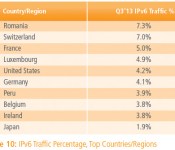
The advanced IPv6 standard reached the internet well over a year ago. But who’s really using it? Mostly Europeans, if you ask Akamai. The content delivery firm is now tracking IPv6 adoption as of its latest State of the Internet report, and it found that European nations represented seven of the top ten countries using IPv6 in the third quarter of 2013. The US was more modest in embracing IPv6 with 4.2 percent of all traffic relying on the newer technology, while Asia was relatively slow on the uptake. Adoption varies widely from provider to provider, though. More than half of Google Fiber’s traffic was based around the protocol, while more established companies like Deutsche Telekom and Time Warner Cable still leaned heavily on old-fashioned IPv4.
There are a handful of other revelations in the report. Denial of service attacks dropped for the first time since the end of 2012, with China passing Indonesia to once more become the biggest source of incursions. Broadband speeds were also clearly on the way up — Akamai notes that use of high-speed internet access (over 10Mbps) jumped 31 percent quarter-to-quarter to to hit 19 percent worldwide. These increases primarily came from South Korea, the Netherlands and other countries that already have high average internet speeds. Not that Americans can complain too much. The US mostly kept pace with a typical internet speed of 9.8Mbps, or enough to make it the eighth fastest country on Earth.

Filed under: Networking, Internet
Source: Akamai
 AIVAnet