



[OP-ED] A Kickstarter Conundrum: To Release, Or Not To Release

Image Source: Agency 2.0
Kickstarter and the whole crowdfunding movement has had quite some time to sink in now, and while the initial fever has definitely died down, there are still plenty of projects and campaigns being started every day to pitch their ideas. Obviously the allure of backing a crowdfunded project is the uniqueness of the product in question and how it otherwise might not have made it into the public eye, however, the harsh reality of business and manufacturing that some projects struggle along the way, causing delays in the process, sometimes fatally so.
For those who haven’t been caught up in the whole crowdfunding ordeal, essentially what Kickstarter and other crowdsourcing bodies, like Indiegogo, provide is a platform for inventors, entrepreneurs and mad scientists to bypass all the red tape and pitch their ideas directly to the end user, who in turn invests money for what they believe is a good idea. If enough investors, or backers, are on board and the project reaches (or exceeds) its monetary target, the people in charge of the project must now use that money to complete their project and provide the backers with the product that they invested their money in the hopes of receiving. That’s the idea anyway…
The reality is that this isn’t always the case. Several high profile projects have simple fizzled out right after the money did, and have left their backers high and dry and usually quite angry. This has created quite an intriguing stigma that is now associated with Kickstarter and crowdfunding as people have begun to shy away or question the merits of backing projects.
 A subset of the projects that run out of money are the projects that delay their launch long enough for people to become significantly disillusioned with the project. The first project that comes to mind is inevitably the darling of Kickstarter, the Pebble Watch, which raised over $10 million in its short campaign to create its e-ink smartwatch. This single Kickstarter project managed to be the springboard for both the Kickstarter fever as we know it now, as well as the wearables explosion that we were witness to at CES 2014 a few weeks ago. While we can say that in hindsight now, the road to this point for Pebble, and countless other crowdfunded projects, is not quite as smooth…
To give a little background on Pebble for those who don’t know about it, the Pebble Watch Kickstarter was launched in April of 2012 and initially aimed for a target of $100,000 to complete their dream of creating the smartwatch. After reaching that target in only 2 hours of the project going live, it was clear the Pebble team had stumbled onto something special. Stretch goals that promised bonuses to the backers were made and subsequently smashed, eventually netting the Pebble team $10 million, over 100 times what they had originally requested for, easily making them the most successful Kickstarter campaign to date.
 At this point, in May 2012, the Pebble Watch was ‘scheduled’, according to the campaign page, to make its appearance to its backers later that year in September, however, the Pebble team never really set any concrete schedules for when the smartwatch would appear, instead adopting a mantra of “It will be finished when it’s finished”. Fulfilling its promises to 68,929 backers as well as its retail preorders was no tall order; it was going to be a mammoth one. Over the next few months, the Pebble team kept its backers (myself included) well informed with regular updates, decorated with informative photos of the current status of the project.
But all of a sudden it was September. And then it was 2013.
Understandably, many of the backers started to ask questions, ranging from “When can we expect our Pebbles?” to much more profane variations of that question. After all, in the consumer world, who isn’t used to paying money for something and expecting to receive and be able to use it in the immediate future? January rolled in and the Pebble team announced that backers could expect their Pebbles to start shipping out, except with 68,929 smartwatches to ship out, that was no small task either. From my own experience, I was almost bang in the middle of the pack and ended up receiving my Pebble in April 2013. There are infamous stories around this time of people who had preordered Pebbles after the Kickstarter campaign receiving their Pebbles before backers; as you can probably understand at this point, it was a logistical nightmare for the Pebble team to coordinate all this, particularly taking into account shipping time and the like.
 My aim in writing this isn’t to vilify the Pebble team; in fact, I have nothing but praise to speak of the Pebble team. My aim in using Pebble as an example is because they are the most visible of the crowdfunding projects, but the same concepts can be applied to any crowdfunding project. Neither you nor I would have been able to do a better job than the Pebble team did in getting all those Pebbles to their backers. Of course, there are little things they could have done better, but one of the things they did do right was adopt the credo of ”It will be finished when it’s finished”. This part of this discussion is by far the most difficult to swallow because as consumers, we are so used to getting what we want, when we want; the consumer world has grown to the point where we can basically be instantly gratified. So when we saw delays in Pebble, and all the other crowdfunded projects that have seen delays, we instinctively sensed weakness and were quick to jump to anger and outrage.
In reality, the Pebble team was doing exactly what they were supposed to do. As a company creating a product, and this goes for all crowdfunding projects, their responsibility is to give their backers the best possible product in the best possible timeframe. This means that if there is something wrong somewhere along the line, it is their responsibility to make sure it is right, even if it means redoing that process; this is usually the main source of delays and the fact of the matter is that they can’t do anything about it. If they had just gone ahead with a sub-standard part, the backlash of thousands upon thousands of unhappy backers would far outweigh a delay to make it right.
 The beauty of the Kickstarter and crowdfunding model in general is that they lay out the whole project process for all to see, guts and all. Don’t think for one second that these kind of things don’t happen in giant manufacturers either; any time that you hear a product won’t be arriving in time due to lack of supply or parts, this is exactly the same situation, except you don’t normally hear about it because the whole process is behind closed doors. The difference with crowdfunded projects is that as backers, you have unprecedented access to what is going on behind these closed doors. In fact, knowing more about the situation should make us more understanding, however, this isn’t, and probably never will be, the case as we’re almost all hard-wired to be consumers.
All the same, I implore you: the next time you back or consider backing a project, understand that the team behind the project is trying to fulfill their dream just as much as you want to get your hands on their product. All they want is to get what is in their head into your hands, so when there is a delay, you better believe it was because they want to give you the best possible outcome to your backer experience.
Limefuel Doubles Your Nexus 5 Battery With A Great Case

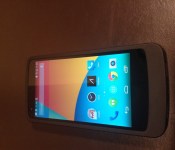
We all know how great the Nexus 5 is, a pure AOSP device with a blazing fast Snapdragon 800 processor, 5 inch HD display and Android 4.4 Kit Kat out of the box, what’s not to love? With all that said there is one issue I just can’t get over, the embedded battery. Say what you will, but I just want to have the removable battery option. I usually drain my Note 3 in 4 hours during heavy use which is most of the time but because it has a removable battery I can simply swap to another one when I need it. Obviously the Nexus 5 doesn’t have that option. There are however various options to help you get some juice on the go. One solution is a case with a rechargeable battery. There are plenty battery pack toting cases around for the iPhone 5, quite a few for the Samsung Galaxy S4 and even some for the HTC One, but I have only found one for the Nexus 5. The one I found was on Amazon (via Google Search) but it didn’t look superb. I want more variety, thankfully the folks over at Limefuel apparently saw the same issues and have decided to put out their take on a battery backup charging case for the N5.


Many of you might not be familiar with Limefuel. There name used to be Limeade. Due to circumstances that we won’t be covering here, it has been changed to Limefuel. Prior to CES 2014 they sent me 3 of their battery banks; a 6000 mAh portable battery pack, 13,000 mAh portable battery pack, and a whopping 24,000 mAh one. If I would have received the 24,000 mAh alone I would have been set. Thanks to that monster I didn’t have one device die on me during the entire show week. I’m talking one GoPro Hero3+, Note 3, Verizon HTC Rezound (hotspot purposes), and my Google Glass all charged the entire week thanks to the Limefuel 24,000 mAh portable battery pack. That is just to give you an idea of how far Limefuel has come since their Kickstarter days and it looks like they have no plans in slowing up their designs or functionality. Which, in my opinion, is a great thing. There is nothing worse then helping fund a company to watch one product come out and then disappear.
While at CES I got a chance to see the new Limefuel Nexus 5 rechargeable battery case and I have to say it looks like a great case. It is a two-piece slider style case that makes putting your Nexus 5 inside not only a breeze, but also gives you worry free usage. Often these types of cases make you force or jimmy your device into them and can potentially harm your USB charge port. The case lightweight, at only 3.8 oz and slim enough (3.3-inches) to not take too much from the Nexus 5′s sleek design. The Limefuel case packs a whopping 2860 mAh battery (made with Grade A cells with protection against short circuit, anti-discharge protection, anti-overcurrent protection and anti-explosion protection) which will give you one full charge and a bit more. That is more than enough for the average user. If you do happen to have issues though, Limefuel products come backed with a 12 month warranty.
I have included links below so you can get your hands on one. All I can say is I may have to buy a Nexus 5 so I can review this amazing Limefuel product. So stop reading and go get you Nexus 5 rechargeable case as of this article Amazon only had 19 left. I added in the 13000 mAh battery pack below also, mainly because it is great and only $39.99.
Take a look at more Limefuel gear

Official website is at Limefuel.com

BLU’s new midrange VIVO phone is thin, gaudy and costs $250

Nokia and Apple aren’t the only ones making brightly colored phones, you know. Upstart Android manufacturer BLU has just released a new midrange handset, called the Vivo 4.8 HD, that’s sure to appeal to those with a taste for neon and Android 4.2. It comes in neon pink or greenish yellow, along with matte black or white variants, and has a 4.8-inch, 720 x 1280 Super AMOLED display. On the inside, the Vivo 4.8 HD packs far from cutting edge tech: a 1.5Ghz quad-core chip from Mediatek, 1GB of RAM and 16GB of storage. Yet, it crams that gear — along with an 8 megapixel rear shooter and a 5-megapixel front-facing unit — into a svelte, pocketable 6.9mm thick chassis. Unfortunately there’s no LTE inside, but you can pull HSPA+ 42 speeds from AT&T or T-Mobile. The best part, as is the case with other BLU phones, is the price: just $249 unlocked.
Filed under: Cellphones, Mobile
Source: Virtual Press Office
 AIVAnet