



Huawei pays off Apple and Microsoft-led consortium in Android patent spat

While Google does all it can to avoid the Android patent headache brought on by the “Rockstar” patent group, another of the consortium’s targets has decided it wants out. FOSSPatents reports that Huawei, one of seven Android OEMs sued alongside the search giant, filed a joint motion with Rockstar and its subsidiary to dismiss claims that it infringed on numerous networking and UI patents. The move suggests that the Chinese company chose the less costly option of settling instead of embarking on an expensive legal battle. Bear in mind that the Rockstar consortium counts Apple, Microsoft, BlackBerry, Sony and Ericsson as members, which closed the purchase of thousands of patents previously owned by Nortel for $4.5 billion. With a deal seemingly worked out, Huawei is free to use Rockstar’s patents without fear of future reprisals, leaving Samsung, LG, ASUS, HTC, Pantech, ZTE and Google firmly in Rockstar’s crosshairs. Huawei’s settlement prove decisive, however, as it demonstrates the group’s patent claims have merit, which could motivate the remaining phone makers to broker their own deals.
Filed under: Cellphones, Software, Mobile, Microsoft, Google
Source: FOSSPatents

Former Foxconn Employees Charged with Accepting Bribes from Supply Chain Partners
Several former Foxconn employees have been charged in Taiwan for allegedly accepting kickbacks from partner companies in Foxconn’s supply chain, reports The Wall Street Journal. According to the report, a former general manager is being held on bribery charges and three former employees are released on bail. However, Apple and other Foxconn clients are not being investigated as authorities do not believe those companies were involved in the kickback scheme.

The bribery allegations were made public last year when an internal Foxconn audit revealed several employees were accepting kickbacks from supply chain companies. Foxconn then acknowledged the criminal activity and turned the employee(s) over to the Chinese police for investigation.
“We can also confirm that our internal investigation found these violations to be limited to the procurement of consumables and accessory equipment related to a small part of our business,” Foxconn said in a statement. “The employees in question are no longer with our company.”
The charges come as Foxconn has been under fire multiple times in recent years for labor violations. The company has also been working with Apple to improve conditions for employees in its city-like factories, but it has been a slow process. After agreeing in 2012 to examine worker pay and limit working hours, a recent Fair Labor Association report shows the company now is meeting the FLA’s 60-hour work week, but still exceeds China’s legal limit for weekly working hours and overtime. 
     |

UK carrier finds loophole to let it increase prices mid-contract

Well, that didn’t take long. It’s a matter of hours since the UK telecoms regulator Ofcom brought in new rules to protect mobile customers from mid-contract tariff increases, and already one network has ducked them by changing its T&C’s. As of today, any customer who signs up with O2 must explicitly agree that their tariff will go up each year in line with inflation, starting with a 2.7 percent increase on March 1st. By contrast, customers who had signed up before today had only been told that prices might go up with inflation. Why is this so ironic? Because, indirectly, Ofcom’s involvement seems to have turned a possible price increase into a definite, contractual one, whereas the original intention was to ensure that “fixed means fixed.” Anyhow, in O2′s defence, it hasn’t breached Ofcom’s code, and other carriers may well be planning to do the exact same thing.
[Thanks, Anon]
Filed under: Cellphones, Mobile
Source: O2

Honda develops braking system for early pedestrian detection

Honda’s hoping you haven’t had your fill of self-driving autos from CES, because it’s just revealed an automatic braking system that’s supposedly better than similar technologies out there. According to the Japanese automaker, its system’s capable of stopping cars just in time to prevent collision, even if they’re going as fast as 37mph. Honda claims that’s a lot faster than what other auto-brake tech can handle, but it’s worth noting that Mercedes’ and Volvo’s systems (though not developed specifically for pedestrian detection) work even if the cars are moving at 50mph. We’ve yet to know how much the tech will cost to install, but it’s expected to come baked into Honda’s Legend sedan, which is set to debut in late 2014.
Filed under: Misc
Source: Nikkei
Must Have Windows Phone 8 Apps
Microsoft has been a little slow coming on to the smartphone scene, but it is starting to make some headway with the introduction of Windows Phone 8. The slick and easy to use UI is very comfortable for both those new to the smartphone experience, and those familiar with the Windows 8 OS.
The partnership with Nokia, as well as still providing the Windows platform to third-party manufacturers like HTC has resulted in some very nice handsets at a very competitive price – some even under £100.
Though they are still playing catch up in the app department, the Windows App store now offers over 100,000 titles. Though that is dwarfed by Android’s and Apple’s 1,000,000 titles, Microsoft follows strict guidelines on what apps can be sold for their platform, much like Apple does. This guarantees that the apps you get will behave properly, and work well, ensuring a smoother overall experience.
Windows Phone 8 comes loaded with many handy Apps like Microsoft Office, Polished Email, Calendar, News, Photo and Music Apps. Here’s a short list of some must-have apps that goes beyond these basics:
1.WhatsApp – If you have any familiarity with smartphones, chances are you’ve already heard of WhatsApp. If not, this is a smartphone messenger that is available for all popular platforms like Android, iOS, and now Windows Phone 8.
The latest iteration has fixed many of the previous version‘s bugs, and runs much smoother. WhatsApp allows you to use your 3G, 4G or Wi-Fi connection to message family and friends who have the same app.
This is a great way to save on texting charges, especially when travelling abroad.
2.Skype – Much like WhatsApp, Skype is the omnipresent video chat software available for connections from phone-to-phone, phone-to-computer (or vice versa), computer-to-computer, and even connections to landlines.
Though the video chat is the nicest feature of the app, it will allow you to make phone calls and texts as well. This is another great way to make free calls using a Wi-Fi connection, which could save you a bundle when you learn to use this procedure correctly.
Be sure that when you are using Skype, you are calling someone who is also running Skype. Though you can call any phone, if it doesn’t go through Skype on the receiving end, you will get connection surcharges, and be charged like a normal phone call.
3.Networking Apps (Facebook, Twitter, etc.) – These have been linked together, because most people understand the idea of social (or business) networks already. Many of the major players like the two mentioned offer apps for Windows Phone 8.
These apps allow you to share thoughts, information, pictures, and your location, even what you’re eating – anytime, anywhere. If you frequent the Social Networks (even if it’s just to play some of their games), and would like the convenience of mobile access, these apps are a must.
4.Indigo – This is a Siri-like voice enabled personal assistant app for Windows Phone. Though the interface is more command based than conversation, you can still accomplish a great deal with this PA, such as: updating Facebook, interacting with Twitter, get recommendations for local restaurants, bars and other venues, get directions, create and store diary entries, create notes and reminders (with alerts), play music stored on your phone and more.
Indigo is a definite must for the ultimate hands-free Windows Phone 8 experience.
5.Yelp – Indigo can tell you how to get somewhere, and Yelp can help you decide where to go. With reviews of near-by hotels, restaurants, and other social gathering places, Yelp is a must have for the user on the go.

Pixelmator Updated With 16-Bit Color and Full Mac Pro Support [Mac Blog]
 Pixelmator has updated its image editing software to version 3.1, adding full support for the new Mac Pro, including 16-bit per channel images, full GPU support, and optimizations for the multi-core processors in the new machine.
The app now uses both Mac Pro GPU’s simultaneously for composition rendering and uses lots of background computing to speed up zoom and other tasks, with the company claiming that “image editing is now completely seamless, and even with large and complex compositions you will experience profoundly faster and more responsive performance.”
“We are extremely excited for professionals to experience the power and speed of Pixelmator 3.1 Marble on their new Mac Pros,” said Saulius Dailide of the Pixelmator Team. “Harnessing the power of the Mac Pro’s dual-GPU architecture, we’re now able to support 16-bit per channel images for the first time and push the limits of Pixelmator performance like never before.”
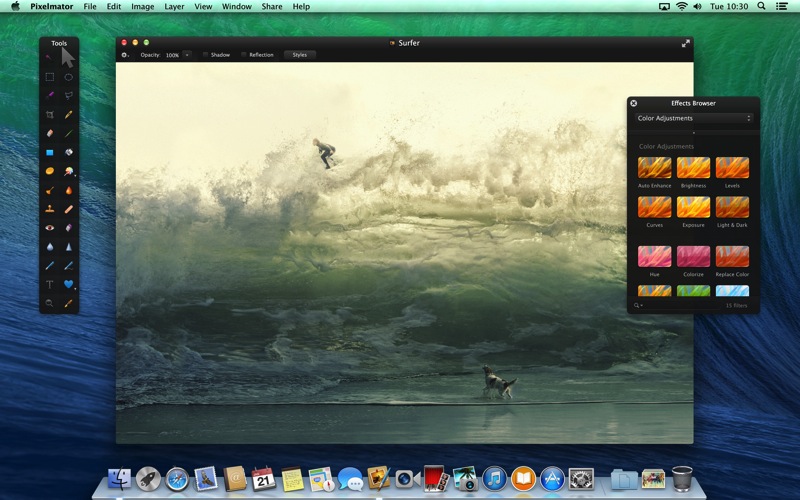
Pixelmator has also gained a new Order Prints feature that allows users to order postcards, notecards, gallery frames, or posters right in the app. The app received its last significant upgrade back in October when it gained a new image editing engine.
Pixelmator 3.1 is a free upgrade for existing users, while new users can download the app from the Mac App Store for $29.99. [Direct Link]
| |

New Apple Patent Details Uses for Sapphire Glass
An Apple patent detailing methods of using and mounting sapphire to mobile devices was published today by the United States Patent and Trademark Office, reports AppleInsider. Entitled “Attachment Techniques”, the application describes a system in which sapphire could act a display’s cover glass, and also gives insight as to how the material could be used to dissipate heat generated by a device.
The patent introduces itself by describing the difficulty in attaching sapphire to existing materials, and also notes the current implementation of sapphire as a cover for the rear camera on the iPhone. Apple suggests effective methods for using sapphire as a cover glass would involve creating an aperture within a sapphire substrate, and then using a second material with a lower melting point like metal or plastic to pour into the aperture. The joining of the substrate and the filling of the second material would then act as attachment point for other materials that can be welded, soldered, or secured.

The aperture formed in the substrate may have one or more securing features to help hold the second material within the aperture. For example, the aperture may have one or more tapered sidewalls. Alternatively, or additionally, the aperture may have a notch or step in one or more sidewalls. In still other embodiments, an interior surface of the aperture may be threaded or include a lip or protrusion that serves as a securing feature. It should be appreciated that other securing features may be implemented and, further, that multiple securing features may be used in conjunction.
Apple also describes how sapphire could be used as a heat spreader because of the similarity in the material’s thermal conductivity levels to that of metals. Apple further states that sapphire could be attached mechanically and thermally to a processor to dissipate heat.

Presently, Apple uses small pieces of sapphire glass to protect the cameras on the iPhone and on the home button for the Touch ID-equipped iPhone 5s. However, the company has also shown a strong interest in perhaps expanding its use of the material in its products, announcing plans last November to build a sapphire glass manufacturing plant in Arizona. GT Advanced, Apple’s manufacturing partner for the plant, also sent out postcards to local residents this week advertising for open positions at the new facility.
A report from June 2013 also stated that Apple experimented with sapphire crystal displays but found them infeasible, with Vertu COO Perry Oosting stating that Apple felt that the material was unsuitable for production in the numbers that Apple required. It was reported last March that future smartphone displays may use sapphire instead of glass, with all major mobile phone said to be considering the use of the material.
The patent application, which was originally filed on July 19, 2012 and published today, lists Dale N. Memering, Matthew D. Hill, Christopher D. Prest, David A. Pakula, Tang Yew Tan, Stephen B. Lynch, and Fletcher Rothkopf as its inventors. As with all of Apple’s patents and patent applications, it is unclear when and if the exact technology described will make it into a final product.
| |

Pixelmator Updated With 16-Bit Color and Full Mac Pro Support [Mac Blog]
Pixelmator has updated its image editing software to version 3.1, adding full support for the new Mac Pro, including 16-bit per channel images, full GPU support, and optimizations for the multi-core processors in the new machine.
The app now uses both Mac Pro GPU’s simultaneously for composition rendering and uses lots of background computing to speed up zoom and other tasks, with the company claiming that “image editing is now completely seamless, and even with large and complex compositions you will experience profoundly faster and more responsive performance.”
“We are extremely excited for professionals to experience the power and speed of Pixelmator 3.1 Marble on their new Mac Pros,” said Saulius Dailide of the Pixelmator Team. “Harnessing the power of the Mac Pro’s dual-GPU architecture, we’re now able to support 16-bit per channel images for the first time and push the limits of Pixelmator performance like never before.”
Pixelmator has also gained a new Order Prints feature that allows users to order postcards, notecards, gallery frames, or posters right in the app. The app received its last significant upgrade back in October when it gained a new image editing engine.
Pixelmator 3.1 is a free upgrade for existing users, while new users can download the app from the Mac App Store for $29.99. [Direct Link]
| |

Detecting the Latest Security Trends
As the years pass, technology is becoming more and more advanced and the technology that’s used for surveillance systems is no different. Home and business owners who plan on getting a security system or who plan on upgrading their current security system should look into the newest security innovations to see if there’s anything that they might want to include into their system.

Security on the Go
You can now monitor your home no matter how close or how far you might be from it with mobile security. Smartphones can now be linked up to your security system so that you can activate or deactivate your system without being physically present. You can also monitor the video feed to keep an eye on your kids if you aren’t home when they get back from school.
In addition to monitoring security systems, you can also use your smartphone or tablet to turn lights on and off and adjust your thermostat.
Wireless Security Equipment
Now you don’t have to worry about tripping over the cords from your security system or drilling holes into your walls thanks to wireless security equipment. One of the great things about wireless equipment is that you can place sensors wherever you’d like rather than only where the wires will reach. If you do a lot of moving around, wireless security equipment is a breeze to pack up and move with you to your new home.
Better Video
Now you can enjoy high quality high-definition video with your home surveillance. You don’t have to worry about looking at a blurry image whenever you want to zoom in on an image now that there are more megapixles to enjoy. The advantage of this is that law enforcement will have an easier time of identifying criminals and the details of crime scenes.
There are also video verifications that allow you to receive a video clip via email or text whenever your alarm is tripped so that you can verify whether or not you have an intruder before an alarm is sent to the security company. If you’re charged for every false alarm that your system triggers, you’ll be thankful for the special verification system.
Firefighting
Rather than buying inexpensive smoke detectors for your home, you might prefer to have your home monitored 24 hours a day, seven days a week. You can’t always depend on a smoke detector to work properly, and you might get so tired of it beeping every time there’s a mishap in the kitchen that you remove the batteries and forget to put them back in.
If you live in an area that’s especially prone to wildfires, fire surveillance might be something you want to consider for your home and family. Another great thing about the new fire surveillance system is that the alarm is sent over the Internet instead of through your home’s phone line, which means that you don’t have to worry about paying for a monthly phone line. After about a year or so, the system will pay for itself.
Even if you already have a home surveillance system, you might want to think about upgrading it with the latest security technology. Criminals are getting smarter, so make sure that your surveillance system is up to the task of keeping you safe.

Nokia’s phone business ends not with a bang, but with a whimper

2013 is the last year that we’ll see Nokia in its current form, as the world-famous handset business should be hived-off to become part of Microsoft’s corporate family in the next few months. But how did it do in the last quarter? Not particularly well, it seems, but it’s hard to judge how badly, as the company has decided not to break out sales of its Lumia and Asha handsets, so we’re left looking for evidence elsewhere. What we do know is that the company has conceded that both smart and dumb-phone sales have fallen. Naturally, Nokia is blaming the drop on the usual suspects, like the competitive market and cheaper devices from rival manufacturers. From the figures, it appears as if the company’s phone department lost around €198 million ($270 million) in the period, so whatever Microsoft plans to do with its latest toy, it’s still got some work to do before Windows Phone 8 can be considered a success.
Filed under: Cellphones, Tablets, Mobile, Microsoft, Nokia
Source: Nokia
 AIVAnet