


It was only a matter of time: Sex with Glass is now a Thing
 When Google Glass was released, we knew its potential was limitless. That potential, as with all new visual technology, also included a new and uncharted way to explore sex. While we have heard various reports of porn Glassware apps that allow Glass wearers to virtually assume the point of view of the person partaking in sexual activities, a new app being called Sex with Glass is taking a slightly more personal and intimate approach.
Sex with Glass aims to allow two people, both with Google Glass, engaging in the act of sex to view their own perspective as well as the perspective of their partner through Google Glass. A third perspective can also be achieved by linking your Glass with your smartphone. Apart from opening new avenues for couples to explore their bedroom activities, Sex with Glass also allows the video of the entire partaking to be saved in the cloud for 5 hours before it is deleted.
The app also aims to integrate with other systems like Smart Homes and things accessible by your smartphone, like turning down the lights or starting some mood music. Apparently if the mood isn’t right and you need to truncate your sexual adventure, you can halt the recording by saying “ok glass, pull out”. It will be interesting to see if Google moves to ban Sex with Glass when it is released considering they banned the MiKandi app based on the appearance of “nudity”. There aren’t too many details about the app, but if you want to find out more you can visit the site below.
What do you think about ‘Sex with Glass’? Would you use it? Let us know what you think.
Source: Sex with Glass via Phandroid
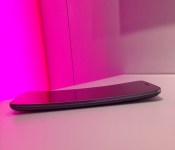
T-Mobile Opens up Pre-Registration Page for the LG G-Flex
Sprint already opened up pre-orders for the upcoming launch of the curved LG G-Flex. Now T-Mobile is getting in on the action. We already knew T-Mobile was bringing it to the network, now you can go pre-register to get your name on the list for one on the Uncarrier. 
Quick recap on the LG G-Flex specs
- Qualcomm Snapdragon 800 quad-core 2.26GHz
- 2GB RAM
- 32GB internal Storage
- 3,400 mAh battery (not a typo, it is 100 mAh less on T-Mobile)
- 6-inch HD screen at 1280 x 720
- 13 MP Rear Camera
- 2.1 MP Front Camera
Specs obtained from LG.
Head on over to T-Mobile’s LG G-Flex pre-registration page to get signed up for more news and release info.
Via T-Mobile G+

Amazon is thinking about shipping you packages you haven’t ordered yet

Looking forward to buying the next season of Game of Thrones on Blu-ray? Amazon may already be preparing to send it to you. The retail giant is working on an idea it calls “anticipatory shipping” as a way to reduce package transit times. It’s everything the name implies — according to a December patent, the system will send items out before they are ordered. That doesn’t mean you’ll start receiving unannounced packages from Seattle, however: the patent’s examples illustrate a speculative shipment system that deploys goods to specific geographical areas. If a customer in that area places an order that matches a nearby package, it would then be redirected to its final destination. Sure, our next box-set might not land with the fanfare of a drone delivery, but anything that gets us our R.R. Martin fix sooner is certainly a good thing.
Filed under: Amazon
Via: Wall Street Journal
Source: USPTO

Supreme Court to determine if police need warrants to search cellphones

It’s now clear that police don’t need a warrant to track your cellphone, but searching that phone is another matter; there’s no obvious guiding policy. Any murkiness may be settled soon, as the Supreme Court has agreed to rule on two cases where the accused have objected to cops obtaining evidence from their phones without warrants. Decisions in either case could set precedents for searches across the US; if judges determine that warrants are necessary, they could challenge guidelines in California and other places that allow warrantless searches after arrests. The court hasn’t scheduled the relevant hearings, though, so it may be a while before there are any definitive answers.
[Image credit: Erin Nekervis, Flickr]
Filed under: Cellphones, Wireless, Mobile
Via: Wired
Source: SCOTUSblog (1), (2)
Better late than never, Path arrives on Windows Phone

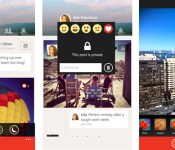
Path for Windows Phone has had an unusually long development cycle for a mobile app — we first saw it at a Nokia event in July, and the rest of 2013 came and went without a release. Still, fans of the smaller-scale social network will be glad to know that a Path beta is at last available in the Windows Phone Store. The software mirrors much of the functionality seen in the Android and iOS versions, including private sharing, although it also takes advantage of Nokia’s imaging software and provides 50 unique photo filters. No, Path isn’t as exciting as Instagram or Vine, but we doubt that Windows Phone owners will mind getting another well-known app on their platform of choice.
Thanks to all the Windows Phone 8 users who have been waiting patiently for this day, you can find Path BETA here: http://t.co/xniseL7ifm
– Path (@path) January 17, 2014
Filed under: Cellphones, Mobile
Via: WPCentral
Source: Windows Phone Store, Path Blog, Nokia Conversations
HTC M8 cases appear to confirm existence of dual-sensor Camera
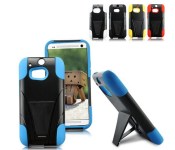
 We do love it when excited case makers start posting up their case listings for new phones that have yet to be released, let alone announced. This is exactly what is occuring with the HTC M8, the successor to the HTC One, which may have potentially confirmed that the M8 will possess a dual-sensor rear camera.
As you’ll see in the photos above, the cases have the standard hole for the camera and flash which is accompanied by yet another hole above that. If the rumour we heard this morning about a larger HTC One is anything to go by, this is likely the additional sensor that will be part of this dual-sensor system. There is also a rumour that this hole is in fact not for the camera but instead will be used for a fingerprint scanner, as with the HTC One Max. This would be a very unusual location for the scanner to inhabit, however we’ll just have to wait to see what it actually is.
What do you think that additional hole is for in these HTC M8 cases: camera sensor or fingerprint scanner? Let us know what you think.
Note: There is a poll embedded within this post, please visit the site to participate in this post’s poll.
Source: HTC Source via Phandroid

New Hires Point to Apple’s Continued Research on Next-Generation Health Sensors
With Apple CEO Tim Cook suggesting that Apple will use its skills building software, hardware, and services to create “great products” in product categories that Apple does not currently participate in, the company is making a number of potentially significant hires related to the development of next-generation medical sensors.
According to a report from 9to5Mac, Apple has hired a pair of personal health sensor hardware experts in recent months.

Apple recently hired Nancy Dougherty as a hardware engineer, according to her LinkedIn page. Dougherty was previously a hardware developer at Sano Intelligence, a biosensor startup that was profiled by The New York Times back in 2012.
According to a Google cache of her LinkedIn page — the current page reads slightly differently, with less detail about the projects she worked on — Dougherty worked on a hardware product to monitor blood chemistry via a wearable device.
Hardware Lead
Sano Intelligence
November 2012 – December 2013 (1 year 2 months) San Francisco Bay Area– Hardware Lead in a very early stage company designing a novel system to continuously monitor blood chemistry via microneedles in the interstitial fluid. Brought system from conception through development and board spins to a functioning wearable pilot device.
– Solely responsible for electrical design, testing, and bring-up as well as system integration; managing contractors for layout, assembly, and mechanical systems
– Building laboratory data collection systems and other required electrical and mechanical systems to support chemical development
Before working at Sano, Dougherty worked at Proteus Digital Health on a “Bluetooth-enabled electronic “Band-Aid” that monitors heart rate, respiration, motion, and temperature”.
Separately, Apple hired Ravi Narasimhan away from Vital Connect, a biosensor technology firm where he was “responsible for biosensor technology and algorithms for remote physiological monitoring with wearable medical devices”. His devices could process a number of functions including heart monitoring, respiration, fall detection, posture and activity. He has been prolific writer, with a number of papers published in technical journals and he is listed as an inventor in dozens of patents.
Both Dougherty and Narasimhan have electrical engineering degrees from Stanford. Last year, Apple made a number of other hires related to the health sensor field and 9to5Mac says both have joined the iWatch team.
Aside from the hires, 9to5Mac reports that Apple is actively investigating iris scanning technology and is looking at using other sensors already built into the iPhone, like the accelerometer and compass, to improve facial recognition. Apple increased the iPhone’s security significantly with the addition of the Touch ID sensor in the iPhone 5s.
     |
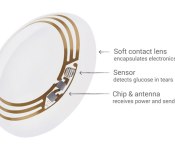
The power of tears: Why Google has its eye on smart contact lenses

When the cronut craze swept across New York in early spring of last year, the only major inconvenience associated with Dominique Ansel’s novel culinary confection was the pain of waiting in line to get it. For a responsible person living with Type 1 (or Type 2) diabetes, like my good friend Cara, that wait time for a hip baked good would’ve been compounded by a few more irritating factors.
First, there’d be a necessary finger prick test (administered in the open by an always on-hand glucometer) to measure blood sugar levels an hour before eating. Then, a guesstimate would need to be calculated of just how many carbs that precious SoHo sweet contained, followed by an adjustment of insulin delivery levels on a waist-worn pump. And, finally, a follow-up finger prick test would need to be done two hours after eating the cronut to once again establish a necessary insulin base line. That is true inconvenience. That is life with diabetes. And as you might imagine, not all diabetics are this disciplined. But Google wants to change that… with contact lenses.
The idea isn’t new, so don’t race to applaud Google just yet. Researchers have been kicking around various ways to implement contact lens-based glucose monitoring for years; methods that include a biofuel cell that runs on tears and glucose level fluctuation via fluorescence. Google’s taking a similar approach with its smart contact lenses, only with LEDs in place of fluorescence to alert wearers. Yes, that means diabetics could be walking around with color-changing contacts in their eyes, just not in the way you or Lil’ Kim would necessarily want.
The idea isn’t new, so don’t race to applaud Google just yet.
The other obvious upside to contact lens-based glucose monitoring can be boiled down to two words with heavy resonance amongst diabetics: continuous and non-invasive. Would you want to prick your fingers multiple times a day? Don’t worry, I’m aware the sane answer is no. Would you want to check a mirror or compact every few hours to monitor a colored dot beneath your lower eyelid that corresponded to varying glucose levels? The correct response is: “Sure. I prefer anything that doesn’t involve stabbing myself and running the risk of infection daily.” And that’s the promise of Google’s smart contact lens technology. It would afford diabetics a degree of freedom they don’t currently enjoy; an ability to forgo that crude blood drawing ritual in favor of contacts that wirelessly “generate a reading once per second.”

Unfortunately, wearable diabetes-detection technologies like this haven’t yet made it to the mainstream. It’s not because they lack a proof of concept, but because of price, as one researcher behind fluorescence-based detection discovered. That cost barrier is something Google could help to alleviate with its pervasive, free-to-use services model… or, at least, I assume that will be the approach. When daily disposable contacts are already too much for most people’s health insurance to cover, the prospects for disposable, glucose-monitoring contact lenses appear niche and dim. But are they?
According to a Center for Disease Control report from 2011, nearly 26 million Americans are currently living with diabetes and about a further 7 million are undiagnosed. That figure doesn’t even take into account the additional 79 million people living with prediabetes, the precursor to Type 2 diabetes, which accounts for up to 95 percent of all cases in the United States. Type 2 is the form of diabetes associated with aging and a sedentary lifestyle, so the figure, though alarming, shouldn’t faze you all that much.
Now, that’s our government’s latest data from three years ago. Google, in its smart contact lens announcement, cited 2013 figures gathered by the International Diabetes Foundation, a non-profit based in Brussels, Belgium. The IDF numbers peg the United States as the number three country for persons living with diabetes between the ages of 20 and 79, with about 24.4 million diabetics. Contrast that with China and India, which are home to 98.4 million and 65.1 million diabetics, respectively. Those numbers then conflate to about 382 million globally when every territory is factored in, and that’s just for 2013. Estimates for the year 2035 have the incidence of global diabetes spiking up to 592 million. Or to go with the CDC’s projections, we’re looking at one in every three Americans being diagnosed with diabetes by 2050. Are you starting to see the problem here?
The truth is, Google wants data. It’s a company that’s built on information-gathering as a trade.
But why does Google care about diabetes? Surely, the news of its contact lens project would’ve been met with less confusion had Google announced it was an obvious progression of the Glass project; a mobile wearable that’s literally on your eye. I’m sure that’s what most of us expected, anyway. The truth is, Google wants data. It’s a company that’s built on information-gathering as a trade. It’s why the company recently shelled out $3.2 billion for Nest — an obvious bid to track our energy usage. You get your Gmail and search and various other Google services for free because Google gets your personal data. That’s Google currency and our health information is just another facet of that. We all get sick, and we all know doctors and HMOs and hospitals and pharmacies are a chore to deal with. Google knows this and if it can flip that paradigm around and put the control into its users’ hands, well then it’s a win/win. We get to track, control and monitor our health data via a Google-hosted database and partner apps, and Google gets to mine that info for every last dollar it’s worth.
You’re not alone in sensing a state of déjà vu here; Google’s done this before and the results were disappointing. Back in 2008, the company introduced Google Health, a database for the personal collection of health records that was, in theory, a great idea: health records that belong to and move with you, not medical practices. In the company’s own words, Google Health was “based on the idea that with more and better information, people can make smarter choices … in regard to managing personal health and wellness[.]” Of course, that access to information is a two-way street. This being Google, the usage habits of Health users were recorded (e.g., links clicked, number of sign-ins) for internal purposes — the kind of data that makes up Google Trends. Ultimately, though, the power to disclose information remained solely in the hands of users, as Google Health’s privacy policy explicitly stated. So Google, barring any mandatory compliance with governmental requests, could only see what medical info users chose to disclose and nothing more.
It failed, though, and Google was forced to shutter the project in 2012. Turns out, it was unsurprisingly only popular with “tech-savvy patients and their caregivers, and … fitness and wellness enthusiasts.” Let’s break that down a bit further. Google Health’s base was comprised primarily of early adopters and fitness freaks — the exact sort of demo that takes immediately to wearable technologies. Take that demo, add in a known (and growing) epidemic like diabetes, existing contact lens-based glucose monitoring technologies, mix them all together and you have a recipe for the successful resurrection of Google Health. But let’s not call it that just yet, until Google does, that is.
So Google’s getting back into the health game, albeit through the backdoors of upward trending wellness issues like geriatrics and diabetes. And all because Google cares… about your data.

Engadget Podcast 380 – 1.16.14

After surviving nearly a week in the desert and braving the wilds of CES, the crew is back in New York and ready to mainline you some podcast love. It’s a fine time, this 2014, as you should be able to purchase an Oculus Rift at some point this year and Steam Machines are also cleared for a landing. In this podcast: Terrence bemoans the loss of an on-stage onesie performance, Joseph sends his wearable to a toilet timeout and the rest of the gang can’t stop talking about this robot hivemind thing. So please join us for some laughs amidst torrents of tech talk in this edition of the Engadget Podcast, conveniently located at the streaming links below.
Hosts: Terrence O’Brien, Marc Perton, Joseph Volpe, Ben Gilbert
Producer: Jon Turi
Hear the podcast:
07:39 – Wearable craze adds skin sensitivity to the list of considerations for gadget buyers
13:17 – The Oculus Rift ‘Crystal Cove’ prototype is 2014′s Best of CES winner
14:49 – Valve’s VR-friendly Steam UI launches in beta prior to its headset reveal
19:31 – Steam Controller drops touchscreen, adds physical buttons
25:56 – European researchers have created a hive mind for robots and it’s being demoed this week
38:46 – Appeals court strikes down key parts of the FCC’s net neutrality rules
Subscribe to the podcast:
[iTunes] Subscribe to the Podcast directly in iTunes (enhanced AAC).
[RSS MP3] Add the Engadget Podcast feed (in MP3) to your RSS aggregator and have the show delivered automatically.
[RSS AAC] Add the Engadget Podcast feed (in enhanced AAC) to your RSS aggregator.
[Zune] Subscribe to the Podcast directly in the Zune Marketplace.
Download the podcast:
Contact the podcast:
Connect with the hosts on Twitter: @terrenceobrien, @marcperton, @realbengilbert, @jrvolpe
Email us: podcast [at] engadget [dot] com
Filed under: Podcasts
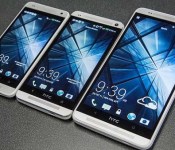
[RUMOUR] HTC apparently readying a larger HTC One for March. HINT: It’s not the HTC One Max
 HTC has done quite a few questionable things in the last few months, in my personal opinion. While struggling mightily on the financial front, HTC continued to pump out unusual projects like solid gold HTC Ones and a giant HTC One Max whose focus was cloudy at best. A new rumour today that is coming out of Bloomberg is yet another venture which I think belongs in the same category as the previous two cases. This new report says that HTC is readying a larger HTC One for release in March, and no, they aren’t referring to the HTC One Max that has already been released. The report is actually saying this HTC One variant will inflate the screen size of the HTC One from 4.7-inches to 5-inches.
I’m assuming this means that this larger HTC One will supercede the current HTC One as the report also states that the overall design of the 5-inch One will still resemble the original device. While there’s no information on whether HTC will bump up the specifications of this new device, it is quoted that larger HTC One will have something called a ‘twin-sensor’ real-facing camera which will presumably work favourably with HTC’s existing UltraPixel technology.
As I said before, this new HTC One device is hard to swallow; it’s not that the HTC One was a bad device, in fact it was arguably the best device for the first half of 2013, some say even the whole of 2013. It’s more the fact that HTC is sticking with the design of its tried and true award winning device, which in and of itself isn’t a bad thing, but it does ironically go against HTC’s own innovation mantra of “Here’s To Change”. This device might end up selling moderately well, but it’s not going to save HTC, which is the saddest thing of all. And with a release in March, it’s going to be going up against the new Samsung Galaxy S5 in the sales charts. Uh oh…
What do you think about this rumour: is HTC going in the wrong direction with its development efforts? Let us know what you think about this larger HTC One rumour.
Source: Bloomberg via TechCrunch
 AIVAnet