


Jawbone’s second-gen Era headset is 42 percent smaller, comes with its own charging case

Wearables may have been the talk of the town at CES, but given that Jawbone just released the Up24 a month ago, chances were slim it was going to announce another fitness tracker so soon. Instead, then, the company is going back to its roots: it just announced a new version of its Era Bluetooth headset, with a markedly smaller design, a 10-hour battery and a bundled charging case. In particular, the new Era is 42 percent more compact than the last-gen model (see the comparison pic after the break), with a new earpiece that’s said to fit more securely. On the audio front, Jawbone moved to tiny MEMS microphones and also overhauled its Noise Assassin noise cancellation technology with support for wider-band audio. You can also use voice commands to order Siri around, assuming you have an iDevice. It’s on sale today in four colors starting at $100, though if you want that charging case, you’ll need to shell out $130 for the bundle.

Filed under: Wearables
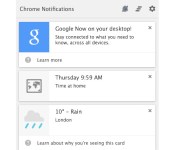
Google Now comes to Chrome on the desktop in experimental form

You may not have to reach for your phone to check Google Now in the near future. The latest build of Google’s experimental Chrome Canary browser introduces the context-aware notifications to the desktop; toggle a flag and you’ll get alerts from the menu bar (Mac) or taskbar (Windows). Google Operating System notes that it’s not quite a seamless experience. You’ll have to use Google Now on your mobile device first, and location-sensitive cards like weather are tied to that device’s location, not your computer. Even with those caveats in mind, it may be worth downloading the unfinished software for the added convenience.
Filed under: Internet, Software, Google
Via: The Next Web
Source: Google, Google Operating System

Apple Investigating iBeacon-Assisted Mobile Payment Methods
Apple’s iBeacon technology based on the Bluetooth LE standard is being installed in Apple Stores and other retail outlets to assist customers and send them promotions while shopping, but as noted by Patently Apple, a newly published patent application suggests this technology could also be used to send secure mobile payments while making purchases.

Patent application number 20140019367, filed in September 2012 and published today, describes a method that would send payment data through various wireless interfaces without compromising the user’s data. The method uses two links — one connection to a point-of-sale device to establish the initial connection and a second, secure connection that sends the payment information. This payment information is then processed by a backend server, which uses a shared secret to verify that the connection was secure before it authorizes the payment.
In one or more embodiments, a method of performing a commercial transaction is provided. The method includes establishing a first secure link over a first air interface by a purchasing device, the first secure link between the purchasing device and a point of sale device, identifying a second air interface different from the first air interface, establishing a second secure link over a second air interface, the second secure link between the purchasing device and a backend server, and conducting, using the second air interface, a secure commercial transaction between the purchasing device and the backend server using payment data secured by a shared secret known to a secure element in the purchasing device and to the backend server.
The payment method described in the patent may use NFC as well as Bluetooth and Wi-Fi to connect the mobile device to the point-of-sale terminal. Though iBeacon is not directly named in the patent, it is easy to see how the technology could be used as the conduit for the secure Bluetooth connection. Apple even notes in the patent that NFC “is less desirable for longer transactions,” while Wi-Fi or Bluetooth has “more desirable characteristics for maintaining the link over time than NFC.”
The use of Apple’s iBeacon technology, rolled out alongside iOS 7, is expected to increase over the coming year as other retailers such as Macy’s have begun piloting the Bluetooth LE technology. Most recently, the Consumer Electronics Association used iBeacons for a scavenger hunt at CES 2014, while Major League Baseball will be bringing the technology to stadiums.
     |
Pantech’s flagship Vega Iron 2 due in April, report says
Pantech’s next flagship smartphone, the Vega Iron 2, is expected to arrive in April, according to recent reports. Set to take on the Samsung Galaxy S5, the handset will battle it out in the company’s native Korea. Allegedly, at least three carriers are lined up to offer the Pantech smartphone. In terms of details, all we know at this stage is that the Vega Iron 2 should employ a fingerprint scanner and seamless metal design.
Pantech, who has a history of releasing lesser expensive devices with admirable hardware, has not made much noise in the U.S. market as of late. It’s unclear whether the Vega Iron 2 will come stateside or whether our carriers might offer a branded variation.
The post Pantech’s flagship Vega Iron 2 due in April, report says appeared first on AndroidGuys.
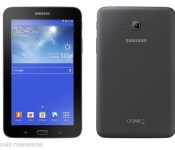
Samsung’s Galaxy Tab 3 Lite doesn’t bring much to the crowded budget tablet market

Samsung’s regional Polish site inadvertently jumped the gun a few days ago, publishing a user manual for an unannounced Galaxy Tab 3 Lite to its support pages. Today, the Korean company’s press blog has finally caught up and formally introduced its new low-end, 7-inch slate. The standard 7-inch Galaxy Tab 3 doesn’t exactly boast market-leading specs, but this Lite variant is diminished is several areas nonetheless, making some cheap tablets look like flagships. We’re looking at a 1,024 x 600 resolution panel, 1.2GHz dual-core CPU, 1GB of RAM, 8 gigs of expandable storage, 3,600mAh battery and a lone 2-megapixel camera. It appears both WiFi-only and 3G editions of the black or white tablet, which runs Android 4.2, will be available come launch, whenever that may be. We’re no clearer on pricing, either, but if Samsung hopes to sell these things en masse, anything but seriously cheap is going to put a stop to those plans.
Via: Pocket-lint
Source: Samsung
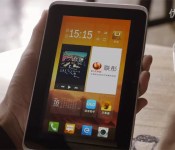
China reveals COS: a government-approved operating system designed to break the monopoly of foreign software

China’s tried to create its very own mobile OS ecosystem in the past, but let’s face it, the attempt with OPhone was hardly something that would make the nation proud. This time round, though, a company by the name of Shanghai Liantong has joined forces with the ISCAS (Institute of Software at the Chinese Academy of Sciences) and the government to launch COS, which simply stands for China Operating System. While there’s no official mention of this, it appears that HTC is a big supporter behind this project, which would match what we heard from a Wall Street Journal report from August.
Apart from the open source code, this Linux-based OS is said to be developed “entirely independently,” in the hopes of breaking the foreign software monopoly, as well as providing better localization for the likes of language input, cloud services and monetization. At yesterday’s launch event, the head of ISCAS criticized iOS for being a closed ecosystem, while Android has the infamous fragmentation problem, and both Windows plus Android are let down by poor security.
Ironically, all the COS variants — in the form of phones, tablets, PCs and set top boxes — shown in the promo video after the break are very Android-like, and some of those features like multi-tasking, content streaming plus remote desktop are nothing new. Even the HTC One and Butterfly S we saw looked like they were still carrying Sense 5. But hey, maybe such a close relationship with the Chinese government is just what HTC needs for its recovery this year.
Via: Engadget Chinese
Source: People.com.cn (Chinese)

Nickelodeon’s new interactive kids channel will bring streaming features to live TV

As parents have rapidly discovered, kids don’t really mind the drawbacks of Amazon or Netflix streaming (limited, older versions of the same content library) and just want to watch their favorite show, often repeatedly. That’s where the internet services are beating traditional TV channels, and Nickelodeon has been preparing an answer. As confirmed to the Wall Street Journal and Fierce Cable, its new “My Nick Jr.” channel will appear in the guide like any other but provides a custom lineup of shows based on preselected preferences, and even cuts out the ads. Other features will let parents monitor what their kids watch and set time limits, while the kids can rate shows with a smile or frown.
There’s no word on the technology behind My Nick Jr., but it’s coming to Verizon’s FiOS TV service first in the US, and eventually mobile devices too. Viacom already tested out the service on France’s CanalSat, and hints that the personalized channel concept could spread to its other networks like MTV. A major issue holding it back however, is the presence of millions of older cable boxes that won’t be able to handle the new setup. So far, massive conglomerates like Viacom and the existing US TV carriers have shown little interest in chopping up their bundles or offering video on-demand style access as an alternative. Besides an abundance of network-specific mobile apps this channel is one of the first steps towards that line, we’ll see if increasing competition and original streaming content pushes things further.
Filed under: Home Entertainment, HD, Verizon
Source: Fierce Cable, Wall Street Journal

Spotify gives desktop users unlimited music without a subscription

Streaming from Spotify’s desktop client has never been a simple affair. Users had to abide with grace periods, monthly usage caps and even limits on how many times they could listen to individual tracks, but now, that’s all changing. The company recently announced that it’s eliminated those stipulations, and you can listen to as much music as you want without a subscription. There will be ads of course (because nothing is truly without cost), but at least this move is a little more flexible than the service’s effort to free up its mobile apps; there aren’t any shuffle-only requirements on desktop. The change will certainly be a boon to penny-pinching users, but hopefully it won’t affect the payouts for new artists — rumor has it they’re low enough as-is.
Filed under: Internet
Source: Spotify

Oppo’s latest smartphone lets you text with gloves on

Answering a text message in the middle of winter can pose a serious threat to your fingers if you aren’t careful — polar vortex or not — but Oppo is looking out for you. See, the outfit’s newly announced Neo smartphone has what it’s calling “gloves mode” that apparently allows you to keep emailing or tweeting even if you’re, well, gloved. This isn’t exactly new though, as other OEMs have done it before. We’re still happy to see it spreading further, regardless. Sadly, there isn’t much else to boast about spec-wise: the device sports a 4.5-inch 854 x 480 display, a dual-core 1.3GHz processor and a twin SIM slot among other accoutrements. It isn’t the cheapest way to get a ColorOS handset (around $422) however, but it is less costly than Oppo’s flagship N1. If you live stateside and are keen on the Neo though, you’re out of luck — it’ll only be available in Indonesia to start.

Filed under: Cellphones, Mobile
Via: Android Community
Source: Oppo Indonesia

Google rolls out 3D maps for Tokyo and other Japanese urban hubs

As ubiquitous as 3D city maps might be these days, they typically don’t cover Tokyo — quite possibly due to the massive size of Japan’s megalopolis. Google, however, has just taken on that daunting task. Fire up Google Maps or Google Earth and you’ll now see 3D imagery for the greater Tokyo area, including landmarks like the Tokyo Sky Tree (that giant tower you see above). The expansion also brings 3D to the major population centers of Chiba, Kanagawa and Sendai. We’d advise against exploring the entirety of Google’s enhanced Tokyo map unless you have a couple of hours to kill, but you can at least take a quick tour at the source link.
Source: Google Asia Pacific Blog
 AIVAnet