


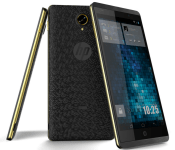
HP Headed to India with two new Smartphone Phablets
While some might poke fun at the notion of using a 7-inch tablet as a phone, a good chunk of the world already does it. Our very own Stephen Yuen was in Hong Kong prior to his travels to Las Vegas for CES and was amazed to see so many people pulling out tablets for just that reason. HP is seeing a need in emerging markets overseas, primary India, and is looking to fill that void with two new phablet offerings. Introducing the Slate6 VoiceTab and Slate7 VoiceTab.
 The official specs haven’t been announced in full, but a few things were mentioned by VP of consumer devices Ron Coughlin.
Both the Slate6 & Slate7 have:
- Quad-Core Processors (make, model and speed unknown)
- 16GB onboard storage
- Micro SD card support
- 5MP rear camera
- 2MP front camera
- Android Jelly Bean
The Slate6 will have a screen resolution of 1280 x 720 and the Slate7 will have 1280 x 800.
Prices were mentioned to be very practical for what they are with the Slate6 sitting at $250 and the Slate7 at $200. That isn’t a mix up either, the Slate7 is less expensive. We will have to find out why or if the information released was mixed up.
Via GottaBeMobile
Sprint Live will come to Sprint Android devices, powered by NQ Mobile
NQ Mobile and Sprint have recently signed an agreement to create the next generation of Sprint ID.
For those who don’t know, Sprint ID is a “theme” that the user can choose on their Android phone, powered by Sprint. It’s almost a recommendation on how to use your homescreen, wallpapers, shortcuts, icons, etc.
Suffice it to say, this isn’t the most popular way to use your Android phone, but it works. Will the NQ Mobile and Sprint partnership change that?
The new form of Sprint ID will be Sprint Live, “an engaging mobile desktop that will change the way consumers use their connected devices.” The change is set to take place later this year on all new Sprint-powered devices.
Sprint ID gives app/shortcut recommendations to users, and NQ Live is more of a wallpaper replacement, pushing content straight to the users homescreen. The marriage between these two spawn Sprint Live. It will run in the background on the homescreen, while still letting users operate their normal apps and widgets. It’s sort of a “best of both worlds” partnership.
This could possibly be big for Sprint, giving users more options when using their phones. But this poses some questions – Should carriers focus on things like this? Or should they stick to service alone? Is this just more carrier bloatware that will use up precious memory? We’ll have to wait to find out later this year.
The post Sprint Live will come to Sprint Android devices, powered by NQ Mobile appeared first on AndroidGuys.
xPC wants to be your next tablet, desktop and crowdfunding gamble

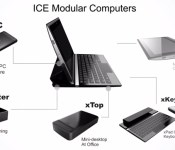
We’ve followed ICE Computer’s modular PC design all the way from first concept to prototype to demo unit, and after several years, it’s now almost ready for prime time. The company has recently taken to Indiegogo, where it’s set a $300,000 crowdfunding goal that’ll finally put xPC into production. The idea is xPC will be several devices in one, housing all its main components within a smartphone-sized case: x86 Intel Atom quad-core CPU (Bay Trail), 4GB RAM, 64GB SSD, WiFi, Bluetooth and webcam. Now, to make use of what’s inside, you marry it with peripherals such as the xPad 10.1-inch tablet dock (much like ASUS’ Padfone range), or the xAdapter dock, which turns the xPC into a mini desktop. The company talks of other accessories like the xTop (an xAdapter with external storage) and xKeyboard to compliment the xPad, but these aren’t mentioned in any of the pledge descriptions, leading us to believe they’ll be made later.
ICE Computer’s pitching the xPC as a long-term investment. Thanks to “open connector architecture,” third parties are encouraged to make other docks and peripherals that’ll work with this and future generations of xPC. You see, the plan is to merely refresh the base hardware — the outfit also expects to achieve a fully functional smartphone/xPC “within the next year.” For now, though, an xPC with full-fat Windows 8 installed, xAdapter and July shipping estimate is going for the early bird price of $369. It’s not too enticing a figure when you’re essentially betting on an underdeveloped ecosystem, but at least you’ll have something to show for it, unlike a similar concept that’s never risen past big promises and pretty renders.
Filed under: Desktops, Laptops, Tablets
Via: Engadget Chinese
Source: Indiegogo, ICE Computer

This machine can sequence your DNA for just $1,000

Even a decade ago, sequencing a genetic code would set you back around $250,000. The target, of course, has been to crunch that figure down to a more reasonable sum, and now a company believes that it can do it for just $1,000 a go. Illumina Inc. has announced that the $10 million HiSeq X Ten kit will crank out tens of thousands of genomes per year. Even better, is that the $1,000 figure includes the hefty price for the hardware — which is hoped will kickstart a new era of genetic research. Naturally, the first customers include the Harvard-MIT Broad institute and Regeneron, with the latter planning to use the tech to develop cheap new drugs to heal our ailing bodies.
Via: Forbes
Source: Yahoo Finance
Alienware’s Steam Machine launches in September

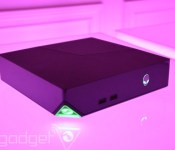
The Alienware-made Steam Machine we showed you at CES 2014 arrives in September, the company announced during Valve’s first Steam Dev Days conference in Seattle. Alienware’s little black box has some form of Haswell chip inside, and promised us earlier this year that it’d “perform on par with a gaming notebook” — outside of that, we don’t know any specifics on what powers it. The company’s apparently hoping to push it across “several market segments,” which we take to mean you can configure it to a variety of different spec/price points. We’ve reached out to Dell for more specific info and will update this piece as we learn more!
Filed under: Gaming
Source: Twitter (@DaveOshry)

FTC says Apple’s gotta pay for your kids’ in-app purchases

In my day, when a kid spent his parents’ money when he wasn’t supposed to, a form of indentured servitude ensued to pay off the debt. These days, courtrooms and federal agencies are the parentally-preferred sources of remuneration. Today, Apple settled up with the FTC over a complaint filed by the Commission many moons ago regarding in-app purchases made by children without mom or dad’s consent.
Why should you care? In truth, you shouldn’t. See, Apple already went to court over this very issue, and agreed to refund these unwitting customers hoodwinked by their genetic spawn months ago at the conclusion of a class-action lawsuit. Thing is, the FTC complaint is separate from that lawsuit, despite the fact that it concerns the very same issues — today’s announcement merely tidies things up by putting the issue finally and completely to rest.
The outcome of both settlements is that Apple modifies its billing practices to get express, informed consent before allowing in-app purchases, and allow that consent to be withdrawn at any time before the end of March. Additionally, Apple’s gotta refund at least $32.5 million dollars to affected customers, and should it send out less money in settlements, then the difference will be paid to the FTC. Apple’s not so keen on the FTC’s announcement, but an internal memo from Tim Cook obtained by Recode confirms that this settlement with the Commission’s is entirely duplicative of Apple’s ongoing lawsuit settlement efforts. Gotta love governmental redundancy, right?
Filed under: Tablets, Mobile, Apple
Source: Apple FTC Consent decree (PDF), Federal Trade Commission
Brief Look at LG G Flex [CES 2014]
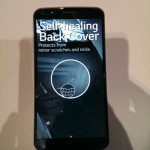
The LG G Flex was announced earlier last year in October and is due to be released in the U.S. sometime in quarter one. I got my hands on one at CES and wanted to share a few pics that I took. This is by no means a review, rather just a brief impression of the few minutes I had with it.


As the name suggests, it does actually flex, I was able to almost push it flat on a table. Also, the self-healing Woverine-ish skin is something else, though I was unable to witness this voodoo as watchful eyes were protecting the devices as if they knew that I (and everyone else) wanted to to see how self-healing the skin actually was. It’s a rubbery plastic that is a fingerprint magnet, so those with OCD among us will still cringe after holding the device for two seconds. Though it’s flexible, it still felt solid in the hands and I could see this shape fitting nicely in a pants pocket.
The Optimus UI skin turns AOSP (stock Android) on its head and spits out cartoon-y icons with bright colors everywhere. Much of this is customizable, but if you’re a HOLO warrior, forget it, this is Rainbow. I’m not a fan really, the look reminds me of the many TouchWiz variants, but it’s still very functional and snappy. I experienced no lag and was able to easily navigate throughout the interface without a hitch. There’s some new features not seen on the G2 such as dual-window multi-tasking, which takes advantage of the ginormous screen; it’s similar to what the Note line has been bring us for years. If you’re interested in a full review of the UI, one can be found HERE.
The G Flex looks like a contorted and stretched version of LG’s G2 and has the same form factor with buttons on the back. In fact it shares many of the same internals as the G2 including the same RAM, CPU, and GPU. Specs include (per Phone Arena):
- OS: Android (4.2.2) UX UI
- Screen: 6″, 720×1280, 245 PPI, P-OLED
- Camera: 13MP back, 2.1MP front
- CPU: 2.26Ghz Snapdragon 800, Krait 400
- GPU: Adreno 330
- RAM 2GB
- Storage: 32GB
- Battery: 3500 mAh
When the LG G Flex becomes available in stores, I suggest checking it out for yourself. It’s similar to the G2, but the updated UI features, bigger screen, and flexibility make it worth your time to see first-hand. I can’t say that this phone is for me, but it’s nice to see fresh ideas on a dated form factor.
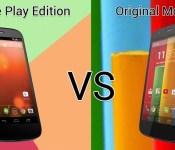
Moto G VS Moto G Google Play Edition (GPE)
Now I know what you’re thinking, not another one of those Android blog sites claiming the same thing about Google releasing yet another “Google Play Edition” phone. Yes, yes we know how stressful seeing the same thing all over the place can be, but not this time! Today I want to make things a little bit different. As many of you know Google today released their own version of the Motorola G. There is a lot of controversial opinions about why they did this and what the big deal is between the GPE version and the original Moto G.. Well fret not, that’s where I come in to clear some air.

The GPE Moto G or (Google Play Edition) from Google , is simply a mirror image of the original Motorola G except for minor details you won’t find outside of the box. If you don’t already know On August 15, Google announced an agreement to acquire Motorola. This in part has changed the way Motorola develops their phones..at least on the software side. A great example would be if you purchase any of the two Motorola’s created under Google’s rein so far you will notice that they are pretty much already running stock versions of Android and by stock I mean none of that infested bloat filled atmosphere that Samsung phones come with. As I just noted the original Moto G under Motorola’s brand that was first released already runs a stock version of Android with only a few minor of Motorola’s software customization’s. This in part is a plus because no one and I mean no one, likes having a cluttered phones taking up precious space, especially if the phones are ones with no selection of expandable external storage memory. Now if you look at the GPE Moto G you are guaranteed a stock flavor of Android. Many may prefer this over the Motorola branded one. This means no bloat and you’re ready to sail away to your desired customization preference out of the box.
Now moving along, the second detail to point out is that the GPE Moto G is more likely to receive quicker updates rather than the original Motorola Moto G. This isn’t to say that the first Moto G is going to be left behind because as we have already seen, not too long ago it has already been updated to Kitkat Android 4.4. The only pros that I see in getting the Google version of the Moto G is guaranteed faster software updates.
Last but not least, this part is going to be the most important part in whether users purchase the Google version or the actual first Motorola Moto G. The GPE Moto G does not support 1700 MHz AWS band so it won’t work on all T-Mobile 3G coverage areas. Now don’t get all down in the dumps this doesn’t mean it won’t go any faster than just regular 3G, in fact the GPE Moto G supports UMTS/HSPA+ up to 21 Mbps on (850, 900, 1900, 2100 MHz.) All this means is that for those T-Mobile users that depend on the 1700/700 Mhz (4G Coverage) should stray away from this Moto G Google version. The original Motorola branded Moto G doesn’t have this problem, in fact it supports (UMTS/HSPA+ up to 21 Mbps (850, 1700 (AWS), 1900 MHz) so those lucky T-Mobile users can enjoy plenty of 4G coverage to roam in.
Moto G & GPE Moto G Wrap up:
Aside from all the above, the hardware on the original Motorola branded Moto G and the Moto G Google Play Edition are exactly identical. No changes have been made. They both have a price point of $179 and are unfortunately only available in the US.

Apple Makes Progress on Upcoming Retail Store in Tokyo’s Omotesando District [Mac Blog]
Apple is creeping closer to opening a new flagship store in Toyko’s well-known Omotesando district. Previously reported to be scheduled for a March 2014 opening, an image of the store published by Mac Otakara shows significant progress has been made on the store. Although wrapped in a black shroud, the exterior of the building is starting to take shape, with the building appearing to bear a resemblance to the Apple’s new Stanford store.

Just like the Stanford location, the Omotesando store appears to have floor-to-ceiling glass walls and a thin steel roof. Mac Otakara notes that the glass front and sides stand out from the silver-colored metal eaves. This same design is also evident in Apple’s new stores planned for Portland, Oregon and Aix-en-Provence, France.
The Omotesando location will feature 20,000 square feet of floor space spanning three floors. Two of the floors will be underground, while the top floor will be above ground. Apple has been hiring employees to staff the store for over six months, and it will be the first new store Apple has opened in Japan since 2006.
The opening comes as Apple is seeing strong iPhone sales in Japan, with estimates from Kantar Worldpanel indicating that the iPhone 5s and 5c accounted for 76% of smartphone sales in the country in October, just after their debut.
     |

Apple Agrees to FTC Terms Over In-App Purchases With $32 Million Settlement
 Apple and the U.S. Federal Trade Commission have entered into a consent decree over in-app purchases on the App Store. In a memo to Apple employees, CEO Tim Cook wrote that the company felt it had no other choice.
According to the agreement, Apple will be required to provide full refunds to parents whose children purchased unauthorized in-app items, setting a floor of $32 million on refunds.
A large part of the FTC’s concern was related to a fifteen-minute window after a password is entered on the App Store, during which other purchases can be made without a password being entered. Apple will now be required to notify users that the fifteen-minute window exists.
In early 2013, Apple settled a class action lawsuit originally filed by parents after their children ran up hundreds of dollars on in-app purchases in freemium games.
In the memo, which was obtained by Re/code, Cook wrote that it didn’t “feel right for the FTC to sue over a case that had already been settled” and it “smacked of double jeopardy”.
From: Tim Cook
Date: January 15, 2014
Subject: FTC announcementTeam,
I want to let you know that Apple has entered into a consent decree with the U.S. Federal Trade Commission. We have been negotiating with the FTC for several months over disclosures about the in-app purchase feature of the App Store, because younger customers have sometimes been able to make purchases without their parents’ consent. I know this announcement will come as a surprise to many of you since Apple has led the industry by making the App Store a safe place for customers of all ages.
From the very beginning, protecting children has been a top priority for the App Store team and everyone at Apple. The store is thoughtfully curated, and we hold app developers to Apple’s own high standards of security, privacy, usefulness and decency, among others. The parental controls in iOS are strong, intuitive and customizable, and we’ve continued to add ways for parents to protect their children. These controls go far beyond the features of other mobile device and OS makers, most of whom don’t even review the apps they sell to children.
When we introduced in-app purchases in 2009, we proactively offered parents a way to disable the function with a single switch. When in-app purchases were enabled and a password was entered to download an app, the App Store allowed purchases for 15 minutes without requiring a password. The 15-minute window had been there since the launch of the App Store in 2008 and was aimed at making the App Store easy to use, but some younger customers discovered that it also allowed them to make in-app purchases without a parent’s approval.
We heard from some customers with children that it was too easy to make in-app purchases, so we moved quickly to make improvements. We even created additional steps in the purchasing process, because these steps are so helpful to parents.
Last year, we set out to refund any in-app purchase which may have been made without a parent’s permission. We wanted to reach every customer who might have been affected, so we sent emails to 28 million App Store customers – anyone who had made an in-app purchase in a game designed for kids. When some emails bounced, we mailed the parents postcards. In all, we received 37,000 claims and we will be reimbursing each one as promised.
A federal judge agreed with our actions as a full settlement and we felt we had made things right for everyone. Then, the FTC got involved and we faced the prospect of a second lawsuit over the very same issue.
It doesn’t feel right for the FTC to sue over a case that had already been settled. To us, it smacked of double jeopardy. However, the consent decree the FTC proposed does not require us to do anything we weren’t already going to do, so we decided to accept it rather than take on a long and distracting legal fight.
The App Store is one of Apple’s most important innovations, and it’s wildly popular with our customers around the world because they know they can trust Apple. You and your coworkers have helped Apple earn that trust, which we value and respect above all else.
Apple is a company full of disruptive ideas and innovative people, who are also committed to upholding the highest moral, legal and ethical standards in everything we do. As I’ve said before, we believe technology can serve humankind’s deepest values and highest aspirations. As Apple continues to grow, there will inevitably be scrutiny and criticism along our journey. We don’t shy away from these kinds of questions, because we are confident in the integrity of our company and our coworkers.
Thank you for the hard work you do to delight our customers, and for showing them at every turn that Apple is worthy of their trust.
Tim

| |
 AIVAnet