


Appeals court strikes down key parts of the FCC’s net neutrality rules

If you were hoping that the FCC’s net neutrality rules would survive the many legal challenges thrown in its path, think again. A Washington appeals court has voided the anti-blocking and anti-discrimination requirements in the FCC’s Open Internet Order, arguing that they go beyond the agency’s mandates.
Developing…
Filed under: Networking, Internet
Source: GigaOM
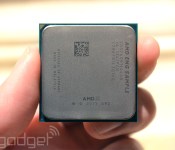
AMD says its next PC chip trumps Intel with 12 ‘compute cores’ and smoother gaming

A decade ago, AMD brought us the first dual-core x86 processor. Then, starting in 2008, the company came out with tri-core and quad-core designs in quick succession, leading up to octa-core chips in 2011′s FX range as well as in the latest AMD-powered game consoles. Today, we’re looking at a fresh leap forward, albeit one that will take a bit of explaining: a desktop and laptop chip called Kaveri, which brings together up to four CPU cores and eight GPU cores and gives them unheard-of levels of computing independence, such that AMD feels justified in describing them collectively as a dozen “compute cores.”
Marketing nonsense? Not necessarily. AMD is at least being transparent in its thinking, and besides, if you’ve been following our coverage of the company’s HSA project, and of GPU compute in general, then you’ll know that there’s some genuine technology underpinning the idea of GPU cores being used for more than just 3D rendering. Nevertheless, even if you don’t go for the whole 12-core thing, AMD still makes some down-to-earth promises about Kaveri’s price and performance — for example, that it matches up to Intel chips that cost a lot more (the top Kaveri desktop variant costs just $173, compared to $242 for a Haswell Core i5), and that it can play the latest games at 30fps without the need for a discrete graphics card. These are claims that can — and will — be put to the test.
“Compute cores”

Let’s start with the theoretical stuff, even though it’s largely academic until more software comes along that can make use of it. The reason AMD calls the GPU cores inside Kaveri “compute cores” is that they’re said to be fundamentally different to the GPU cores in other PC processors. This difference lies in the fact that they’re able to function as equal citizens: instead of relying on the CPU to orchestrate their workload, they can access system memory directly and take on tasks independently — almost like a CPU core does. The only difference is that they can’t take on the same types of tasks as a CPU, as they’re better suited to simple parallel chores rather than complicated serial processing.
As things stand, software developers are already able to exploit the GPU for general computing using tools like OpenCL, which can be used to accelerate anything from Photoshop to big spreadsheets. But OpenCL requires reams of code and a lot of inefficient to-ing and fro’-ing between the GPU and CPU — all of which, AMD says, will be drastically reduced if developers latch onto HSA. That’s a big “if,” of course, but now that AMD has recruited a bunch of partners into its HSA Foundation, and now that it has managed push its silicon into millions of households via next-gen games consoles, developer interest looks more likely, and Kaveri’s compute cores at least bring it some future-proofing as a result.
Gaming

Bearing in mind that we’re mostly reliant on AMD’s in-house test results for now, until independent reviewers put their graphs online, let’s look at that basic claim about Kaveri undercutting Intel as a gaming processor. The chart above shows a top-end Kaveri A10-7850K pitted against Intel’s Core i5-4670K for games being played at 1080p with max settings (or at least close to max settings — there’s a bit of ambiguity there, but it doesn’t affect the comparison). In each case, the processor is paired with a discrete graphics card, AMD’s mid-range Radeon R9 270X, presumably because most enthusiasts would still avoid relying solely on integrated graphics. As you can see, Intel is slightly ahead in a number of games, but never by a significant margin, suggesting that spending $70 more on Intel’s chip doesn’t add much to the experience.
Power efficiency and onboard graphics

In addition to Kaveri’s suitability for gaming when paired with a separate graphics card, the slide above suggests the chip also has an advantage over a Haswell Core i5 on certain synthetic benchmarks, likely due the fact that it has a bigger GPU than you’d find on an Intel processor. Kaveri’s built-in GPU accounts for 47 percent of all transistors in the chip (over a billion in total), and is potentially meaty enough for it to run games without the need for a discrete graphics card, thereby saving energy and money while also allowing for much smaller PCs. In practice, we played through a level of Bioshock: Infinite at 1080p with low settings, with Kaveri running beneath a little third-party cooler, and we experienced a steady frame rate of 30fps. This is something AMD claims is also possible in other big titles like Battlefield 4, which it’s bundling free with high-end boxed Kaveri chips, but again, you have to be prepared to accept low detail settings.
For the sake of balance, it’s important to point out that an Intel’s chip is likely to be more power-efficient in its own right. Haswell has fewer transistors (1.4 billion instead of Kaveri’s 2.3 billion) and its transistors are also significantly smaller (22nm instead of 28nm), which should equate to reduced power draw — something that’s especially when you think about notebook or hybrid/tablet versions of these chips, particularly ones that don’t need to focus on 3D graphics (or, equally, which delegate all such tasks to a separate GPU).
Mantle and TrueAudio

Speaking of Battlefield 4, we arrive neatly at Kaveri’s other big claim to fame — and it’s a claim that requires a much smaller leap of faith than HSA does. You see, Battlefield 4 is one of a growing number of games that will take advantage of an AMD-tailored programming tool called Mantle, which promises big boosts in performance even on lower-power (e.g., HTPC and laptop) versions of the chip. Mantle runs on any AMD graphics card that contains the newer Graphics Core Next (GCN) architecture, and since Kaveri’s graphics processor is based on GCN, it can run Mantle-optimized games and applications too, resulting in claimed performance increases of up to 45 percent in BF4 (once it gets its Mantle update later this month) and as much as 300 percent in real-time strategy games running on the new Star Swarm game engine. (For more on Mantle, read this.)
Finally, in addition to Mantle, Kaveri also brings another feature across from AMD’s latest graphics cards: TrueAudio. This is a dedicated, programmable audio processor that sits on the chip and helps to improve the audio in games by decoding data about location (giving sounds a feeling of directionality and distance) and also increasing the total number of voices and effects that can be heard at one time.
Wrap-up

Kaveri apparently took four years to develop, due to all the extra gubbins AMD has squeezed onto it, including HSA, Mantle and TrueAudio. This also explains why Kaveri chips are priced significantly higher than their predecessor, Richland: the lower-specced A8-7600 will start at $119, rising to $152 for the A10-7700K and, as we’ve mention, $173 for the flagship A10. Will they be worth the money? We’ll wait to round-up independent reviews from specialist sites before we make any final judgement, but it certainly looks like AMD has brought some clever additions to this generation that could boost its value. It looks good as a traditional gaming processor right now, especially if you intend to pair it with a Radeon graphics card in order to enable Dual Graphics (with the GCN cores in Kaveri’s GPU and in the discrete GPU effectively being added together), but we’ll need to see more Mantle- and HSA-enabled software before we’re ready to believe it can tackle Intel on general computing.

Huawei launches 5.5-inch B199 in China with a battery for hire

Huawei recently outed the Ascend Mate 2 with a colossal 4,000mAh battery that can actually charge other devices, and it’s now brought that tech to a mid-range handset. The 5.5-inch B199 is a successor to the A199, and packs similar specs: a 720p screen, 2GB of RAM, 16GB of storage (expandable via MicroSD slot), dual sims (3G only) and a quad-core processor. The new model, though, has a Snapdragon, rather than a Huawei K3V2 CPU and also carries a much larger battery: 3,000mAh instead of 2,100mAh. Huawei says that’ll power the phone through long browsing sessions and even let you charge other devices — though it’d be odd to be packing another cell phone when you already have one with two sims. And given those dual-sims, we’d not expect the $330 phone to be available outside China and similar markets.
Filed under: Cellphones, Mobile
Via: Engadget Chinese (translated)
Source: Huawei
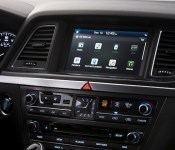
Hyundai and Kia tap SoundHound to help you identify music in your car

Always pulling out your smartphone to identify a song you’ve heard on your car radio? You’ll no longer need to if you buy a new Hyundai or Kia model in the coming year. The Korean automakers have teamed up with sound recognition specialist SoundHound to bring its music discovery tools to select 2014 models in North America, Korea and China. The partnership will see Hyundai and Kia integrate music tagging directly into their infotainment systems, letting you pull up information on a song or artist with a press of the SoundHound icon. If you so choose, the app can keep a record of your searches, giving you the option to pull them up on a mobile device at a more suitable time.
One model that will definitely get SoundHound’s music discovery feature is Hyundai’s 2015 Genesis sedan, which is already set to let owners remotely lock their cars, perform maintenance updates and send Google Maps directions to the car with Google Glass. Not content with that, the car maker is also one of the six founding members of the Open Automotive Alliance. As part of the alliance, Hyundai worked with Google to develop an Android-based version of its custom infotainment system, helping the search giant expand further into the world of connected cars.
Filed under: Transportation, Internet, Software, Mobile, Google
Via: Slashgear
Source: SoundHound (BusinessWire)
Android 4.4.2 KitKat hitting Galaxy Note 3 international variant
Samsung is pushing out its the latest update, KitKat 4.4.2, to the Galaxy Note 3. It includes a host of UI changes along with some performance enhancements to keep your tablet, I mean phone, running smooth!
The update is currently only available in Poland via Samsung Kies, however more countries are being pushed out soon. Now remember, this is for the unlocked international variant, so if you think your updates are coming to your carrier based Note 3, well you are at the mercy of your specific carrier.
Changes:
- Music album art shows on the lock-screen while music is playing
- A camera shortcut is now displayed on the lock-screen
- New emojis support
- Select between the stock messaging app or Hangouts for SMS and MMS
- Select between TouchWiz or other launchers through settings
- Wireless printing
- Updated Google apps
- Updated Galaxy Gear Manager brings improved connectivity and better email options
Source: Phandroid
The post Android 4.4.2 KitKat hitting Galaxy Note 3 international variant appeared first on AndroidGuys.

Virgin Galactic tests new thrusters, further disregards gravity (video)

Last year, Sir Richard Branson promised Virgin Galactic’s first commercial mission would rip through the atmosphere in 2014. That goal has edged ever closer with SpaceShipTwo’s latest trip beyond the sound barrier, where it shot past previous records and hit an altitude of 71,000 feet. This recent dry-run was the maiden voyage for a set of newly designed thrusters (used to keep the vessel on-course in space), and a new coating for the tail section that reflects heat from the rocket engine. As the company tells it, the purpose of this flight was to gather more transonic and supersonic data — it isn’t certain how many more test flights are needed, though. Given that Branson and his kids will be Galactic’s first passengers, however, we’ve a hunch he’ll keep tinkering ’til everything’s just right.
Filed under: Misc, Transportation, Science, Alt
Source: Virgin Galactic

Valve’s VR-friendly Steam UI launches in beta prior to its headset reveal

If Oculus Rift’s new “Crystal Cove” prototype is anything to go by (it’s seriously guano, if you hadn’t heard already), then gamers are really going to appreciate the virtual reality revival. It’s no secret Valve, too, is cooking up its own VR headset, and the company recently added a new search filter to its Steam client to highlight games supporting such hardware. Today, the headset-friendly Steam overlay that’s been in the works, now called “SteamVR,” is available in the platform’s beta client, and those who’ve got it working are seeing what’s essentially a floating and curved version of Steam’s Big Picture Mode. The launch of this experimental feature lands immediately before the Steam developer conference, where we fully expect to see Valve’s own VR hardware finally become a… well, you get it.
Filed under: Displays, Gaming, Peripherals, HD
Via: Road to VR
Source: Valve

Google Image Search makes it easier to sort results by licensing rights

Google Image Search has allowed users to filter results based on how they’re licensed since 2009, but the option remained hidden under an advanced options menu where few users ever look. Now, a request by law professor and Creative Commons founding member Lawrence Lessig has changed that. Bing added the option to filter by licensing rights last July with placement front and center, and Googler Matt Cutts tweeted that his company’s search engine has a similar option, shown above. Perfect for bloggers in a hurry (cough) or anyone looking to whip up an image for a new meme, it can pick out images labeled for reuse, reuse with modification, or commercial variants of either.
Now you can slice/dice Google image searches by usage rights under “Search tools. Thanks to @lessig for the request! pic.twitter.com/8mQxxebTHJ
– Matt Cutts (@mattcutts) January 14, 2014
Filed under: Internet
Source: Matt Cutts (Twitter)

CyanogenMod’s new gallery software now available as a beta download

Think CyanogenMod’s image gallery is lacking? As it turns out, the CyanogenMod team itself thinks so too. In a recent Google+ post, the custom ROM maker not only admitted the current gallery’s shortcomings, but also also announced its replacement — an app it calls GalleryNext. In addition to functioning as a standard gallery app, the updated tool also bakes in support for Flickr, Picasa, Facebook and Dropbox. CM also plans to give it an Android KitKat-esque interface overhaul in the future, too. Unfortunately, early adopters report that the app is a bit buggy (not unusual for a beta), so proceed with caution. Still, CyanogenMod has made the beta available to anyone who joins its Google+ page, and the app itself can be found on Google Play, naturally.

Filed under: Mobile
Source: CyanogenMod (Google+)

Sony grows its Xperia line by two with the 6-inch T2 Ultra and Walkman-centric E1

You’d think a company that very recently announced two new flagship smartphones at CES would slow its roll and hold off on the product announcements for a bit. But no, Sony’s introducing two more handsets to the mix with the Xperia T2 Ultra and Xperia E1, albeit for very specific markets. Neither the T2 Ultra, which gains its ‘Ultra’ distinction by virtue of a 6-inch, 720p display, nor the diminutive 4-inch E1, with its 100Db speaker and focus on music, are going after the early adopter crowd. Instead, Sony’s crafted these devices for those with less champagne tastes; the T2 Ultra’s aimed at “emerging markets”, while the E1′s a mid-tier take on Sony’s Walkman legacy. And both arrive with dual SIM variants.
For the T2 Ultra, Sony’s kept some specs consistent with the original Xperia T, like the 720p display (here of the Triluminos variety) and 13-megapixel camera, while enlarging the phone’s overall footprint and beefing up its battery life with a 3,000mAh cell. Yes, that 6-inch display means pixel density will suffer, but on the upside, the phone is relatively thin at 7.6mm — the same thickness as the iPhone 5s. Storage-wise, users are looking at meager 8GB of internal memory with the option to expand that by an additional 32GB via microSD.
Sony’s bundled a handful a camera apps for those users that want to take advantage of the T2 Ultra’s 13-megapixel module. It’s not entirely the same app suite we saw on the Z1S — Info Eye, AR Effects and Social Live didn’t make the cut — but users will have access to Background defocus, Sweep Panorama, Collage, Timeshift burst and the selfie-friendly Portrait Retouch.
Despite its emerging markets bent, the T2 Ultra is indeed an LTE handset, owing to the unspecified 1.4GHz quad-core Snapdragon processor inside. That said, HSPA-only versions will be made available in certain markets where LTE isn’t readily accessible.

As for the E1, that tiny (by today’s standards) 4-inch HSPA+ handset’s all about the music, not top shelf specs and will be available in three colors: white, black and purple. Its combination of a WVGA display (800 x 480), 1.2GHz dual-core Snapdragon 200 processor paired with 512MB RAM, and 1,700mAh battery makes the E1 a solid budget device. What saves it from mid-tier Android smartphone obscurity and sets it apart, however, is its 100Db speaker.
If you’re unfamiliar with decibel ranges, the E1′s 100Db speaker essentially means you’ll be able to blast the latest Pitbull/Ke$ha collabo over your dad’s Saturday morning lawn mowing or the soothing sounds of jackhammers attacking the pavement. We’re aware that audio quality could take a hit at those levels, but Sony’s packed in its ClearAudio+ and xLoud technologies to ensure overall balanced sound. The E1 also features a dedicated hardware key for Sony’s Walkman application, support for shake-to-shuffle play controls and a 30-day trial for Sony’s Music Unlimited catalog.
At the moment, Sony hasn’t released pricing or release info for the Xperia T2 Ultra or Xperia E1 — not even pegging them for something as vague as a Q2 launch. We do know though that the Xperia T2 Ultra is being geared towards China, the Middle East, Africa and Asia Pacific, so don’t count on seeing it show up in Europe or stateside anytime soon. The Xperia E1, on the other hand, is more of a wild card, but we’re betting that 4-inch Android boombox gets the broader market rollout.
Filed under: Cellphones, Wireless, Mobile, Sony
 AIVAnet