


Live from the Engadget CES Stage: The Engadget Podcast

Here we are, the final Engadget Podcast of CES 2014 — and, for yours truly, the final Engadget Podcast, period. It’s been a hell of a trip in both respects, so let’s end things off with a bang, a little controlled chaos and some out-of-control champagne. This is Vegas, after all. Join myself and pretty much everyone writing for Engadget these days on-stage at the Las Vegas Convention Center. And heck, if you’re still in town for CES, swing by our booth in the Central Hall lobby to take part in the mirth and merriment. If we shed a tear or two, it’s only because we just got a little bit of Korbel in our eyes.
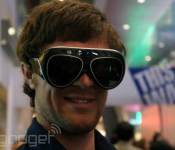
The MetaPro glasses do some pretty amazing things with augmented reality

Yeah, I went through the whole “not another wearable” thing when the folks from the Meta team showed up sporting an early prototype of a device tethered to a small animal-style backpack. But one rep started namedropping some of the parties involved in the AR glasses — names like Steve Mann. The wearables pioneer now sports a “chief scientist” designation on the company’s site. And while we would have preferred to have been first on the demo list, it’s hard to complain when the ones ahead of you are people like Paul Allen and Steve Wozniak. In fact, as they set up the demo in the green room behind our CES stage, one employee pulled out a small, translucent vase, measuring an inch or so tall. “Paul Allen made that one,” he said, handing it to me.
For anyone who’s ever spent time around a desktop 3D printer, it wasn’t a particularly impressive artifact, more the sort of thing someone learning CAD might design in week two. What’s impressive, of course, is how Allen designed it. The demo is really just a proof of concept for the technology, but it really drives home the connection between the real and the virtual that the device is bridging. A quick note about the hardware above, before we go any further: These being prototypes, they’ll naturally look a fair bit slicker down the road than what you see. In fact, we’re told that the final version of the MetaPro will look like a set of aviator glasses, with a little extra (including some wings on the side to help obscure some of the sensors. In fact, we’ve included a rendering of what that’ll look like below.

The interface, too, is far from finished, and one of the company’s big recent announcements was that the designer behind the Iron Man movie interface will be helping the UI — so, naturally, the company drops a reference to Tony Stark’s alter ego whenever possible. What I saw was an AR grid laid over the real world; the X, Y and Z axes laid out to give you a better idea of where the virtual objects are placed. The demo involves grabbing a virtual lump of clay, sculpting it with hand gestures and tossing it to a real-world 3D printer, thus making the virtual a reality. The system tracks hands without the need for gloves, identifying yours and others, so multiple people can interact in the same AR world at the same time. In the current demo, the system renders appendages as sort of covered in static, while the final version will be a fair bit subtler (thank you, Tony Stark).

In its final version, the MetaPro will run around $3,000, a hefty premium over the recently released developer kit, which ran $667. That’s thanks in part to some premium parts like the Core i5 Haswell chip inside and the Carl Zeiss lenses. As the company happily points out, the MetaPro will also have a viewing angle that’s 60 percent larger than Google Glass. Plenty of developer kits have been moved, and the company is expecting somewhere around 100 functioning apps when the product ships, including the aforementioned sculpting one.
Filed under: Wearables
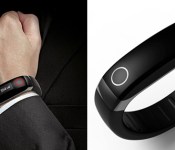
Live from the Engadget CES Stage: LG EVP Jim Clayton

LG’s certainly not the only player in the wearables game at this year’s CES, but this isn’t the company’s first horse race. This time out, the company’s showing off the Lifeband Touch, a new fitness tracker that pairs nicely with the company’s heart rate headphones. Jim Clayton, the company’s EVP of home entertainment and new business development will be joining us on-stage to discuss LG’s play in the space.
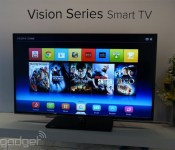
Android TV at CES 2014 highlighted by Chinese manufacturers Hisense and TCL

The project formerly known as Google TV has a limited presence on the CES show floor in 2014. While a number of companies are still working up Android-powered boxes and dongles, the largest TV manufacturers we saw on the floor promoting it were Hisense and TCL. Both are showing off skinned versions of Android TV with Google Play, which look different, but offer similar features like gesture and voice control. Hisense was also showing a new version of its Pulse add-on box, which sports some very Chromecast-like video sharing features. Announced in December, Pulse Pro will ship later this year with Android 4.2.2 and brings a new remote with an integrated microphone for voice control. Hisense’s Android TVs include its Ultra HD H9 and H8 line
While other manufacturers focus on their homegrown smart TV platforms, it appears Google is doing battle by opening up the services and apps it developed for Google TV to the companies interested in using Android. We’ll see if this looser approach helps its reach any, or if Google has any major surprises up its sleeve in 2014, like that Nexus TV box that has been rumored.
Filed under: Displays, Home Entertainment, HD
Source: Hisense
Unleashing the tech show hype beast

There’s a technological revolution going on; innovation is at all-time high; and we’ve seen it all before. While many of the devices we’ve seen this week are new and even exciting, the unending hymn of hyperbole that echoes through the halls of the LVCC is an old standard. For months leading up to the big show, small startups and tech giants flood the inboxes of tech journalists, attempting to catch their attention with bold and often ridiculous claims. And on the show floor, sprawling booths from the likes of Samsung and LG boast laundry lists of “world’s firsts.” Each year, we put all of that aside to bring you only the freshest goods CES has to offer — until now. It’s time to unleash the hype beast!
A war of words
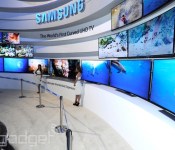
You know something fishy is going on when Pizza Hut is touting itself as a technological tastemaker. The fast food chain was at a pre-show event celebrating the 20th anniversary of “the first physical good ever purchased over the internet.” It’s a mouthful, but that’s the sort of subtle phrasing that’s necessary to set yourself apart in a sea of “world’s firsts.” Samsung and LG are the kings of this sort of nuance. The Korean tech giants both claimed a slew of ultimate achievements, but the devil is in the details. Samsung’s booth featured the “world’s thinnest ultra narrow bezel,” while LG had the “world’s narrowest bezel 3.5mm video wall.” We didn’t bust out the measuring tape, but as you can see, there’s a fine line when it comes to promoting even the tiniest of things.

Believe it or not, bezels weren’t the main attraction at CES. The real confusion came in the 4K TV space. While LG presented its “world’s first 4K flexible OLED TV,” Samsung was just a few doors down showing off its own flexible 4K display. This one, however, was of the LED variety. The outfit didn’t publicly promote the TV as a first, but a Samsung rep told us it was the “world’s only one.” Both companies had a number of other claims scattered about their booths, with LG touting firsts with HD portable projectors, an Ultra HD 3D wall, an ultrawide QHD monitor and the world’s largest Ultra HD display at 105 inches. Nearby, Samsung staked claim to the first curved UHD TV and the world’s largest Ultra HD TV at 110 inches. It even carried the hyperbole over to its household appliances with the “world’s largest washer and dryer” and the “world’s only sparkling water refrigerator,” serving up SodaStream bubbles from its door.
Samsung’s and LG’s were among the biggest booths on the show floor both in terms of size and bombast. However, one of their biggest competitors for show floor real estate took a subtler approach to pushing its products. Sony’s booth relied more on its products than marketing jargon to set itself apart. The booth, which covered a massive corner of the LVCC, featured a number of new and impressive devices like its diminutive $2,000 4K camcorder, but there wasn’t a single proclamation of a world’s first, smallest, biggest or thinnest. Instead, three slogans featured relatively subtly above a series of the Japanese manufacturer’s new wedge-shaped 4K TVs, promoting the best brightness, color and picture ever.
World’s firsts you didn’t know you didn’t need
When it comes to hype, size doesn’t matter.
When it comes to hype, size doesn’t matter. The big brands often dominate CES coverage, but there are hundreds of smaller companies jockeying for headlines on the show floor and they’re often just as quick to yell: FIRST! This year’s show played host to an enormous amount of “revolutionary” innovations that claimed to do something no one else had. More often than not, these devices fill a gap that no one knew existed, like iToy’s “first connected fighting mini robots” or the Phantom 2 Vision, the “world’s first consumer quadcopter with a built-in high-performance camera capable of high-quality photography out of the box.” Also on display this year: Nymi’s “world’s first cardiac ID technology” that aims to replace passwords and PINs by using the wearer’s ECG as a biometric for authentication and RJ Reynolds’ “world’s first digital vapor cigarette.” Unfortunately, neither Stephen Dorff nor Courtney Love was on hand to provide a celebrity endorsement.
The Official Hype Machine of CES 2014

It wouldn’t be CES without a few grandiose statements from the CEA itself. In years past, the organization has sent out a press release just days after saying attendance has reached an all-time high. That may not be the case this year, but that hasn’t stopped the wheels of hyperbolic sentiment from turning. The CEA claimed a “record amount of innovation” in 2014 (something that’s clearly hard to measure) with 3,200 exhibitors covering 2 million square feet. In an email, it also touted itself as “the world’s largest mobile technology event.” That’s not a distinction we would have bestowed ourselves. The big brands are abandoning the trade show circuit for their own launch events, and Sony was the only major player to launch a phone at CES this year. One area where we’re more than willing to give the CEA credit is in the growth of autos. In a November 18th press release, it proclaimed a record number of automotive exhibitors. Given, that number is nine, but they came correct, so we’ll let that one slide.
If you ask the CEA, it will tell you this is the greatest show on Earth, and given the media circus surrounding it, we’d have to agree.
Lead image by Will Lipman
Filed under: Cellphones, Displays, Misc, Home Entertainment, Robots, Transportation, HD, Mobile, Samsung, Sony, LG

Intel’s Mike Bell on what’s wrong with wearables, and how he plans to fix it

If there’s one buzzword that sums up CES 2014, it has to be wearables. There has been everything from cameras to earbuds. Not to mention a veritable deluge of smartwatches, wristbands and fitness trackers. Even Intel is in on the game, bringing us some of the show’s most memorable wearable tech: the baby onesie, a smart mug concept, an earpiece and even a watch of its own.
There’s a good reason why Intel is investing in wearables, though — and his name is Mike Bell. He’s the general manager of the New Devices Group at Intel, and he thinks wearables are a massive opportunity. One problem though: He also thinks we’re currently doing it wrong. To that end, he’s tasked with shaping Intel’s wearable future, which, if all goes well (for him), will be our wearable future too.
When you’re heading up the new devices team at Intel, we imagine you try and look a little further than what’s currently trending; ideally you’d be creating the trends. When Bell (the man in said position) enthusiastically shows us a set of headphones that measure your pulse, we can’t help feel a little… like it’s something we’ve seen before. It’s not until he explains that the ones he’s brandishing do this with no extra batteries or cables, meaning you won’t need to charge them. For Bell, this is how wearables should be: smart, unobtrusive, effortless. It was Valencell (a company that makes biometric sensors) that came to Bell and his team with the headphones concept initially. “They had the reference design, which was their sensor connected to a white horseshoe-shaped thing that goes around your neck with batteries. I saw that and the team said, ‘What do you think?’ I said, ‘It’s great, but you have to lose the batteries and the Bluetooth.’”

If you brought many of the wearables revealed at CES this year to Bell and his team, it’s likely that you’d get a similar response — something along the lines of “please try harder.” It’s clear what Intel’s vision is: to provide a platform for wearable technology that doesn’t mean having another thing to charge, another control web-panel to log into or another data log to maintain. Bell would rather that it doesn’t require you to do anything different at all, yet you still get benefit out of it. “Most wearables are a one-off that does this, or does that, and doesn’t communicate [with others], and you have to upgrade them. Right now, I think it’s so fragmented; I don’t think people are thinking through that entire experience,” he tells us.
Despite the perceived limitations of current products, Bell is fully aware of the hype surrounding the product category; this is something that he thinks causes its own problems. “The hype just gets bigger and bigger and bigger — to ever achieve that, you need to think about the whole life cycle, the whole washing it, charging it, cleaning it, storing it. You need to actually think about every aspect of what somebody’s going to do with that, not just ‘Hey, isn’t that cool.’”
The team said, ‘What do you think?’ I said, ‘It’s great, but you have to lose the batteries and the Bluetooth.’
So if hype, weak implementation, walled (platform) gardens and a poor user experience are the problems, what are the answers? Bell’s perspective is simple. The category is still young, and undeveloped enough that he thinks Intel can step in and try to push it in a different direction and help define it. It’s clear that Intel is willing to invest heavily in this market, and that’s not entirely surprising. After sitting pretty in the desktop space for decades, it’s possible the chip maker never really expected the mobile industry to slip between its fingers, but it did. It won’t want to make that same mistake with wearables. Not least because it could also provide it with a backdoor into mobile again, if it can gain enough traction with device makers — particularly in a market where tight integration and cross-platform functionality are vital.

It’s no surprise to learn that Intel — under Bell’s supervision — has assembled a handpicked team of experts to usher in its wearable-technology vision with a specific focus on how to improve the human interface. “We’re working on some very interesting technologies that will hopefully just make it so natural to interact with these devices so that it isn’t as artificial as it is today. It doesn’t feel so sci-fi; it feels normal.”
The last, and possibly most important, piece that needs to be in place for Intel’s vision of a wearable future to work is open data. In fact, above and beyond any other point, Bell can’t seem to stress just how important this is. “Going forward, these visions of the connected houses and connected wearable devices without an open data exchange format, none of this is going to happen.” This is something that Intel is already taking action to address. Its open-source Galileo platform was a step in this direction, but it’s the new, equally open, Edison technology — announced right here at CES — that it hopes will help provide the light bulb moment for the industry. As for what’s next? Bell is tight-lipped, only giving us: “There’s lots of stuff. We’re hoping to surprise you a bit more.” Along with a wry smile.
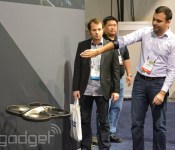
When Parrot AR.Drone meets MYO armband, magic ensues (video)

Ah, Las Vegas, the perfect location for a spontaneous wedding. Earlier today, we witnessed a quick and dirty collaboration between Parrot and Thalmic Labs at CES, where they paired an AR.Drone 2.0 with a MYO gesture control armband. The demonstrator was able to control the drone’s tilt direction by using just one arm, as well as toggling the rotors by clicking fingers. This author gave it a go as well and found this control method to be as effortless as it looked, though due to the WiFi interference on the show floor (ugh, so typical of large events these days), the drone had to stay within a close proximity of the iPad that was relaying the MYO’s commands.
There wasn’t a way to adjust the vehicle’s height in that particular demo, but there’s no stopping Thalmic Labs from assigning additional gestures for that — maybe clench fist to ascend and spread hand to descend. Understandably, neither company could confirm whether they are bringing this feature to market, but we’d be very surprised if they don’t sustain their marriage moving forward.

Live from the Engadget CES Stage: KnCMiner

What better way to send off CES 2014 than with some Bitcoin talk? KnCMiner, the Swedish company behind a number of high profile Bitcoin mining machines will join us for our final on-stage CES interview of the year.
Filed under: Misc

In Brief: Android-related accessories announced at CES 2014 (Volume 1)
This edition features smartphone-related products and accessories announced for CES 2014
In Brief is a compilation of notifications, rumors, and Android-related news tidbits which, for whatever reason, did not end up with a post of its own on AndroidGuys. These are things that we still feel are worth knowing, even if in a passing manner. Consider it a grab-bag of Android goodies. If you have something that you think is worth a mention on AndroidGuys, be sure to reach out to us via our contact page.
For the sake of this article, we will use excerpts from press releases.
Powerocks

Powerocks, a leading manufacturer of fashionable power banks, announced the Smart Power 5200mAh colorful, portable and light-weight power banks that charge smart phones, tablets, and other devices on the go. Smart Power includes an intelligent Android App that precisely analyzes a device’s battery life, so you never have to worry about running out of batteries while on the go.
iDevices
 iDevices, LLC, the premier app-enablement company and creator of the original iGrill, announced the release of their newest connected grilling products: the iGrill2 Bluetooth Smart Meat Thermometer and iLP Bluetooth Smart Liquid Propane Monitor. Made for the serious griller, these app-connected products will take your grilling experience to the next level of excellence.
iGrill2 and iLP use Bluetooth Smart technology, which provides a flawless user experience by simplifying the pairing process. iLP and iGrill2 work with the brand new iDevices Connected App for iPad (Generation 3 and up), iPhone (4S and up) and iPod touch (5 and up). The interface is user-friendly and totally responsive, with a device manager, personalized dashboard and fully customizable settings. An Android version will be released in 2014.
Paick
 Paick, the company creating new digital fashion ideas for life, launched Noble, the ultra-thin ½ inch portable 6000mAh power bank for business professionals. Fashionably styled with a streamlined wallet-sized aluminum alloy high performance casing, Noble is much thinner than other power banks, which are usually over 1 inch thick. Noble features an intelligent dustproof pop-up interface with two USB slots and 1 Micro USB slot that lets you pop-up for access to the USB charging slots or pop-down to keep it extra slim and free of dust.
YiFang Digital

YiFang Digital announced it is entering the wearables category at CES 2014 with a NextONE smartwatch and wristband pedometer. The NextONE wristband pedometer can be worn all day and night to track details about daily activity, including number of steps, distance traveled, calories burned, and overall intensity of the activity through its accelerometer sensor.
The NextONE smartwatch uses the Android 4.1 operating system and features a 1.55 inch TFT capacitive touch screen with 240×240 resolution, a 1.0GHz low power MCU, 4GB ROM, 512MB RAM, 290mAh battery, and a built-in microphone.
The post In Brief: Android-related accessories announced at CES 2014 (Volume 1) appeared first on AndroidGuys.
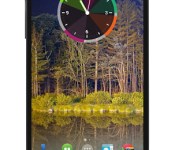
Get This Look: 12Hours
We’re huge fans of changing the home screen around a bit and creating a new user experience for our Android. So much so that we present our ongoing series of Get This Look posts. In a nutshell we show you a new layout, app, widget, or icon set for your Android handset and tell you which apps you’ll need to mimic the feel.
Some of these are a little easier to create than others and many of them can be tweaked to no end. The following details are but the ingredients to which you can create your own delicious Android dish; your results will vary. Which is awesome!
If nothing else, this is a great way to discover new apps, widgets, icons, and more!
12Hours by Tajchert

Why we love this look:
It’s one of the first and only analog clocks we’ve encountered that tips us off to calendar events and their corresponding time(s). What we like most is that it’s a simple clock that matches up with just about any launcher, wallpaper, or icon pack. This one looks sharp whether you’ve got a busy calendar full of appointments or a humdrum, boring lifestyle.
The developer has already started working on updates to bring about some changes and tweaks. Thanks to feedback from the Reddit community, we could soon see a version that doesn’t feature the pie wedges but just the ring around the clock. Additionally, a digital clock may also be in the works.
What you’ll need:
- 12Hours | FREE
The post Get This Look: 12Hours appeared first on AndroidGuys.
 AIVAnet