


Native Union’s Jump charging cable can juice up your devices on the go

It only took a little over 24 hours for Native Union’s Jump, a charging cable with a built-in battery pack for juicing up on the go, to reach its funding on Kickstarter. Still, the company hasn’t abandoned its booth here at CES to go out and celebrate, so we dropped in and laid some paws on the accessory. In case you need a recap, Jump consists of a central hub which contains an 800mAh battery, one braided cable with a Lightning adapter (or micro-USB) at the end, and another with a USB plug.
The hardware is lightweight, easily pocketable and feels quite sturdy. Even the cords themselves feel like they can withstand a significant amount of wear and tear. While at first sight, the cables might appear as if they retract, they simply wrap around the central box and fit into small grooves. stretched from end to end, the contraption measures up at roughly 18 inches in length. On the face of the gadget sit a trio of lights that indicate the built-in battery level when a button on its rear is pressed.
Not only does the device feel solid, but it’s also quite smart. When plugged in, it’ll make sure the gear you’ve connected will be charged up before topping off its own battery. While Jump will be available for $50 when it launches in May, you can snag it now through its already-successful Kickstarter campaign for $40.

New iOS Swiping Keyboard Capable of 120WPM Speeds
App developer Yose Widjaja has created a new Swype-style keyboard designed to allow users to type with two hands using swipe gestures, and he’s demoing the keyboard in his Hipjot note taking app.
Poised as a cross between both gesture-based Android keyboard Swype and the standard iOS keyboard, the Hipjot keyboard can be typed on like a regular keyboard, but it also supports two handed sliding between letters. That means users can type the letters of a word, such as “deviant” with two hands simultaneously in a single double loop gesture.
Because the keyboard allows users to both type normally and swipe through letters with one or two hands, it can result in some impressive typing speeds. Widjala is able to reach peak speeds of 120 words per minute, which is higher than the predicted Swype typing speed of 50 words per minute.
While Swype, which is limited to Android, also allows for gesture-based typing, it does not let users type with two hands simultaneously nor does it allow users to switch between swipes and standard key entry.
Because the Hipjot keyboard incorporates dual entry methods, users have more control over the typing experience. It’s also designed to be highly forgiving of inaccurate touches and it includes both selectable corrections based on input and a customizable dictionary.
With two finger inputs, you can be a lot more explicit in your touches, so it allows you to type without choosing what you want to type, most of the time, while retaining a comfortable swipe where you want to. One finger swipes are inferior in that words like “paraphernalia” forces your finger to go left/right so much.
Currently, Widjala’s Hipjot note-taking app is designed to serve as a way to show off his innovative keyboard. The app itself, while functional, has a steep learning curve and a custom user interface that is difficult to decipher.
While Widjala is willing to work with other developers and would like to see his keyboard gain traction in iOS, custom keyboard implementation on the platform must be done on a per-app basis because Apple does not allow third-party keyboards to replace the default keyboard. While many iOS users would like to have the option to install keyboards like Swype, or Hipjot‘s own dual-swipe invention, Apple has yet to budge on the matter.
Some developers, such as those behind predictive keyboard Fleksy, have skirted Apple’s rules by releasing an SDK for other developers to use, but custom keyboards like the one found in Hipjot are unlikely to catch on until Apple relaxes its rules.
The dual-swipe typing experience is currently limited to Widjala’s Hipjot note-taking app, which can be downloaded from the App Store for $1.99. [Direct Link]
     |

Tesla will give Model S owners safer wall charging adapters to prevent fires

Tesla isn’t relying on software alone to reduce garage fire risks for Model S owners. The automaker will soon offer drivers a free, upgraded wall charging adapter with a thermal fuse. The new device will cut electricity when it detects overheating, even if circuit breakers in the car or house don’t intervene. Both new and existing Model S owners should start receiving new adapters within weeks, Tesla says. While the company doesn’t believe that the chargers are necessary to minimize the danger to customers, it doesn’t want to leave anything to chance — even if it’s prepared for the worst.
Filed under: Transportation
Via: Bloomberg
Source: Tesla

CES 2014, Day 5: Five things 50 Cent missed while he was busy hawking headphones

It’s been a fun week of awards, announcements and intentionally awful headlines, but all good things must come to an end. Before the doors to the show floor closed for the final time this year, we spent some moments with a pair of smart headbands, some augmented reality glasses and even a remote-controlled airplane, but we understand if you still want more. Don’t worry — that’s why we’re here. Join us one final time to look back at the interviews, innovations and intentional head injuries that defined CES 2014.
Staged

While most of Engadget’s staff spent the week marching all over Las Vegas in pursuit of breaking gadget news, some of it came straight to us. Engadget’s stage was host to dozens of interviews this week, featuring one-on-one conversations with CEOs, vice presidents and more. We learned about what provoked Razer to build a fitness tracker, talked about what it is like to be in the pinball racket in today’s gaming market and even sat down with 50 Cent to see how his branded headphones are doing. Whatever your interest is, we’ve probably got an interview to pique it.
Excitement by design

A big part of covering an international trade show is knowing when to keep your excitement in check. Sure, it’s the biggest week of the year for tech news, but the show’s buzzwords are carefully crafted by marketing professionals to catch your attention. CES is littered with services that claim to be the best, first or most revolutionary product of their type at the show, and it’s all too easy to let these cries of grandeur pull the wool over your eyes. Now that the week has come to a close, however, we can take a step back and look at the hype that defined CES 2014.
Picture this

As much as we love writing about the madness of the CES show floor, some things just need to be seen. Lucky for you, Engadget’s resident photographer, Will Lipman, spent the week exploring Las Vegas with camera in hand, capturing the drones, robots, award ceremonies, giant routers and even a gaggle of overworked Engadget editors on film. Think of it as a brief look at the best sights of Nevada’s biggest tech event — without the trouble of actually flying to Nevada.
Building better wearables

If the company’s keynote didn’t tip you off, Intel has been thinking a lot about wearables recently. In fact, the outfit carted out smart mugs, smart watches and even a smart onesie to Las Vegas this year. Clearly, Intel is placing its bets on wearables as the industry’s next big product category — but that doesn’t mean it thinks the future is clear. According to Mike Bell, the general manager of Intel’s New Devices Group, most companies are approaching the category completely wrong. “Most wearables are a one-off that does this, or does that, and doesn’t communicate [with others],” he says. “It’s so fragmented; I don’t think people are thinking through that entire experience.” Bell sat down to tell us what’s wrong with wearables today, and how he plans to fix it.
Assault and journalism in Las Vegas

Reporting? It’s not always easy. In fact, sometimes it’s downright dangerous. Last year, Reebok brought its Checklight impact sensor to CES, but didn’t have a practical means of showing the product off. This year, the company embedded the sensor in a boxer’s skullcap, inviting us to take a few licks for the sake of journalism. Naturally, it’s a challenge Terrence O’Brien couldn’t resist. If you’ve ever wanted to see an Engadget editor cover CES while enduring repeated blows to the head, now’s your chance.

Dropbox goes down following problem with ‘routine maintenance’

We hope you weren’t planning a big Dropbox sync this evening. The cloud storage service reports that it’s having problems with its site following an issue with “routine internal maintenance.” Just what that means isn’t yet clear, although it’s not believed to be an intrusion attempt. While Anonymous Korea and 1775 Sec claim to have hacked Dropbox, the company tells Engadget that the outage isn’t the result of “external factors.” That news won’t be much consolation to those who still can’t reach their online data, but it at least suggests that users won’t have to worry about changing their passwords.
BREAKING NEWS: We have just compromised the @Dropbox Website http://t.co/HtnbT5cyhE #hacked #compromised
– Anonymous (@AnonOpsKorea) January 11, 2014
BREAKING NEWS: We have just compromised the @Dropbox Website http://t.co/HqnsZOLSXR #hacked #compromised
– The 1775 Sec (@1775Sec) January 11, 2014
Filed under: Storage, Internet
Via: TechCrunch
Source: Dropbox, Anonymous (Twitter), 1775 Sec (Twitter)

Hands-on with the consumer-ready Muse headband and software

If you think the person above looks weathered, broken and a little bit ill, you’d be right. After all, it’s the last day of CES, and although this editor wasn’t sure he had any working neurons left, he nevertheless took a trip to InteraXon’s booth to check out the consumer-ready version of Muse, the mind-probing headband. We first came across Muse this time last year, and in terms of hardware, only minor changes have been made. The EEG sensors in contact with your forehead — seven in total, measuring four channels — are now made of conductive ink instead of cold metal, the whole thing is more flexible, and rubbery cushions have been added to its ends. These make wearing the headband perfectly comfortable, but otherwise, its form factor remains unchanged. The band itself is available for pre-order for 270 bucks, with the first units expected to start shipping in spring. To make use of the hardware, InteraXon has, of course, developed companion software for iOS and Android (the band communicates with mobile devices via Bluetooth). Last year, we saw a basic demo whereby changes in our brain activity triggered different events in a wintery scene. What the company has built over the past year, however, is much more polished.
The app, which we experienced on an iPad mini, starts with a couple of calibration exercises. These go from making sure the headband is fitted properly and all sensors are registering brain function, to asking you to think about different topics for determining what your “noisy” mind looks like. The grand finale is a beach scene that reacts to your mental state. A lady with the soothing voice of a classical radio DJ, who has guided you up to this point, requests that you close your eyes, focus on your breathing, and relax. The more zoned-in you become, the lighter the wind, and sustained periods of concentrated calm will even coax birds to land on the beach. Following your timed session — ours was three minutes, but you can increase this — the app follows up with some stats. There’s also a “gamification” element that awards points based on how long you were able to hold an engaged, albeit relaxed state.
Accumulating points over time unlocks more advanced features, but InteraXon really wants you to set personal goals after you’ve “completed” this process. While others will be able to create games and the like using Muse’s SDK, planned updates to the official software will look at data accumulated over the long term and how users might benefit from different and regular mental work-outs — like a fitness tracker for your grey matter. After all, the company’s goal is to help improve your cognitive function, memory, and decrease stress by using its headband and software. For us, at least, a few minutes of slow breathing and the sound of distant waves certainly did the trick after a long week in Vegas.
Filed under: Peripherals, Wearables
Source: InteraXon

Exclusive: PMD’s CamBoard Pico XS is the tiniest gesture camera we’ve ever seen (video)

Just as we were wrapping up CES today, we caught up with our friends over at PMD Technologies who surprised us with a little exclusive. What you see above is the new CamBoard Pico XS gesture camera that’s dwarfed by the Pico S — the one we saw at Computex — next to it. This tiny module is only 4mm thick, 39.5mm long and 15.5mm wide, making it 1.5mm thinner and almost half as long as its predecessor, while still packing the same Infineon IRS1010C 3D image sensor chip. Given the size plus the fact that it already uses MIPI (Mobile Industry Processor Interface) instead of USB, the Pico XS is truly integration-ready for OEMs.
The main changes that enabled this size reduction are the smaller lens — which is compensated by a sharper laser illumination (but still 850nm infrared) — plus the removal of the aluminum heat sink (which is actually the chassis), courtesy of a much lower power consumption. Instead of a typical 1W you get on the Pico S, the Pico XS requires less than 50mW typically (at 25fps) and 350mW max (up to 45fps). Temperature-wise it goes up by just 10 degrees Celsius at most, apparently.
Despite the slightly reduced viewing angles, we’ve been told that this smaller depth camera offers the same performance as before. That certainly seems to be the case after this author tried it using PMD’s Nimble UX middleware (co-developed by 3Gear Systems), which is able to do two-hand skeletal tracking down to finger level, as shown in our video after the break.
Like before, the Pico XS is optimized for close range gesture control within 50cm, as PMD is currently focused on the “comfort zone” just above the PC keyboard in front of the screen. In other words, you can expect computer manufacturers to embed the Pico XS below their monitors, facing towards the user (unlike Leap Motion). Of course, it’d be nice to have this on mobile tablets as well. As to when we’ll see products shipping with this little depth camera, we’ll let you know as soon as we hear about it.
Filed under: Misc
Spree’s head-worn fitness tracker doubles as a… sweatband

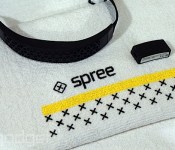
We’ve seen plenty of fitness watches, armbands and pedometers, but it’s a rare moment when we see a pedometer that sits on your forehead. Spree believes that it’s the top of your noggin that offers the most accurate physiological data, and that was enough for us to give the hardware a quick look. The device itself is a small, square, rubber brick with an optical sensor covering one of the sides. Naturally, that side has to be pressed up against your skin in order to monitor your heart rate and body temperature, while an accelerometer records your moment. In order to get the Spree into its intended position, there’s a rubber headband, which doubles as a sweatband, so, no matter how frantic your nodding, you won’t be left wiping your eyes in sticky frustration.
Spree was spun out of a company making optical temperature sensors for workers and American football players, who were running the risk of fatally overheating during training sessions. The company then began to get requests from private individuals asking to buy the tech, which is what prompted development of the Spree. One of the biggest consumers so-far, we’re told, is women, who prefer a forehead sensor over strapping a heart-rate monitor to their chests, which can be uncomfortable. We’re also told that the company is investigating building a pair of heart-rate monitoring earbuds, like the Valencell-powered LG earbuds that launched a few days ago. Connecting over Bluetooth to iOS devices, it’ll last eight hours on a single charge, with the company promising that an Android version of its app will arrive in the Spring. Subsequently, development of a Windows Phone version will begin, although there’s no schedule on when we can expect to see it in the store. The Spree is priced at $300, and is available in grey, teal, black or pink editions – depending on how exactly you plan on styling your temples that day.
Filed under: Wearables

CES 2014 in pictures
 `
`
We’ve written so many words about CES 2014 that our fingers have calloused over. We’ve seen enough 4K TVs, booth babes and wearable computers to last us another 365 days and our resident photographer, Will Lipman, was on hand to capture almost all of it. We’ll spare you the bad catering, grease-smudged demo units and trips to the port-a-john for a glimpse at the more beautiful side of CES. Join us after the break for a closer look at CES 2014.


CES cosplay? This dude’s not impressed.

The new way to check-in.
At least someone’s leaving with a smile on his face.

Mr. Marinator’s claiming its steak for Best of CES.


And still our WiFi connection sucked.

Daddy’s little girl

Nick Cannon: “You’re paying me how much to do this?!”

Life Space UX blue screen of death

“Nah, it’s cool. I’ll wait.”


Under the sea-ES

Do you ever get that feeling that you’re being watched?

Check out these curves.

Ultra HD’s got nothing on this life-like DTS display.

I see a photographer in your future.

Nice grill

Little people. Big show.

We’re not exactly sure what this one is, but stare into the center of it for 30 seconds.

Can someone move that World’s First Curved UHD TV? It’s in the way of my shot.

Picture-in-picture


Don’t cut the red wire.

Welcome to the future. Now get out of the way.
Photos by Will Lipman
Joseph Volpe and James Trew contributed to this report.
PowerUp’s smartphone-controlled paper plane makes us jealous of modern kids

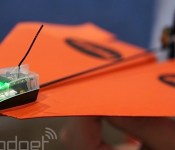
So, it turns out that people really like paper airplanes, and by that we don’t mean the M.I.A. song, although that’s pretty neat too. No, we’re talking about PowerUp’s Bluetooth propellor kit for paper planes that enables you to steer your origami aircraft. Creator Shai Goitein had already developed a propellor kit for kids, but took to Kickstarter to raise funds for a smartphone-controlled model with a rudder, and was staggered when it managed to raise its $50,000 goal in just seven hours. In fact, the current figure is hovering just beneath the million-dollar mark, and there’s still 14 days worth of funding left to go.
Goitein’s career has ranged from industrial designer to cargo plane pilot, but it was his work with children – coupled with a desire to combine his passions of aviation, origami and technology – that inspired him to craft the device. So, how does it work? Once you’ve folded some paper and attached the PowerUp 3.0 to the central crease, you pair the module with your smartphone over Bluetooth and fire up the app. Not only will the software show you an artificial horizon and range information, and as you move the phone from left to right, the rudder will move in time. Charging over a microUSB port, it promises around 10 minutes of flying at a time, and thanks to a rubber and carbon-fiber construction, shouldn’t break no matter how many crash landings it’s forced to make.
Thanks to the overwhelming level of support for the project, Goitein has already commissioned the production run, so early backers should be receiving their units well ahead of schedule. The retail version, meanwhile, will be priced up at $50, which includes a module, some paper and a guide to help you craft the perfect plane. There’s also the matter of more stretch goals, with a dogfighting mode in the works – whereby two models can go at it together in mid-air, ably assisted by button mashing users on the ground. If the project manages to get to the $2 million mark, Goitein will also investigate the feasibility of adding a camera to the next version, adding a whole new level of excitement for kids us.
Filed under: Misc, Transportation
Source: PowerUp 3.0
 AIVAnet