



PulseWallet lets you pay for things using palm recognition, but only if you’re a returning customer

PulseWallet is going to get a lot of attention at CES this week, thanks to its point-of-sale system that allows you to pay for things with a wave of your palm. The interesting thing, though, is that PulseWallet already has a setup that lets customers pay with their fingerprints. The problem, say company reps, is that fingerprints can potentially be lifted. (Also, they’re a bit messy.) So, the outfit is moving to a Fujitsu-made palm sensor, which is more secure and supposedly faster, too. Here’s how it works: after you visit a store once, you can register your palm and link it to the credit card of your choosing. Then, the store will have it on hand (har) the next time you stop by. When it comes time to pay, you can swipe your palm, after which point you’ll need to enter your phone number to verify it’s really you. Et voilà! You’ve managed to pay without digging our your credit card, and without getting (as many) greasy fingerprints all over the point-of-sale system. No word on when you’ll start seeing these in stores, though the company says it will only be available in the US to start.
Filed under: Misc

24 hours at CES

CES, it’s a thing. A big thing. For us here at Engadget, it’s kind of a big deal. For you, the gadget-loving public, it’s a chance to see what the year in tech will look like. But enough about you already… what about poor old us? There’s so much you don’t get to see: the work, the constant scrums of people surrounding products, the late nights and cold trailer food. We figured you all probably wanted to experience those joys for yourselves, albeit vicariously. We hooked up one of our editors, Michael, with a GoPro and a FuelBand, and set him off into the wild with a photographer in tow, so you can get a taste of what 24 hours at the craziest tech show on Earth feels like. Hop past the break to see for yourself.
Day One

15:12
We hook our lucky journalist Michael up with the high-tech conference-tracking technology — namely a GoPro Hero 3+ and a Nike FuelBand SE. This is the sort of cutting-edge motion- and activity-monitoring kit we expect MIT, or NASA likely uses too.

15:12
Michael: “Does it look weird?”
Dan and James: “No, definitely not. Not at all.”

15:13
The pre-event, late lunch, of cold pizza isn’t going down too well. The Engadget trailer currently smells of oregano, coffee and bodies. Take a long moment to really consider what that cocktail would smell like.


15:25
Time for a little research before heading out to CES Unveiled, one of the show’s earliest events. Imagine a ballroom filled with crazy inventors, eager salesmen and flustered bloggers, and you’re not far off what goes on at these things.


15:28
A rare glimpse of daylight as Michael leaves the fug of the trailer behind, and heads out toward CES Unveiled. The show is not even open, and it’s a Sunday, and already the parking lot is pretty much entirely occupied by trailers, tents and trucks. Walking about it means taking your life into your own hands, as forklift trucks and electric carts zip through any available gap.

15:30
While the Las Vegas Convention Center is huge, there’s still not enough space to fit absolutely everything in. There are off-site events, shows and other CES-related fun held all throughout Las Vegas. Unveiled is a short drive away at the Mandalay Bay hotel.

15:51
Fellow Engadgeteer Billy Steele pulls up some details on his phone as our team makes its way to the hotel. That, or he could be looking down to avoid the intense glare reflecting of the hotel’s tasteful gold mirror windows.

15:57
With so much going on, you gotta grab every moment you can to stay on top of email. An escalator ride proves the perfect moment.

16:08
While there’s always something going on, you do also find yourself hanging around an awful lot. Usually with nowhere to sit, or at the back of a long line. If you’re lucky, you can use the time to get some work done…

16:32
…until they let everyone in. And then it’s straight back to work, you know, pounding the floor, bringing you the hottest gadget news, that kinda thing. Also, how wild is that carpet?


16:35
Sometimes finding the tables with Ethernet and power outlets is like dashing for the front row as a concert opens. Engadget’s the official online news source this year though, so we’re lucky enough to get a dedicated spot to work from. That doesn’t mean there are enough seats, and a strict no-WiFi policy (it can interfere with exhibitors’ demos) means we’ve got to cable up. We hate cables.

16:52
Once we’re done doing that though, we spring into action and bring you things like… inanimate rod 3.0. It has an Android and iOS app (no Windows Phone support just yet) and comes in dark gray and black. Only kidding, it’s actually Tobii’s new sensor bar…


16:58
Just let us get these facts straight…

17:14
…and then we’ll take it for a spin if that’s alright with you. This is honestly still work. Honestly.


17:22
Hands-on demo in the bag, and photos taken (we often head out in pairs), it’s back to the wild carpet to find a spot against the wall and write that up for you the dear reader. Repeat this up to 10 times or more.

19:52
Unveiled runs from 4 – 7 PST, so the day is far from done. Instead of going home afterwards (chance would be a fine thing), we decided to head over to a Samsung press conference. Samsung likes to keep things interesting by having the whole thing bathed in low light. Working in low light is clearly much more helpful. Sorry, we didn’t mean to sound bitter.

20:14
It’s even more fun working in the dark, when it’s followed by a scrum of tech journalists, trying to get the first look at the huge (honestly, so very huge) curved TV that Samsung brought along to Vegas with it.


20:29
Are you sensing a theme yet? After getting a look at the 105-inch behemoth we’d really prefer to stand around chatting about it, but the people (that’s you) need to know. And so it is, back onto the laptop. This time, at least, there are some comfy chairs and no wild carpet (unless we can’t see it because of the dark). With that black light, it almost looks like a nightclub doesn’t it? It isn’t a nightclub.

21:02
Now that the crowd has finally dispersed, we get to take a second look. It’s huge. And curved. Huge and curved, that’s what the TV fans can expect this year at CES. And yes, that is the Eiffel tower in the background. #vegas.

21:15
After filing our eyes-on, there’s another brief window to check our email while someone films a hula-hoop performer. Fairly standard for a Vegas press conference. Also, our last external work commitment for the night, we can finally head back to the trailer. Once back, we can look forward to dry, boxed food to replenish our reserves, before — if we’re lucky — knocking off around midnight.

SLEEP (not much).
Day Two

05:14
Gorman gets his early face on…

05:23
…and moments later, shares it with America.

07:14
One interview in the bag means a little time to freshen up before heading out again.

07:40
Judging by the smile on Billy’s face as he waits for Michael in the lobby, he got more sleep.

07:30
Time to jump in a cab and head over to Mandalay Bay (again) for, you guessed it, more press conferences.

07:30
One positive thing about being in the desert is that the sun is usually out providing much-needed vitamin D between dimly lit, body-filled presentations.

07:52
Like this one, causing us to reach straight back into those vitamin D reserves. THANKS LG.


09:12
Exhibit A: Mat Smith went in with a full tan. He apparently now needs either some time in the sun, or some water. Probably both.

09:27
While our guys head out to dose up on sol again, they spot one of CES’ lesser-expected exhibitors… Hilti?


09:29
Vegas hotels aren’t known for their reserved decor, but is it art?


10:52
A quick dash over to CNBC Studios, and it appears they have a… body shop?

10:56
Before you know it, we’re back in front of the camera again. Look how excited Michael looks to be addressing the nation again.

11:30
The real business of the show won’t wait in our absence, so it’s straight back to the trailer for a quick battery change in the GoPro, courtesy of Ben and Todd, our video guys.

11:46
While Michael’s been out “working,” some of the team have been stuck indoors doing the heavy lifting.

11:51
No time to stop for long of course; it’s back off over to the North hall where the Engadget stage is.

11:57
Here is a sneaky look at the backstage area/green room. Some of the biggest names in tech will pass through here over the week. As well as Michael Gorman.

12:14
Today is technically day “0″ of the show. Everything kicks off properly tomorrow, so some of the stands (well, most of them, actually), are still setting up.

12:23
…and because of that, security is tight.

12:27
We guess it’s some lucky person’s job to peel the covers off all of those triangular tiles?

12:31
If you’re wondering why we’re just aimlessly walking around at this point, it’s because Engadget is hosting some tours of CES for a few select partners. A couple of the team wanted to get to know the lay of the land in advance. Shrewd thinking, as this place is — as they say in Spanish — enorme.

12:35
And, unsurprisingly, it doesn’t take them long to get lost.

13:58
Getting lost means our reporters regroup at the trailer for directions, earning them a welcome-back kiss from Jamie. Which is reason enough on its own not to bother coming back at all.

14:05
The next stop back out on the ground floor trek is a booth tour from LG. Once again, that tight security makes an appearance.

14:14
The good news is, all this walking means we smash through our daily goal, reaching it by early afternoon.


14:24
Back at the LG booth we’re given a full-spec rundown of some of the many new products the firm released. Mostly those that weren’t 77-inch curved OLED TVs.

14:46
They seem happy with it, though we’re not entirely sure about their taste in movies.
At this point, our 24 hours come to an end. This means Michael can remove his chest-mounted GoPro, and finally go to the bathroom. But of course, as they say, the show goes on, and the work continues. Many of us landed here around the 2nd or 3rd of January, and won’t leave until the 12th. That’s a long time to be in Vegas, but we do it with pride and a sense of purpose. We hope you enjoy the coverage just as much as we do making it — despite all our moaning to the contrary.
Some photos provided by Will Lipman.
Filed under: Alt

Live from the Engadget CES Stage: WowWee CTO Davin Sufer

More robots? Don’t mind if we do. Davin Sufer is the CTO of WowWee, the company behind toys like Robosapien and Roboraptor. He’ll be joining us on stage to discuss what the company has up its sleeve.
Filed under: Robots
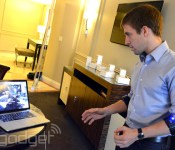
Forget gesture cameras, here’s a wireless armband that senses your muscles

2013 saw the rise of gesture cameras for TVs and various smart devices, but Canadian startup Thalmic Labs thinks its MYO armband is the way forward. During our meeting at CES earlier, co-founder and CEO Stephen Lake explained that his Bluetooth 4.0 device features a new type of biosensor, which can pick up minute electrical impulses in our arm muscles. This allows any wrist movement, finger twitch or fist clenching to be interpreted as a gesture, so long as the inner side of the MYO has skin contact. There’s also an accelerometer, a gyroscope and a magnetometer, so arm and body movements are accounted for as well.
The idea of MYO traces back to the co-founders’ university days, where they explored various wearable technologies while working on a navigation aid for the blind. Lake said since brain control isn’t quite there yet, his team found muscle sensing to be the next best thing. From what we saw and tried today, Thalmic Labs seems to be on the right track: We watched co-founder Aaron Grant play Call Of Duty: Ghosts using just a pair of MYOs, and he was able to make his avatar run, crouch, jump, fire weapon and reload. Lake also gave a demo on music playback control and slideshow presentation on an iPad, both of which worked just fine. But it doesn’t stop there; the CEO also sees opportunity in industrial robotics, space application and even gesture-based authentication.
The retail version of the MYO will arrive within the first half of 2014, and not only will it be half as thick as the MYO Alphas shown today, but it’ll also feature at least two core applications that will make full use of the armband. Lake said he’ll be showing the final design in the next couple of months, but if you’re game, you can now head over to Thalmic Labs’ website to pre-order a black or white one for $149. Need more convincing? Then check out our in-depth demo video after the break.
Filed under: Peripherals

Live from the Engadget CES Stage: Samsung Mobile App Academy scholarships

Presenting the awards for Samsung’s Mobile Boot Camp was far and away one of the highlights of last year’s CES stage, so naturally, when the company asked if we’d be game to give it another go, we jumped at the opportunity. You can watch the awards tonight at 7:30PM ET
Filed under: Cellphones, Mobile
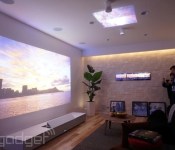
Sony’s Life Space UX demo envisions projectors, screens everywhere

Among the announcements Sony dropped during Kaz Hirai’s CES keynote, the Life Space UX project seemed to be most outrageous, pushing an entirely new vision for projectors. We checked out the company’s CES demo booth and found out it actually goes even further than that. The prototype 4K Ultra Short Throw Projector shown on stage and in the demo is expected to cost between $30,000 – $40,000 when it launches later this year.
Similar to the pricey Cinema Beam projector released by LG last year, it can sit very close to a wall even in high-brightness settings and beam a large, clearly visible image. The combination of zoom lenses, three separate SXRD microdisplays and a laser diode light source make it powerful and sharp enough to put out a 147-inch 4K image that’s visible even with the lights on. Its low sleek design and modular setup (it splits apart to reveal speakers and cabinet space within) is made for flexibility and to be “harmonic” with the room when it’s off. Other prototypes in the demo (check out the gallery for a better look) included a projector placed in the lamp over a regular kitchen table for Surface-style interaction, a mirror that turned into a high-res, touchable display and ceiling projectors that shot upwards.
Filed under: Displays, Home Entertainment, HD
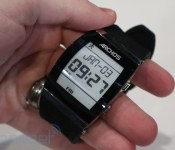
Archos’ Smartwatches don’t want to be smartphones-lite

Archos is coming at the burgeoning smartwatch space in a different way. Rather than hedge its bets on a single device offering, it’s planning to release a trio of smartwatches for every end of the consumer spectrum. The water-resistant smartwatches in question don’t have specific branding attached as of yet — that will presumably come before launch later this summer — but they are easily distinguished by screen size and display tech used.
Unlike the half-baked, it-can-sorta-do-everything Galaxy Gear, Archos’ smartwatch line is hewing more closely to the Pebble route. These Android- and iOS-compatible devices are designed to supplement your smartphone experience, not replace it. And so, users that buy in will have access to notifications (i.e., SMS, emails, text, Twitter, Facebook, etc.), media playback controls and, of course, a clock. What they won’t be able to do is snap photos on a low-resolution camera, talk into their wrists or reply to messages.
The cheapest of the bunch is Archos’ $50 model, a rugged-looking smartwatch that features a 1.55-inch non-capacitive, black-and-white, memory LCD and is rated for between one and two weeks of battery life. For just $50 more, there’s a color capacitive model that steps up the screen size to 1.8 inches (the same size as an iPod nano) and lasts about 36 – 48 hours. Fans of customization and the fashion-conscious will be glad to know the band on this model can be swapped out. And finally, occupying the line’s premium perch, at $130, is Archos’ e-ink smartwatch, which retains the same screen size as the color model, but with an aluminum-encased curved display.
The smartwatch line isn’t slated to launch until sometime this summer, but when it does, don’t expect all three to be available at once. Archos plans to offer only its $50 model initially, with its higher-end models to follow in the months after.
Brad Molen contributed to this report.
Filed under: Wearables
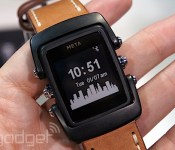
This is the next generation of Meta’s smart watch

MetaWatch, the wearables business that was spun out of watch maker Fossil, has lingered at the periphery of the space for quite a while. Now, however, the outfit has teamed up with the legendary Nokia and Vertu designer Frank Nuovo, who has helped redesign both the branding and the hardware in preparation for a relaunch as the Meta. The hope is that, when this new unit launches in the spring, Meta will be able to jostle as an equal with the Galaxy Gears and Pebbles of this world.
Aside from the name, the biggest innovation has been to shrink the slab-like hardware down to something a little more wrist-friendly. The bezel that surrounded the display has been split into four armatures that pivot — which means that it’ll now drape around your arm rather than jutting out and breaking the line of your sleeve. Considering that the team behind this started at Fossil, which offers a huge amount of interchangeable faces and straps, it’s no surprise to see that Meta will be offered in a wide variety of materials and styles. There’s a flat, shiny plastic model; a chunky (and weighty) stainless steel version; and an aluminum one, which is significantly lighter.
Technology-wise, you’re going to be staring at a 126 x 126 LCD display from Sharp, controlled by a TI MSP 430 microcontroller with a whopping 64Kb RAM. The plan is, at least, that the MetaWatch SDK will be ported over to the new platform, and with it, Bluetooth 4.0 notifications will be pushed from your smartphone to your wrist. The battery will be always on, and will vibrate whenever it demands your attention, requiring a recharge once every seven days or so. Of course, there’s no word (yet) on pricing, but we’re more than a little curious about how this’ll fare when we’re able to get our hands on it.
Filed under: Wearables
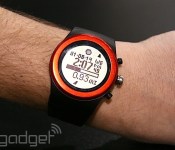
LifeTrak’s new watch combines smartwatch, fitness tracker and ECG machine

Would you like an early clue as to the dominant trend of CES 2014? It’s wearables, and, erm, more wearables. Another watch that’s hoping to earn a space on your wrist is the LifeTrak Zone R415, which grabs a little of everything from the technology buffet with the aim of being all things to all people. From the “smartwatch” table, we’ve got vibrating smartphone notifications that’ll let you know when you get calls, texts and emails. Then there’s dynamic sleep tracking which, like the Jawbone Up, will record your slumber session and wake you when you’re at your most well-rested. From the fitness tracker cart, the company has added a pedometer, calorie counter and activity tracker that’ll keep you informed of how you’re doing in hourly or weekly intervals. Rounding out the selection is an ECG, and by pushing the button on the side of the bezel, it’ll give you your heart rate. Using just a single watch cell battery, the unit should last for up to nine months between replacements and is designed to remain on your wrist, even while you’re in the pool. Holding it in our hand, we found it to be reasonably comfortable and light, and can certainly see some potential in the platform. Naturally, we’ll reserve judgment until we see it launch in Q2, but for now, it seems like it could be worth the $130 price point.
Nicole Lee contributed to this post.
Filed under: Wearables
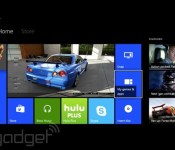
Xbox One’s first big update will address ‘the Live experience,’ expect streaming before E3

Xbox — and Microsoft in general — doesn’t really show up for CES. It’s not hard to understand why: for a big company like Microsoft, there’s no point in competing with the cacophony of voices shouting for attention. “Whenever we want, we can talk about Xbox stuff and get coverage. Why try to talk with 100,000 other things going on?” Xbox chief product officer Marc Whitten told us in an interview this week. Though Xbox isn’t here to show anything off, Whitten’s in town to meet with partners and, as he put it, “It’s just a good time to pop up and see an environmental scan you can get in an immediate dose.” After a long 2013 head down on the Xbox One launch, he’s finally got a second to take the temperature and see the world outside of Microsoft’s Bellevue, Wash. campus.
But we’re not here to ask Whitten about the past. Yes, he’s “really thrilled” with the console’s launch (over 3 million sold by the end of 2013). And yes, he’s very happy with the reaction from consumers. That doesn’t mean work’s over, of course. “There are seams in the product [XB1]. There are still seams in the 360, nothing’s ever done,” Whitten said. As such, first up on the fix docket is what Whitten called, “the Live experience.” Essentially, that’s much of the social features on the latest Xbox console. Whitten takes that stuff personally, having worked on Xbox Live as a service for the last 10 years:
“The feedback we’ve gotten is pretty valid; some of the social stuff is hidden or harder to use than it was on the Xbox 360. So you’re gonna see us come out with an update where, well, we’re going to fix those things. As a person who’s been pretty involved in building Xbox Live for the last decade, I take it pretty seriously when people say it’s harder to get into a party, and the defaults aren’t right, and I don’t like the model. So what I’m trying to do with the team is kind of theme some stuff up. Let’s take an update and really go through a big list of what we’re hearing from customers, what we know is broken with the architecture, areas that we want to improve or complete. I think that’s a theme you’ll really see us push on — that Live experience.”
Based on our conversation with Whitten, it sounds like those Live fixes are coming sooner than later. Promised game streaming functionality, however, may not be coming as quickly. “This is not 100 percent,” Whitten prefaced his statement with. “But my general strategy at E3 is to talk about things that are gonna happen from that E3 to the next E3. So, we are not yet to the next E3,” he added with a smile. So, uh, before June then!

Updates in general, though, will come much faster. While Whitten said we’ll still see the traditional large Dashboard updates, the Xbox One was designed around lessons learned from the 360 before it. One major facet of that design facilitates more regular updates. “The Xbox 360, which I’m still very very proud of, the software architecture was built in 2003. Rethinking [updates] based on everything we learned from 360 was a lot of what went into the Xbox One,” he told us. “You’re still gonna see the big, ‘Hey, here’s the cool stuff we’re doing.’ But you’re also gonna see the box just get better faster than you did in the past.”
First up on that front? “Everything from getting more apps out faster, some of the TV stuff — improving some of that, getting the scale of that internationally where we don’t have some of that. So I think you’re gonna see that come pretty quickly,” Whitten said.
The next big push for Microsoft’s Xbox One starts by March’s Game Developers Conference. As it turns out, the Xbox One gets its first major exclusive game that month in Titanfall as well. And hey, if you ask us, there’s serious incentive for Microsoft to have partying up perfected in time for Respawn Entertainment’s big game.
 AIVAnet