


Half of iPhone 6 Orders Expected to Go to Pegatron
Apple supplier Pegatron is expected to win a contract that will see it manufacturing half of Apple’s iPhone 6 supplies, according to a report from Taiwan’s Liberty Times [Google Translate] as shared by AFP. Currently, Pegatron is responsible for assembling Apple’s iPad mini and iPhone 5c while main Apple supplier Foxconn manages iPhone 5s assembly.
The report does not specify which supplier will take care of the other half of iPhone 6 orders, but it is likely that responsibility will fall to Foxconn. It is also unclear how manufacturing of the iPhone 6 will be split, as it is not yet known if Apple will continue on with its bifurcated product lineup that currently includes both the flagship iPhone 5s and the mid-range iPhone 5c.
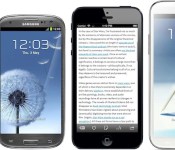
Rumors have suggested that Apple could produce two versions of the iPhone 6 in two different sizes ranging from 4.7 to 5.7 inches and likely at two different price points, keeping with its new two-phone lineup.
 Left to right: iPhone 5, Galaxy S III, “5-inch iPhone Plus”, Galaxy Note II (Source: Marco Arment)
While Pegatron has long been a manufacturing partner for Apple, the Cupertino-based company shifted iPhone 5c production to Pegatron in 2013 in order to improve supply chain risk management, allowing Apple to expand its product lines and prevent potential supply chain disasters. Pegatron will reportedly build a new plant in Kunshan, China to keep up with demand.
In order to meet the demand, Pegatron has started building a new plant at Kunshan, a satellite city near Shanghai where all its iPhones are assembled, the Liberty Times said without identifying its source.
The paper said the Kunshan plant is scheduled to become operational in the middle of the year and start mass production late this year, when Apple is expected to roll out its iPhone 6.
Along with a larger screen up to 5.7 inches, Apple’s iPhone 6 is also rumored to include a curved display and a faster and more efficient A8 chip. A report from this morning also suggested that the phone will continue to use an 8-megapixel camera sensor. Though it is not known when Apple will release the next-generation iPhone, fall of 2014 is a likely candidate given Apple’s past device release history.
     |

The Who What and Where to Smartphone Tethering
 Tethering turns your smartphone into a mobile Internet connection for other devices, such as your laptop or tablet. Some wireless service providers include the cost of tethering within a cell phone plan, while others, such as T-Mobile, offer it as an add-on service with different tiers depending on your needs.
With it’s ever-growing popularity, tethering is becoming as integral to our smartphones as texting. Tethering trends however, may be shifting after a recent FCC settlement against Verizon. Verizon is paying $1.25 million in the settlement, and as a result, will no longer be charging customers for smartphone tethering. In addition, Verizon is no longer able to block tethering apps that got around Verizon’s tethering restrictions. This ruling may encourage other carriers to take a look at the way they handle their tethering services, whether they roll the cost of tethering within the monthly plan or offer it as add-ons.
Tethering in the Business World
An increasingly connected world with significant 3G and 4G data coverage allows workers to go to job sites, research centers, and field locations without losing touch with the main office. However, smartphones aren’t always the best or most secure devices to use for work purposes. Tethering access allows a worker to fire up their Lenovo laptop or Android tablet and access vital work resources, participate in video conferencing, and upload work to the server back at home base. When wireless service providers actively block tethering apps, such as Verizon did, or charge additional prices for tethering, it adds additional pressure on businesses with a high number of mobile workers.
Third party apps such as FoxFi, which provides Wi-Fi tethering and also works with another tethering app called PDANet, has seen over 1 million installations according to the Google Play store. There’s an apparent demand for tethering whether the wireless service provider offers it, or the customer needs to get it through a third-party app. It’s unlikely that another wireless carrier will prevent tethering app installation after the Verizon case, but it’s likely that multiple tethering data tiers will become commonplace. This gives the customer a la carte data options so it’s adjusted as needed.
Tethering in Personal Life
Tethering offers a number of benefits for your personal life as well, especially if you do a lot of travel or live in a location with bad Internet options, a great deal of wireless interference, or other problems with a standard Internet connection. When you use Wi-Fi tethering on your smartphone, your laptops see it as a typical network to connect to. You don’t have to worry about whether the hotel Wi-Fi is good or secure, and you can always bring your phone right by your laptop if the connection seems weak at first. 4G LTE speeds are comparable to basic home broadband speeds, so unless you’re on a turbo charged connection or have the pleasure of Google Fiber connections, it’s servicable for streaming, Internet browsing, social network checking, and other standard Internet uses.

Live from the Engadget CES Stage: MakerBot CEO Bre Pettis

We were calling CES 2013 the year of 3D printing. It’s pretty clear this year, however, that the 3D printing explosion hadn’t even began. The number of companies representing the technology has increased by enough to justify a standalone 3D printing area, and as usual MakerBot is helping to lead the charge.
Filed under: Peripherals

Nokia’s Lumia Black update starts rolling out worldwide (video)

Nokia knows how to start a new year properly — it gave Americans a first shot at the Lumia Black update as 2013 came to a close, and it’s starting 2014 by rolling out the software to Lumia owners around the world. The Windows Phone 8 upgrade is reaching the Lumia 925 and 1020 first; other devices should get it in the weeks ahead. The fresh software brings common features like app folders, Bluetooth 4.0 LE support, an updated Glance screen and the unified Nokia Camera app. Some improvements depend on beefier hardware, however. You’ll need at least 1GB of RAM to use Beamer transfers or Refocus image processing, and only 1020 owners can shoot RAW photos. Whatever device you’re using, you’ll want to hit that Phone Update option in the near future — you may be in for a pleasant surprise.
Filed under: Cellphones, Mobile, Microsoft, Nokia
Source: Nokia Conversations
Live from the Engadget CES Stage: Orbotix

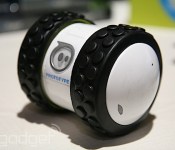
Like cool vehicles you can control from your smartphone? Boy have we got the company for you. Orbotix celebrated CES 2014 with the release of a new kind of Sphero. The 2B has two treads, moves fast and is available at a lower price point than its older sibling. We’ll be speaking with the company’s co-founders.
Filed under: Peripherals
Keecker is an Android-powered robot that projects video onto your walls

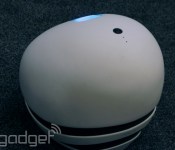
Sure, you could buy a projector for your apartment, or maybe even a TV; people still use those, we’re told. Or, you could get an Android-powered projector instead. Solving a problem that not many people seem to have, Keecker is a smartphone-controllable robot that moves around your home, projecting video onto the walls. In particular, it runs Android with Google Play access, allowing you to stream from built-in apps like Netflix or YouTube. (Fun fact: the company’s founder, Pierre Lebeau, is a former product manager at Google.) As you can imagine, Keecker also has a built-in speaker, meaning you could use this as a giant music player if you were so inclined.
Some might be disappointed by the 1,280 x 800 resolution (especially with a target price of $4,000 to $5,000), but the 1,000-lumen light is at least bright enough that you can watch even with the lights on. (See our hands-on photos from the company’s CES booth to see what we mean.) The thing is, even with clear picture quality, the robot is kinda big. At 16 inches wide and 25 inches tall it has a relatively large footprint, so it’d be a stretch to argue that this offers any space-saving benefits, per se. If you buy this, it’s going to be because you want the freedom to watch TV on any wall in the house, or because you like the idea of having a projector with streaming apps built in (a better reason to splurge, if you ask us). At any rate, this won’t ship until Q4, so you have plenty of time to think on that — and start saving your pennies.
Filed under: Home Entertainment, Robots, HD

Engadget Podcast 377 – CES Day Two – 1.8.14

The finalists for Best of CES 2014 have emerged and Terrence O’Brien, along with Sarah Silbert, kick back to review the merits of these chosen few. While it’s only day two of the main event, the Engadget editorial team have been combing through gadget offerings at CES for nearly a week and sleep deprivation is rapidly descending. Although weary, Terrence, Sarah and a smattering of drop-in guests are keen to share their opinions on these devices, enjoy a refreshing beverage and fill you in on the state of CES so far. Join us for the second edition of the Engadget Podcast, direct from the show floor.
Host: Terrence O’Brien, Sarah Silbert
Producer: Jon Turi
Hear the podcast:
Subscribe to the podcast:
[iTunes] Subscribe to the Podcast directly in iTunes (enhanced AAC).
[RSS MP3] Add the Engadget Podcast feed (in MP3) to your RSS aggregator and have the show delivered automatically.
[RSS AAC] Add the Engadget Podcast feed (in enhanced AAC) to your RSS aggregator.
[Zune] Subscribe to the Podcast directly in the Zune Marketplace.
Download the podcast:
Contact the podcast:
Connect with the hosts on Twitter: @terrenceobrien, @sarahsilbert
Email us: podcast [at] engadget [dot] com
Filed under: Podcasts

Canopy’s Sensus app enhancing case hands-on

We saw Canopy and its Sensus last year at CES with what appears to be similar hardware, but really isn’t. In our conversation with Sensus’ VP of Software Engineering Joel Stewart this evening, he explained that the company was caught in the iPhone 5 Lightning connector storm and rather than push out a product that would almost assuredly fail, they took time to regroup and even redesign. As a reminder, the Sensus case augments the iPhone’s input by adding input on the back and sides of the case via capacitive touch.
Gone is capacitive input on the case; it’s been replaced by pressure-sensitive pads on the back and down the sides. App choice has improved in some ways due to the pressure-sensitive pads. For example, flipping the case over and putting a cup on the case when the weighing app is running will see the case read out the weight of the cup on it. Follow on for some pics of the new packaging, case and a short demo video.
Filed under: Cellphones

Seven Years Ago Today, Steve Jobs Introduced the iPhone
Today marks the seventh anniversary of the introduction of the iPhone, a presentation that took place as part of the keynote of Macworld Expo 2007 in San Francisco. While the device would not launch until over six months later, that presentation offered the public the first glimpse of what Steve Jobs introduced as three devices in one: a touchscreen iPod, a phone, and an Internet communicator.
Today, we’re introducing three revolutionary products. The first one is a widescreen iPod with touch controls. The second is a revolutionary mobile phone. And the third is a breakthrough Internet communications device. So, three things: a widescreen iPod with touch controls, a revolutionary mobile phone, and a breakthrough Internet communications device. An iPod, a phone, and an Internet communicator. An iPod, a phone…are you getting it? These are not three separate devices. This is one device. And we are calling it iPhone. Today, Apple is going to reinvent the phone.
Late last year, former Apple engineer Andy Grignon, who was in charge of the radios on the original iPhone, gave behind-the-scenes look at how Apple patched together demos for the introduction, with Steve Jobs showing off developmental devices full of buggy software and hardware issues. The iPhone team knew that everything had to go just right for the live iPhone demos to succeed, and they did, turning the smartphone industry on its head even as Apple continue to scramble to finish work on the iPhone.
Apple had actually been interested first in developing a tablet known as “Safari Pad”, but as noted by a number of sources including Steve Jobs himself, the company shifted gears once it became clear how revolutionary the multi-touch interface developed for the tablet could be for a smartphone. Apple’s tablet wouldn’t surface until the launch of the iPad in 2010, three years after the introduction of the iPhone.
Seven years after the famous Macworld 2007 keynote, the iPhone has seen significant enhancements in every area, but the original iPhone remains recognizable as Apple has maintained the overall look of a sleek design with a larger touchscreen and a single round home button on the face of the device.
| |

Apple’s Lunar New Year Sale Includes Discounts on iPhone and Retina iPad Mini [Mac Blog]
Apple’s Lunar New Year sale kicked off today in several Asian countries, with discounts available on a wide range of Apple products.
Unlike the Black Friday sale in held in the United States and other countries in November, today’s sale includes price cuts on both the iPhone 4s/5c/5s and the Retina iPad mini. Apple does not typically offer discounts on its iPhones, making this year’s Lunar New Year sale somewhat unusual.

Lunar New Year discounts are cash-based rather than gift-card based like the Black Friday sales in the United States. For that reason, the deals are slightly more modest, similar to the cash deals that were available in Europe.
Apple is offering a discount of HK$ 390 off of full-priced iPhones, which equates to approximately $50 off. The iPad Air is available at a discount of HK$ 310 ($40) and the Retina iPad mini is HK$ 230 off ($30). There are also slight discounts available for the iPad mini and the iPad 2, of HK$ 150 ($19) and HK$ 230 ($30).
Macs are also on sale, with a flat discount of HK$ 770 ($99) available on all models. There are also minor discounts available for the iPod nano, the iPod touch, the Apple TV, and several other Apple accessories including headphones, iPhone/iPad cases, and more.
The Lunar New Year sale is one day only in several Asian countries including China, Hong Kong, Malaysia, Singapore, South Korea, Taiwan, and Thailand.
| |
 AIVAnet