


CES 2014: 3D Systems Releases iSense 3D Scanner iPad Accessory [iOS Blog]
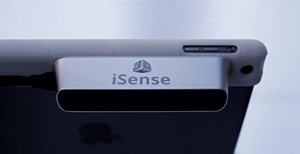 At CES today, 3D Systems introduced an iPad-version of its popular Sense 3D scanner called the iSense. The device clips to the iPad and allows users to scan an object in three-dimensions in real-time, without needing to put the object inside a special scanning box.
The iSense is ideal for physical photography, empowering users to easily capture moments in every dimension. Created for 3DS by Occipital and powered by Structure Sensor technology, iSense can be used on anything and you don’t have to stand still or place an object into a box as required with other 3D scanners. Users simply attach the iSense to an iPad, and they can literally walk around and scan entire objects or environments obtaining a photorealistic copy of the real thing. iSense is powered by the same software as 3DS’ popular Sense scanner.
After scanning an object, users can then transfer the data for editing or duplication via compatible 3D printers. Engadget did an in-depth review of the Sense scanner, the predecessor to the iSense, back in November and found the device to be promising but very much a first-generation product. The site said there is “real potential” for 3D modelers, game developers and the like, but the devices remain very expensive for what they do.
The above video is from the original Sense 3D scanner, not the new iSense. The iSense will be available for $499 in the second quarter of 2014.
Last year, Apple purchased 3D-scanning company PrimeSense, and that company’s Capri sensor enables mobile devices to “see the world in 3D”, a very similar technology to that used in the iSense, though without as much of a focus on 3D printing.
     |
CES 2014: Native Union Shows Off ‘Jump’ Cable/Battery Charger Combo [iOS Blog]
On the CES show floor, Native Union is demonstrating its new Jump accessory, which combines a Lightning cable with an 800mAh battery pack for simple charging and extra battery life on the go.
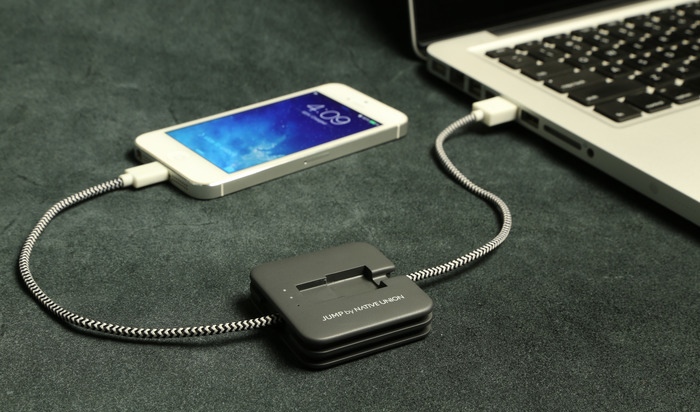
Jump is like standard battery packs, providing battery life to an iPhone, but because it’s also a Lightning cable, the battery portion of the accessory is charged each time the iPhone is charged. This eliminates the need for the battery pack to be charged separately of the iPhone, which is often an inconvenience that requires an entirely separate cable.
The accessory utilizes an AutoCharge circuit prioritization system to detect when the iPhone battery is full, at which point it charges the battery pack portion of the Jump.
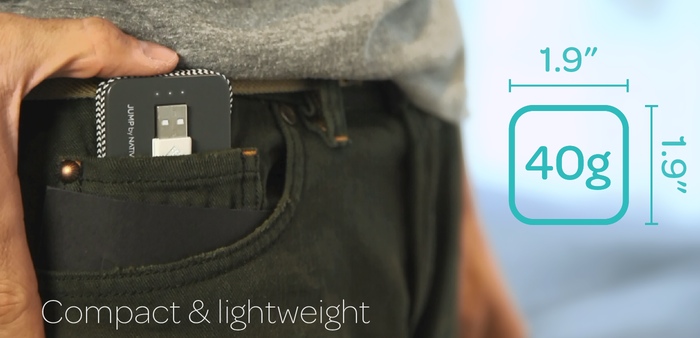
JUMP is not just a charging cable; it also provides your smartphone with a substantial power boost wherever you are, without ever having to remember to charge it. Perfect for work, play, and travel.
Unlike power banks, JUMP charges automatically every time you charge your phone, giving you complete reassurance that whatever situation you are in, there’s always power in your pocket.
Jump is ultra compact (1.9 inches), weighing less than two AA batteries and fitting easily into a pocket. The 800mAh battery pack delivers an extra 1/3 charge, which equates to an additional 3 hours and 50 minutes of talk time or web browsing.
The Jump is currently a Kickstarter project and can be pre-ordered for a $35 pledge. Currently, the project has received just over half of its funding with 36 days to go and will begin shipping to backers in May of 2014 if full funding is reached.
| |

Sprint Spark expands to 11 markets
Sprint today announced that another six markets have started offering Spark LTE speeds. With up to 60Mbps download speed, the tri-band LTE is available in a number Sprint’s recent smartphones. The total footprint, which now stands at 11 markets, sees Texas taking in the lion’s share of new areas.
The six new areas include Dallas, Austin, Fort Worth, Houston, and San Antonio, Texas; Fort Lauderdale, Fla.
These lightning fast Sprint Spark speeds will also be available to Virgin Mobile USA’s Broadband2Go customers once the NETGEAR Mingle Mobile Hotspot touches down. Expected later this quarter, it will provide the same data connections on Virgin Mobile’s Broadband2Go no-contract plans. , which include daily service on Sprint’s 3G/4G LTE networks (where available) for $5/day. Broadband2Go comes in $5/day plans as well as monthly data plans for $25 with 1.5GB or $55 with 6GB. The Mingle connects up to 10 wireless devices simultaneously and works as a dual-mode 3G/4G LTE device.
The post Sprint Spark expands to 11 markets appeared first on AndroidGuys.

Live from the Engadget CES Stage: Scanadu CEO Walter de Brouwer

Health care devices are, once again, all the rage at this year’s CES, and Scanadu’s got one of the more ambitious offerings. The company’s Scout device aims to be a $150 Star Trek-esque tricorder that’ll give users readings for heart and breathing rate, temperature, blood pressure and blood oxygenation levels. We’ve got the company’s founder and CEO Walter de Brouwer to discussion his vision for the future of health care.
Follow all the latest CES 2014 news at our event hub, and check out our full stage schedule here.
Filed under: Peripherals
Setting a course for the future: the best of CES past

Who remembers the CyberGenie cordless phone system from Cygnion? Truth be told: We don’t either. That’s understandable, though, as it came out nearly 15 years ago. While it might seem like this fairly low-tech (by today’s standards) piece of office equipment is a million miles away from what’s on Engadget these days, back in 2000, thanks to its unified messaging features and personalized auto-attendant, the CyberGenie was considered innovative enough to be voted Best in Show at that year’s CES awards. Coincidentally, it’s Engadget that has the honor of deciding which of the thousands of products on display will be worthy of that same title this year. We take a look at a few of the key highlights from the history of CES awards.
Of course, this is quite a responsibility, and with so much new and innovative technology on display, picking the best in each category is challenging. For example, CyberGenie’s ability to notify users anywhere in the world when new voicemail, email or faxes arrived may have excited gadget fans back then, but it’s something that would barely get a mention on a press release today. In this regard, looking back over the history of the CES awards gives a delightful insight into some of the problems we’ve faced in our daily lives, and how technology was employed to solve them.
In 2001, for example, the problem was evidently boredom — as that’s the year that the original Xbox was unveiled at the show. But it was an optical disc — the ill-fated DataPlay format — that went on to snag the top award, before ultimately shuffling off into obscurity. On the other hand, 2005 was all about true HD/1080p. Samsung’s 67-inch HLR6768W TV might look bulky and cumbersome by today’s standards, but nearly 10 years ago, this was probably the nearest you’d get to a wall-mountable full HD set — if your walls were made of meter-thick concrete that is. Samsung’s well-known for both TV and mobile these days, but it was already in the game back then. In 2005, it wasn’t a Galaxy S picking up acclaim; no, it was the snazzy Samsung i730, complete with Windows Mobile 2003, a 65,000-color display and, of course, EVDO/3G. Compare both of those products to current offerings, and you’ll see just how far we’ve come.

Two years after Samsung scooped the top prize, another Korean firm, LG, would get its time in the spotlight. Once again, home entertainment and physical media dominated the show, with the top prize in 2007 going to a machine that ticks about as many CES boxes as you could hope for: the LG BH100 HD DVD and Blu-ray combo player. The BH100 was notable for its ability to play both formats from the same disc tray, but functionality came at a price — an impressive $1,200 price tag. Ultimately, and perhaps unsurprisingly, the hefty price tag wouldn’t be the biggest setback the BH100 faced. The fairly rapid demise of HD DVD soon after would render that half of the deal somewhat limited in appeal, making this one heck of an expensive Blu-ray player. Home cinema and entertainment always feature prominently at CES, but 2007 was an especially viewing-friendly year, as even the winner of the cellphone category was Verizon’s Wireless V Cast TV.

The living room continued as the inspiration for the Best in Show award a year later when Philips took the top title with its Eco TV, but 2008 also reminded us how fickle technology can be. Motorola caused more than a few head-scratches when its Rokr E8, complete with eye-catching design, only offered 2G connectivity, but still won the cellphone category. Meanwhile, iRiver — remember iRiver? — bagged the top spot in the portable media player category with its W7 PMP. While the 480 x 272 display and lack of WiFi might make it seem an unlikely winner, a 3-inch touchscreen media player in 2008 was still something worth talking about.
As this list demonstrates, technology is, by its very nature, transient, or prone to self-cannibalization. A fact no more eloquently proven than by 2009′s Best in Show and People’s Voice Award winner: the Palm Pre. You might think that taking home two gongs would solidify the Pre’s place in the technological zeitgeist of the time, but the historical facts tell a different story. The webOS platform it ran might have been “all new” at the time, and the combination of touchscreen and full QWERTY keyboard certainly could have given it broad appeal, but both are also excellent reminders of how quickly the public’s tastes can change. Both the operating system and the physical keyboard eventually fell into relative obscurity in the years that followed (the former, not least thanks to HP). But of all the items in this article, it’s hard not to see the Pre as the harshest example of technology’s temporary nature. The top-spot spoils between 2010 and 2013, however, were shared between TVs and — for the first time — tablets, showing both a new form factor gaining prominence, and the reliable consistency of home theater wares winning over judges.

While it may seem easy to paint this as a cautionary tale — a long list of since forgotten gadgets — there’s a part of all these award-winning devices that lives on today. Whether it’s the full HD display in your mobile, or the gradual move away from physical formats, or even the ability to notify users anywhere in the world when new voicemail, email (or even faxes) arrive, there’s a little bit of “Best of CES” in everything that surrounds us. And this is, perhaps, the real job that rests at Engadget’s feet in 2014: spotting the features, functions, designs and trends that make a gadget stand out from the rest. Particularly those that will then be adopted, improved upon and ultimately rendered obsolete in the grand silicon circle of life. So, you might be thinking “no pressure, Engadget,” but we prefer to think of it as a responsibility.

Live from the Engadget CES Stage: Lenovo VP Dilip Bhatia

What are Lenovo’s big plans for 2014? We’ve got the VP and general manager of the company’s iconic ThinkPad business line onstage to discuss the place of the laptop and tablet in the ever-changing business world.
January 7, 2014 6:30:00 PM EST
Follow all the latest CES 2014 news at our event hub, and check out our full stage schedule here.
Filed under: Cellphones, Laptops, Tablets, Lenovo
Ford Sync will soon let you order pizza while on the road

Ever wish you could (safely) order pizza while driving home? You’ll have that chance soon. Ford has just announced Sync AppLink support in five apps that could prove handy for many commuters, including Domino’s Pizza. An upcoming version of the eatery’s software will let you dictate orders without taking your hands off the wheel. New editions of Parkopedia and Parkmobile, meanwhile, will respectively help you find and pay for parking. ADT’s Pulse app will verify that your house is safe and sound, and an update to HABU later this month will send mood-setting tunes to the car stereo. It’s not clear just when all of the new apps will be AppLink-ready, but it shouldn’t be long before you’re asking for an extra-large Pacific Veggie while you’re stuck in traffic.
Filed under: Transportation

Live from the Engadget CES Stage: 3D Systems CEO Avi Reichental

The company that helped invent rapid prototyping has been in the 3D printing game for nearly three decades. In recent years, 3D Systems has been making an aggressive play at the consumer market with products like the Cube, CubeX and Sense as one of the driving forces in the desktop 3D printing revolution.
January 7, 2014 7:00:00 PM EST
Follow all the latest CES 2014 news at our event hub, and check out our full stage schedule here.
Filed under: Peripherals

Kazuo Hirai on unifying Sony through Ultra HD and PlayStation Now (video)

Sony CEO Kazuo Hirai left the theatrics at home during his opening day keynote this morning, instead choosing to focus on the company’s vision of the future and his push to unify its disparate divisions. Since he took the reins last year, he’s been preaching a unified approach, something he calls “One Sony.” That approach manifested itself in a collaborative effort to push 4K content, distribution and devices, and, as of today, a new service called PlayStation Now. That service will allow users to stream PlayStation content to gaming devices, tablets, smartphones and Bravia TVs. We met up with Hirai at Sony’s CES booth where he told us to expect more collaboration in the future and, eventually, PlayStation Now on iOS, Android and beyond. For more of Hirai’s plans for the future of Sony, check out our interview after the break.
Filed under: Cellphones, Cameras, Displays, Gaming, Home Entertainment, Software, HD, Mobile, Sony
PlayStation Now actually works! (hands-on)

You’ll excuse us if we didn’t expect PlayStation Now to work so well. It’s a game streaming service, and the history of game streaming services is littered with dead bodies. When Sony spent an unbelievable $380 million on Gaikai, it seemed impossible that the service could ever live up to that incredible sum. While PlayStation Now may not live up to that massive payout, it does, in fact, work. And it works really well.
We got our hands on PlayStation Now today at a CES 2014 PlayStation event, where we tried God of War: Ascension on a Bravia TV (without a PS3) and The Last of Us on a Vita. Both games played like there was a local PlayStation 3 (including the incredibly long initial load for The Last of Us) and ran without a hitch. There was zero perceptible lag in our (admittedly brief) playtime, and we suspect that the internet Sony’s using is of the very strong variety.
The service is set to launch later this month in closed beta, and later this summer on PlayStation 3, PlayStation 4 and Vita. As for mobile devices and Bravia support, that’s expected by years end. Given the relative earliness of PlayStation Now, the UI we saw was non-final (and looked like little more than placeholder art). The same goes for the list of supported titles via streaming — the service will launch with a variety of “marquee PS3 games,” though nothing’s set in stone thus far. We expect the God of Wars and Gran Turismos of the world will be there on day one, but only time will tell.
Beyond full games, there’ll be rental and demo options available through PlayStation Now. But again, none of this is final, and only one facet of PlayStation Now was available for testing here at CES. What we did see was impressive and fulfilled the promises Sony’s made when it comes to game streaming, but there’s a long way to go before PlayStation Now launches this summer.
 AIVAnet