


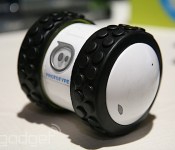
Sphero’s 2B smartphone-controlled toy is quick, easy to control and a lot of fun (hands-on)

We know, we know. Sometimes a poem just doesn’t do it when it comes to a product announcement. Thankfully, Sphero’s new budget 2B rolled into CES Unveiled just in time. The smartphone-controlled toy will retail for $100 when it drops in the fall — that’s $60 less than Sphero 2.0′s current asking price. The company had a handful of models on the floor, and while all of them are prototypes, they worked remarkably well. We got the hang of it from the first moment we picked up the iOS app. It’s responsive and handles a lot better than its predecessor right out of the box, no doubt owing to the slightly more traditional form factor — that is, if you can use a word like “traditional” to refer to a device like this.
Also, in spite of being a prototype, the 2B is pretty rugged, as we found ourselves playing Sphero bumper cars. The rep we spoke with told us that the final version will likely have IR built-in, so multiple 2Bs can interact — and with the lower price point, it’ll be that much easier for people to pick up a couple of devices for their home. The final version will also have more lighting effects built-in. Those nub tires you see are removable, by the way, so you can customize your device. The company was also showing off a 2B rocking smoother tires, which was even faster, with speeds of up to 14 feet a second, a fair bit zippier than the pricier Sphero 2.0.
Filed under: Robots

Samsung’s SmartCam HD DIY security cameras do 1080p video indoors or outdoors

Just in case the NSA isn’t keeping a close enough watch over everything, you can use Samsung Techwin’s latest SmartCams (previously seen in 2012 and 2013) to do your own surveillance. The SmartCam separates from its competitors by recording 1080p video to an internal SD card, and has a version designed to work outside. That means that unlike Dropcam, for example, it’s not constantly uploading video to a remote server for storage and doesn’t require an add-on subscription to work. While that cuts out some of the cloud-based security Dropcam can offer, it combines with Samsung’s compression tech to enable these to use about 30 percent of the bandwidth other cameras require, and still lets owners tap in remotely for a peek whenever they like.
Both connect over WiFi, and can be configured from Android or iOS devices using the SmartCam app and WiFi Direct. Both claim excellent low-light video quality, and while the indoor version has a range of about 16 feet, the outdoor version extends to 50 feet. Beyond its extra viewing range, the outdoor version is ruggedized for the elements, and comes in two parts, keeping the power and WiFi module securely inside your home, connected to the camera outside via a network cable. The SmartCam HD and SmartCam HD Outdoor should hit shelves around March for $179 and $229, respectively.
Dana Wollman contributed to this report.

LG’s latest 84-inch 4K TV breaks cover at CES

Sure, a 105-inch curved, ultra-widescreen TV is LG’s pride and joy at CES 2014, but it’s also brought along a handful of flat Ultra HD televisions along for the ride. We’ve just laid eyes on the 84-inch variant of the 4K (3,840 x 2,160) set and came away fairly satisfied. Sure, the LCD panel isn’t nearly as vivid as an OLED one, but it still manages to handle itself adequately while keeping a thing profile. Hidden from sight is the “Tru-ULTRA HD Engine Pro” chip, which handles upscaling anything SD, HD and “True HD” (read: 1080p) content. The set itself doesn’t have an extravagant stand or frame as is often the case with UHD sets, but its sleek body and pair of thin, side-mounted speaker bars would look right at home in any (exceptionally large) entertainment center. To lay eyes on the panel for yourself, check out the gallery below.
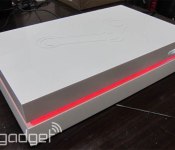
Here are Valve’s 12 Steam Machines partners (so far)

Valve’s Steam Machines initiative is supported by a first-party box that 300 beta users have right now, but 2014 is all about third-party Steam Machines taking that reference box and running with it. Thus far, the only third-party we know of that’s making a Steam Machine is iBuyPower (pictured above) — today, that all changes. Alienware, Falcon Northwest, iBuyPower, CyberPowerPC, Origin PC, Gigabyte, Materiel.net, Webhallen, Alternate, Next, Zotac and Scan Computers are among the first companies signed on to support Valve’s initiative, Engadget learned this afternoon.
The entire lineup will be on display this week at CES 2014, and we’ll have many more details in the coming days. Beyond the dozen companies above, it’s totally possible that there are other third-parties signed on for Steam Machines — we’ll have to wait and see when Valve unveils everything at its press conference tomorrow afternoon.

Up to 150 Ultra HD TV announcements possible at CES

During a pre-CES briefing today, Shawn Dubravac, chief economist for the Consumer Electronics Association, said he “wouldn’t be surprised to see 75 UHD TV announcements” this week. That number could be as high as 150, including hardware rollouts, distribution deals, and more, as manufacturers and programmers begin “coming together to figure out what that’s about,” he said.
While Dubravac said it will be a while before most people upgrade to UHD, he pointed out that, according to CEA research, close to 500,000 UHD TVs will be sold this year, up from just 60,000 in 2013. By 2017, that number could leap to almost 3 million, as consumers upgrade HDTVs purchased in the last decade.
Dubravac is also bullish on 3D printers, and said that about 7,000 square feet of exhibit space will be devoted to the devices at CES this year, and that 99,000 units will be sold worldwide in 2014. Wearable technology is also expected to grow dramatically (as you may have heard), with worldwide smartwatch sales hitting about 1.5 million this year, and ratcheting up to about 4 million by 2017.
Perhaps unsurprisingly, growth in UHD TV is expected to follow a pattern similar to other new technologies, according to Dubravac, with slow early adoption followed by more rapid growth. He compared it to the 3D TV market, which he said experienced 100 percent growth last year. “3D TV has done really well,” he said. “We’ve just stopped talking about it.” He did point out, however, that most people aren’t necessarily buying 3D sets for their 3D functionality. As a feature on higher-end and midrange TVs, “consumers are adopting it by default.”
Filed under: Displays, Misc, Home Entertainment, Wearables, HD

Eyes on with Tobii’s gaming eye-tracking engine and SteelSeries prototype hardware

Tobii’s getting serious about bringing eye tracking to gamers the world over. Days ago, the company announced a partnership with SteelSeries to build a new sensor bar and its EyeX engine meant to bring eye tracking to more games in 2014. Today at CES, we got to see a non-functioning prototype of that SteelSeries hardware (seen in our gallery below) and test out EyeX playing Deus Ex. As a bit of background, the EyeX engine was released a month ago, and using Tobii’s SDK and APIs to implement it, devs can combine gaze controls with regular mouse, keyboard and touchpad inputs to provide new gaming user experiences.
Our demo was a bit rough, given that the game was running at a startlingly low frame rate for some reason, and the device hadn’t been calibrated to our eyeballs due to time constraints. Still, we could see the potential for the technology, as it allows for faster in-game navigation. For example, the EyeX middleware allows for developers to overlay quick menus on top of the game screen at a touch of a button, and you make your selection by merely looking at the icon you want. Additionally, the control for aiming down the sights simply required closing one eye, while squatting or looking around corners was accomplished by moving our head up and down or side to side. In practice, the menu selection was the smoothest and most accurate implementation, while the character movements were far less reliable — they worked in about two out of three attempts. Of course, you don’t have to take our word for it, you can see for yourself in the video after the break.

Cat’s super-rugged B100 is pretty cool for a feature phone

I know, I know, it’s a feature phone. But still, pretty cool as far as these things go. Granted, though, when we played around with the Cat B100, we had to get ourselves back into that pre-smartphone mindset (a phone without a touchscreen? Whaaa?). Like its older sibling, the B15, the B100 is as rugged as you’d expect of a device bearing the Caterpillar branding and a black and yellow color scheme. The B100 feels solid, owing much to its metal sides. The phone can take up to a 1.8-meter drop, and thanks to covered ports, can survive being submerged in one meter of water for half an hour.
In place of the 15′s touchscreen is a large-button keyboard, which you should theoretically be able to operate while wearing work gloves while on the job. On the rear is a three-megapixel camera and flash, along with a large speaker – or you can just open up the headphone jack located on top of the phone. As for availability, well, we know it’s coming to Germany and other parts of Europe this year. No word on if when it’ll be available here, though a rep assured us that more news would be forthcoming on that front later this year.
Filed under: Cellphones, Mobile
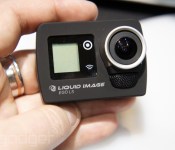
Hands-on with Liquid Image’s LTE-capable Ego LS action cam

Liquid Image revealed its 4G LTE Ego LS action cam just hours ago, so we made a dash to take a look for ourselves. In terms of size, the LS is a bit smaller than the popular Go Pro cams, but there’s no built-in battery and the 1,900mAh cell nearly doubles the thickness of the unit. It’s wrapped in a rather dapper matte black soft-touch coating that gives the gadget a nice feel. On the face, there’s a display for keeping tabs complete with a red light recording and connectivity indicators. There’s a play button up top, with power and connectivity buttons (the cam has both WiFi and Bluetooth options) around to the side. The requisite ports for HDMI, microSD card, USB and connecting to either power, the aforementioned battery or the 4G LTE module lie on the bottom edge.
Meanwhile, Liquid Image has partnered with Verizon for the cellular connectivity bit, which comes at the hands of a clip-in accessory complete with its own 1,900mAh battery to power the streaming. That LTE module will set you back an additional $199 on top of the two hundred bones that Ego LS costs on its own and nearly doubles the size (we’re talking width here) of the action cam alone. For a look at the whole lot, there’s a quick video walkthrough just past the break.
Filed under: Cameras

Weekly Roundup: 2013 in review, NSA iPhone hack, live at CES 2014 and more!

You might say the day is never really done in consumer technology news. Your workday, however, hopefully draws to a close at some point. This is the Daily Roundup on Engadget, a quick peek back at the top headlines for the past 24 hours — all handpicked by the editors here at the site. Click on through the break, and enjoy.

The year in reviews
We reviewed more than 170 products in 2013, but rather than leave you to sift through them yourself, we’ve compiled our most memorable reviews into one simple package. Click on through for more details.

We’re live at CES 2014!
While you’ve been enjoying a restful weekend, folks at Engadget have been hard at work, prepping for the insanity to come. Click the link for a sneak peek of CES 2014.

2013 in review
Engadget takes a closer look at the biggest triumphs, breakthroughs and failures of the year gone by. From the Netflix explosion to the rise of wearables, we’ve got you covered. Click through to take a look.

Mac Pro teardown
Apple products aren’t exactly known for their serviceability, but according to iFixit’s latest teardown, repairing the new Mac Pro is a surprisingly straightforward affair. Click through for details on the repairability score.
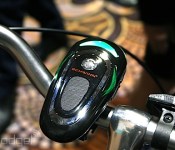
Schwinn’s CycleNav bike navigation system points cyclists in the right direction

When you’re in a car, it’s easy enough to keep an eye on your navigation without moving your hands away from the ol’ 10 and 2 positions, but how do you manage your trips when you’re on a bike? Enter Schwinn’s CycleNav bike navigation system, a $60 Bluetooth device that clips onto your handlebar. The idea is pretty simple: download the product’s iOS or Android app, put in your destination, choose the best route and then let the CycleNav point which way to go, using one of three LED arrows. After your journey comes to an end, the app records fitness stats for you to track (such as distance, calories burned and duration). Fortunately, it doubles as a headlight for your bicycle as well. The navigator will be available at Walmart beginning in March, but you’ll be able to grab the CycleNav starting January 15th.
Filed under: Cellphones, Peripherals, Mobile
 AIVAnet