



PrioVR full-body mocap suit promises accurate motion tracking in VR gaming

Sure, Kinect’s done a bang-up job of bringing full-body motion tracking closer to the mainstream, but it hasn’t exactly fulfilled the dreams of futuristic gaming that Hollywood (and our imaginations) promised. PrioVR, a motion-tracking suit meant for virtual reality games, aims to bring us closer to that future with accurate full-body motion-capture abilities without a camera array in the mix.
The demo on hand today was pretty impressive: A rep was decked out in the upper-body suit, complete with Wii nunchuks, playing a first-person shooter. Sensors on his chest, back, head, arms and hands translated his movements to the screen with little latency, showing up on the display in a fraction of a second. We did notice an ever-so-slight choppiness — which could have more to do with the game engine than the hardware — but how much it affects gameplay remains to be seen. Though only an upper-body rig was being shown off, a full-body getup promises to capture everything from walking to kicking.

YEI Technology, the company behind PrioVR, originally launched a Kickstarter effort late last year, but after only raising $111,237 of its $225,000 funding goal, the firm’s giving the prototype another go, with a new campaign launching on February 14th. The upper-body suit will reportedly go for about $300, while the full-body version will come in under $400. Obviously, this type of tech opens up a world of possibilities for developers, especially when paired with likes of the Oculus Rift and other head-mounted displays. Expect a few compatible games when the PrioVR makes its way to Kickstarter backers this summer, and a proper hands-on as CES continues.
Sarah Silbert contributed to this report.
Filed under: Gaming
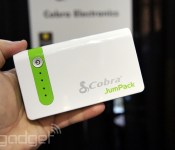
Cobra Electronics demos power pack that can jump-start your car

Cobra Electronics is a big player in the automotive world, largely thanks to its line of radar detectors. What a lot of people don’t know, however, is that the company has also been dabbling with products that jump-start your car. At this year’s CES, Cobra is introducing the JumPack, which it says is a game-changing device for jump-starting — an odd-sounding statement, no doubt, but we have to agree. The 7,500mAh portable JumPack (CPP 7500) looks suspiciously like your run-of-the-mill external smartphone/tablet charger, and it’s the smallest jump-start power pack we’ve come across. It features a 200A starting current and gets up to a peak current of 400A, which is enough to give your car’s battery a few jumps — given that it only takes three to four hours to recharge, it should be more than enough to manage those unfortunate situations in a lonely parking lot. It also comes with a built-in flashlight as well as USB output (2.1A) in case you want to give your smartphone a power boost. When it makes its way to stores in March or April, you’ll be able to pick one up for $130.
Sean Cooper contributed to this post.
Filed under: Transportation
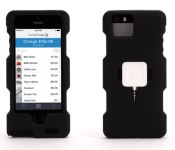
Square and Griffin unveil merchant case at CES, gives sellers a place to store their card readers

Need a place to put that Square card reader when you’re not making the small-business bucks? Griffin has a case for that. Teaming up with Square for CES 2014, the case manufacturer has announced an iPhone 5 case designed specifically for businesses on the go. For the most part, the Merchant Case is little more than your standard durable silicone phone sleeve, but a few minor tweaks make it particularly suited to Square users. The case’s bottom edge, for instance, is designed specifically to hold the reader in place, while also providing a credit-card shaped groove to help glide customer plastic into the Square. The backside of the phone also has a recessed storage area that can hold on to the reader when it’s not in use, making it easier to carry around. The case looks a little bulky, but it does seem to be a simple solution to a simple problem. The cost? $20 on Griffin’s website. Not bad.
Filed under: Misc

New Apple Store in Beijing to Open Friday at China Central Mall [Mac Blog]
Apple is set to open a new retail store in China on Friday, January 10 at the China Central Mall in the Chaoyang District of Beijing, approximately two miles from the existing Sanlitun Apple Store in Beijing.
The China Central Mall is an upscale shopping center with more than 70 shops and restaurants, including stores like Gucci, Prada, and Chanel. It’s also flanked by two major hotels, the Ritz-Carlton and the JW Marriot Hotel.

News of the new Apple Store first surfaced in May of 2013, and according to reports, the store spans 500 square meters over two separate floors. The store opening comes just a week before China’s largest carrier, China Mobile, is slated to begin iPhone 5s and 5c sales.
Apple’s new China Central Mall retail store, its fourth in Beijing, will open at 10 a.m. on Friday. The store has already begun accepting reservations for workshops and Genius Bar appointments.
(Image courtesy of Go Shop Beijing)
     |
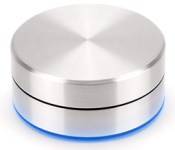
CES 2014: Griffin Debuts ‘PowerMate Bluetooth’ Controller for Mac [Mac Blog]
Griffin today announced a new version of its PowerMate wireless controller for the Mac, bringing wireless Bluetooth 4.0 capability as well a redesigned PowerMate app for easier user configuration.

Like its predecessor, the PowerMate Bluetooth acts as a programmable wireless controller that is designed to replace keyboard shortcuts with twist gestures and clicks. The controller also comes with presets for programs such as iMovie and GarageBand out of the box, as users can add custom commands to any Mac application with the included PowerMate app.

Users can also control the behavior of the pulsing LED on the device to provide system status, and are also able to pair multiple PowerMates through Bluetooth in order to assign specific commands to each.
The PowerMate Bluetooth will be available Summer 2014 for $59.99 through Griffin’s official website and various retailers. 
| |
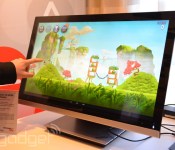
Lenovo trots out a 4K Android-powered all-in-one, with a standalone monitor to match

So Lenovo announced a whole bunch of all-in-ones, you say? You’ll have to be a little more specific than that. In addition to unveiling a trio of Windows-based models, the company announced two more that run Android. These include the consumer-friendly N308 and the ThinkVision 28, a 4K machine destined for the workplace (pictured above). Starting with the consumer model (this is CES, after all), it costs a reasonable $450 and, accordingly, comes with some fairly middling specs — notably, a 19-inch, 1,600 x 900 display and a spinning hard drive with up to 500 gigs of space. That big display aside, you’re basically looking at an oversized tablet, with Android 4.2 installed and a quad-core Tegra 4 SoC running the show. Like other all-in-ones Lenovo’s released over the past year, this one’s portable, with a battery rated for three hours. At 10 pounds, though, give or take, it’s actually a good deal lighter than that other portable desktop Lenovo just announced.
As for the ThinkVision model, it’s crowned by a 28-inch, 3,840 x 2,160 display, allowing you to poke around Android 4.3 at a screen density of 157 pixels per inch. Note that the OS interface is actually upscaled from a 1080p resolution, but we were told that all 4K content is played in its native resolution. Additionally, the machine uses NFC and a “tap to connect” feature to pair devices, though you could also hook them up using one of the four USB ports, three HDMI sockets or the micro-USB connection.
Want the same screen quality, but can do without the NFC and Tegra guts? Lenovo is also selling the ThinkVision Pro2840m, which has a similar 28-inch, 3,840 x 2,160 screen (and a staid, less flexible design). As it turns out, the monitor arrives first, priced at $799 with shipments expected to begin in April. The ThinkVision 28 will follow in July, with prices starting at $1,199.
Richard Lai contributed to this report.
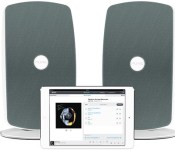
Pure delves deeper into multi-room audio with higher-end Jongo and Evoke systems

Pure first set foot into the multi-room audio space at last year’s CES with its frugal Jongo line; in 2014, it’s targeting slightly more affluent listeners who would otherwise go for Sonos gear. Its $299 Jongo T4 speaker (above) is reaching the US for the first time, and carries enough oomph at 50W to fill a living room. The $229 Evoke F4 (below), meanwhile, is the company’s first internet-savvy radio with Jongo support built-in. There’s also a pair of big software upgrades on the way, including SiriusXM streaming (for subscribers) and a developer kit for third-party app support. Both the T4 and F4 reach the US this later this month, while the software should arrive during the first quarter of the year.

Filed under: Home Entertainment, HD
Source: Pure
LaCie Fuel brings 1TB of wireless streaming storage to your Apple devices for $199

We’re quite familiar with LaCie’s reputation for stellar storage devices, and here at CES 2014, the outfit is expanding its territory. The company has just outed Fuel: a 1TB portable repository for that media library, offering wireless streaming to your Apple arsenal. With no internet connection required, Fuel acts as a WiFi hotspot for on-the-go streaming to iPad, iPhone and Mac (up to five devices or three HD streams at once) while claiming 10 hours of battery life. The peripheral is accessed just like an external drive and — as you might expect — allows file transfers sans cords with Dropbox integration in tow. For times when a cable is absolutely necessary, there’s a USB 3.0 port for handling those tasks. Streaming stored media on those mobile devices is sorted via the Seagate Media app and the unit plays nice with AirPlay-compatible devices and Apple TV. In a spot with connectivity? Fuel will allow you to share it with that handful of gadgets as well. If all of that sounds too good to pass up, you can snag one when they hit shelves “soon” for 200 bucks.
Filed under: Home Entertainment, Storage, HD

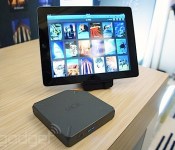
Lenovo’s Beacon media hub can house up to 6TB of video and photos, streams to PCs and Android devices

Lenovo makes a lot of laptops. And tablets. And a few phones. But amid its exhaustive PC range, there’s also the eye-catching Beacon. Priced at $199, although lacking any storage out of the box, it tries to strike a balance between personal cloud storage and media server. It comes preloaded with XBMC, while dual HDD bays will support up to a heady 6TB of storage. The Beacon, powered by a dual-core (unspecified) Atom processor can then stream whatever you put inside it to multiple devices at once — we saw it in action, and it managed to output to both a PC and Android phone without a hiccup. You can use your hand-held smart device as a remote (replete with mouse cursor), which makes digging through piles of photos and videos at least a little bit easier.
On the back, alongside HDMI, there’s Ethernet and twin USB ports, meaning it’ll be happy to link up to PCs and TVs for big-screen viewing. Once linked to the respective app, pics and videos captured on your phone can be automatically (or manually) uploaded. As you can see, it’s also not the typically unassuming (read: dull) storage hub either and will launch in orange, blue, gray and black finishes this April.
Richard Lai contributed to this report.
Filed under: Cellphones, Home Entertainment, Tablets, HD, Lenovo
Dish’s ‘Virtual Joey’ is a streaming app for smart TVs that takes the place of a set-top box (video)

Assuming you’re not a home-theater gear head, we’ll start this post by giving you a quick history lesson. Back at CES 2012, Dish Network announced a whole-home DVR setup, including the Hopper DVR and a multi-room extender, called the Joey. Then, at last year’s CES, Dish introduced a version of the Hopper with Sling built in, allowing you to send both live and recorded shows to a mobile device. This year, Dish is turning its attention back to those Joey boxes except, well, it doesn’t necessarily have any hardware to show for it.
The company just announced the “Virtual Joey” a smart TV app that will come built into select LG televisions, and which will take the place of a physical Joey extender. To be clear, you’ll still need a Hopper DVR to anchor the whole experience, but this would at least mean you have one less piece of hardware taking up space in your house. According to company reps, the app will come to 2013 and 2014 LG smart TVs, though it’s working to ink deals with other manufacturers as well. We hope to get an in-person demo here at CES, so hang tight for some hands-on!
Filed under: Home Entertainment, HD, LG
Source: Dish
 AIVAnet