


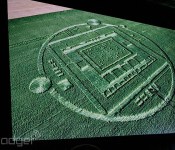
NVIDIA seriously made a crop circle for marketing its new Tegra K1 chip

You know that new NVIDIA Tegra K1 chip? And you know that crop circle that popped up and then disappeared? Yup, that was an advertisement for the new chip. Yes, seriously.
Filed under: NVIDIA
Source: NVIDIA Blog
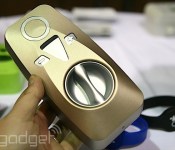
Okidokeys gives you more options than you could ever possibly need to open your front door

We first got word of the Okidokeys smart lock system roughly an hour ago, and just now got a chance to see the thing in action – well, we got a chance to see it in various states of disarray on a table at tonight’s CES Unveiled event. The primary module hooks up to the lock on the inside of door, with no trace of the mechanism visible from the outside. Trigger it via your mobile device and it rotates to unlock the door. There’s also a large button you can use to unlock it sans smartphone from the inside. The system starts at $179.
There’s also a bundle priced somewhere in the mid-$200s, which will get you an RFID reader. The reader doesn’t attach directly to the module, so you can put it anywhere on the exterior of the house to unlock via a bracelet or card you keep in your wallet. Or, if you’re so inclined, you can still use your old fashioned key. Using the Android or iOS app, you can also unlock the door remotely and grant access to users. The sets are available for pre-order now, with shipping set for spring. The company was also showing off a garage door module that works with its proprietary app. No word on pricing for that yet.
Filed under: Household

CES 2014: Keep Track Of What We’re Seeing At CES Via Our Social Media
 The International Consumer Electronics Show (CES) 2014 has not officially started yet, but our team has already been on the floor at CES Unveiled getting an early preview of just a few of the things to expect over the next few days. Since most of our team is here in Las Vegas to cover CES 2014, we might not always have the time to complete full articles, but if you follow us on our social media outlets, we’ll definitely be making an effort to put up what we can when we can.
NVIDIA announces 192-core K1 processor in 32 and 64 Bit Versions
 NVIDIA had a late little press conference this evening and certainly bringed the rain with their announcement. They unveiled the new Tegra K1. The new chip is a 192-core super chip that features the same NVIDIA Kepler architecture that that powers the NVIDIA GeForce GTX 780 Ti . It is some serious power. Check out the press release below.
NVIDIA Unveils Tegra K1, A 192-Core Super Chip That Brings DNA Of World’s Fastest GPU To Mobile
Kepler GPU Architecture in GeForce GTX 780 Ti Morphs Into Mobile Graphics Powerhouse; Available in 32- and 64-Bit Versions
LAS VEGAS, NV – CES – NVIDIA today unveiled the revolutionary Tegra® K1 mobile processor, a 192-core super chip featuring the same NVIDIA® Kepler™ architecture that powers the fastest GPU on the planet, the NVIDIA GeForce® GTX™ 780 Ti. For the first time, next-generation PC gaming will now be available on mobile platforms.
The Tegra K1 processor sets new mobile standards by supporting the latest PC-class gaming technologies, enabling it to run sophisticated gaming engines like Epic Games’ Unreal Engine 4. It delivers advanced computation capabilities to speed the development of applications for computer vision and speech recognition. And its extraordinary efficiency delivers higher performance than any other mobile GPU at the same power level.
“Over the past two decades, NVIDIA invented the GPU and has developed more graphics technologies than any other company,” said Jen-Hsun Huang, co-founder and CEO, NVIDIA. “With Tegra K1, we’re bringing that heritage to mobile. It bridges the gap for developers, who can now build next-gen games and apps that will run on any device.”
Tegra K1 is offered in two pin-to-pin compatible versions. The first version uses a 32-bit quad-core, 4-Plus-1™ ARM Cortex A15 CPU. The second version uses a custom, NVIDIA-designed 64-bit dual Super Core CPU. This CPU (codenamed “Denver”) delivers very high single-thread and multi-thread performance. It is based on the ARMv8 architecture, which brings the energy-efficient heritage of ARM processor technology to 64-bit computing.
Both versions of Tegra K1 deliver stunning graphics and visual computing capabilities powered by the 192-core NVIDIA Kepler GPU. The 32-bit version is expected in devices in the first half of 2014, while the 64-bit version is expected in devices in the second half of the year.
Simply Unreal:Setting Stunning New Gaming Standards
Tegra K1 provides full support for the latest PC-class gaming technologies — including DirectX 11, OpenGL 4.4 and tessellation. These capabilities will enable PC and console game developers to finally bring their stunning, visually rich titles to mobile devices.Such features enable Tegra K1 to run the world’s most advanced game engine, Unreal Engine 4. Unreal Engine is the most successful commercially licensed game engine, powering hundreds of games on high-end PCs and consoles.
Tegra K1 is also the first mobile processor to deliver the same graphics features as the next generation of consoles (Xbox One, PlayStation 4) and faster performance than current generation consoles (Xbox 360, PlayStation 3), all in the palm of your hand.
“With the introduction of this revolutionary processor, we can take applications that run on PC or console and run it on Tegra,” said Tim Sweeney, founder of Epic Games and developer of Unreal Engine. “From here onward, I think we’re going to see the performance and feature gap between mobile and PC high-end gaming continue to narrow to the point where the difference between the platforms really blurs.”
Computationally Advanced:Delivering New Creative Capabilities
Tegra K1 is the first processor to bring advanced computational capabilities to mobile — leveraging its advanced GPU to deliver new mobile experiences.It is also the first mobile processor to support NVIDIA CUDA® — the world’s most pervasive parallel computing platform. Developers have downloaded CUDA more than 2 million times to create cutting-edge GPU-accelerated applications for computer vision, advanced imaging, speech recognition, video editing and more.
Stunningly Efficient: Establishing New Benchmarks
In addition to its graphics and compute capabilities, Tegra K1 delivers breakthrough efficiency. The Kepler GPU at the heart of Tegra K1 is 1.5 times more efficient than other mobile GPUs. This results in faster performance in the same power envelope and a better experience for gaming and GPU-accelerated applications.(1)Kepler – first introduced in desktop and notebook systems, and later brought to workstations and supercomputers — is the world’s fastest and most energy-efficient GPU architecture. Tens of millions of Kepler-based graphics cards and systems have been shipped, including theGeForce GTX 780 Ti.
“Kepler powers all 10 of the world’s most energy-efficient supercomputers,” said Linley Gwennap of the Linley Group. “By scaling this technology down, NVIDIA has set the new standard for what’s possible in mobile devices.”
More details about the Tegra K1 are available at www.nvidia.com/object/tegra-k1-processor.html.

To Keep Current on NVIDIA:
- Like NVIDIA on Facebook.
- Connect with NVIDIA on LinkedIn.
- Follow @NVIDIA on Twitter.
- View NVIDIA videos on YouTube.
- Keep up with the NVIDIA Blog.
- Use the Pulse news reader to subscribe to the NVIDIA Daily News feed.
ASUS Padfone X Announced for AT&T Tomorrow? [CES 2014]
ASUS Padfone X launching for AT&T tomorrow.
— @evleaks (@evleaks) January 6, 2014
ASUS has been teasing us like crazy with their little brief videos, with the date of their CES 2014 live stream. Obviously this just means they have new devices that are going to be unveiled, and not too long ago, the ASUS Padfone X showed up in a benchmark. Now it seems that leak king, evleaks, has confirmed that they will announce the Padfone X, and that it will be exclusively for AT&T. He is usually right about leaked information, but we will have to wait until tomorrow to see if he is right. We will try to keep you posted on what is unveiled tomorrow at their event.
Source: @evleaks

How would you change Amazon’s Kindle Fire HD (7-inch)?

Amazon’s second-generation Kindle Fire arrived with a revamped design, excellent display and stereo sound. For all of these plus points, however, our reviewer’s single objection was the same that it’s always been. The Kindle Fire is less of a tablet and more of a Trojan Horse, a way to keep the Amazon catalog sandwiched between your hands at all times. If you can ignore that issue then it’s a perfectly fine device, albeit one that couldn’t topple the first-generation Nexus 7 as our Android tablet of 2012. The question, therefore, is what did you think of the Kindle Fire HD? Head on over to our forum and speak your brains.
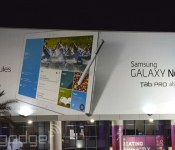
Samsung ad outs Galaxy Note Pro and Galaxy Tab Pro ahead of CES

In the days leading up to CES, there are always a few unfortunate products that are prematurely outed by banners being put up over night. In this case, the victims are Samsung’s upcoming Galaxy Note Pro and Galaxy Tab Pro, as shown by this massive ad at the South Hall of Las Vegas Convention Center. Stylus and SIM card slot aside, it’s hard to tell what else the pictured Galaxy Note Pro has to offer. Its screen size is also a mystery here, though rumors are pointing at 12.2 inches, which would make it Samsung’s largest mobile tablet to date. According to an earlier report by SamMobile, the Galaxy Tab Pro will come in two smaller sizes: 8.4 inches and 10.1 inches. All shall be revealed at Samsung’s press conference in Las Vegas tomorrow afternoon, so stay tuned.

NVIDIA announces Tegra K1 with 192 cores and Kepler architecture

In what’s becoming a yearly tradition, NVIDIA came to its CES press conference with tidings of its next-generation mobile processor which will begin gracing devices in 2014. The chipset maker officially announced Tegra K1, the first 192-core processor based on the Kepler architecture. As you can imagine, NVIDIA is bringing its graphics chops to the new chip, and it packs a serious punch — so much so, in fact, that it will come with support for Unreal Engine 4. In the company’s usual form, we were treated to demos of the new chip’s power compared side-by-side with a Tegra 4, and the difference was quite noticeable; the K1 offers real-time computing, global illumination, higher dynamic range and greater detail like reflective surfaces, dripping water and other realistic physically-based rendering.
Developing…

NVIDIA K1 chip adds Unreal Engine 4 support

The Unreal Engine’s latest iteration, Unreal Engine 4, is adding support for NVIDIA’s latest Tegra chip, the K1. Epic Games’ ubiquitous engine powered much of last-generation games with Unreal Engine 3, and Epic’s promising even more with the next generation. NVIDIA CEO Jen-Hsun Huang announced as much tonight during the company’s CES 2014 press conference, and he made sure to note the much shorter gap between Unreal Engine running on next-gen consoles/PC and mobile devices.
With Unreal Engine 3, Infinity Blade was the first mobile game running on Epic’s game tech — demonstrated on-stage during an Apple keynote for a new iPad. Unreal Engine 4, however, scales both up and down right out of the gate, apparently. “We can take absolutely anything that runs on PC or high-end consoles and run it on Tegra…I didn’t think that we’d be at this level on mobile for another three to four years,” Epic Games head Tim Sweeney said of the news. Color us unsurprised — we expect to see Unreal Engine 4 running on anything that plays games in the coming years.

Here’s a WiFi-enabled Russian Doll that’s designed to replace your mother

When doom-mongers portend that technology is destroying human relationships, plenty of ‘em will use this as exhibit one. Mother is the brainchild of Rafi Haladjian, the mind behind the Nabaztag, and is a device designed to monitor the objects, creatures and people in your home. The white plastic Russian Doll connects to a series of sensors, called cookies, that measure motion and temperature, and will alert you when it notices a change. For instance, if you strapped a cookie to the door where your meds are kept, but one day forgot to open it when you were due, the device would nag you until you remembered — just like your own mother.
Of course, that’s a reasonably simple example, and the company has cooked up 14 different ways in which the cookies can be used to monitor your home. Another example is if you strapped a cookie to your door, Mother will send an alert and make a noise every time it’s opened — which is useful when you’re on holiday and worried about unwanted intruders. Speaking of which, the cookies themselves can be used for up to a year before you have to replace them and you can connect up to 24 at one time — but be warned, buying and replacing those things can be pricey, as it’s $99 for four. The Mother hardware reminds us a little of Eve from Wall-E, although its facial expressions are limited to blinking to show that its connecting to WiFi. It’ll begin shipping between February and March, with one Mother and four cookies retailing for $222.
Jamie Rigg contributed to this report.
Source: sen.se
 AIVAnet
