


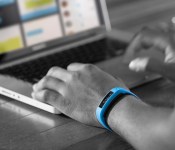
Garmin takes on Fitbit with Vivofit, a fitness band that nags your weight away

Garmin’s been doing the workout thing for a while now in the form of those big fitness-tracking watches. In celebration, no doubt, of the many miles we’ll all be walking this week in Vegas, the company’s edging in on Fitbit territory with the Vivofit. The band’s got a curved display that’ll greet you each morning with a daily goal based on your activity level, adjusting accordingly as you hit different milestones. Given Garmin’s area of expertise, it’s only natural that the device also tracks your progress, including distance, steps and calories — it’ll also send you a friendly reminder when it’s time to get off your butt. The Vivofit arrives in Q1 of this year, priced at $130.

Dolby Vision imaging finally comes home this fall with Netflix and Xbox Video as partners

Dolby’s TV image-enhancement tech has been in development for a long time, and today the company is finally ready to show you when and where you’ll find it. What we saw in December has been graced with the Vision name, and the outfit has promised we’ll see TVs with it baked in this fall. What’s more, Sharp and TCL have compatible hardware on display in their respective CES booths this week, and Amazon, Netflix, VUDU and Xbox Video are stepping up as content providers. Hit the Dolby link below for more information, and be sure to check back later this week for our latest impressions.
Filed under: Gaming, Home Entertainment, HD
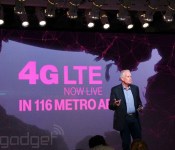
T-Mobile promises better coverage after spending $2.4 billion on spectrum from Verizon

T-Mobile has just made a big move to improve its coverage by purchasing a large swath of 700MHz A-Block spectrum from Verizon for nearly $2.4 billion in cash. T-Mob — which has been in a buying mood lately — said the deal will will help improve its coverage for 158 million people in 21 of the top 30 US markets, including New York, LA, Atlanta and Dallas. The so-called low-band spectrum has a greater range than more common high-band frequencies, which will be particularly useful for T-Mob in the surrounding areas of large cities. As part of the deal, it’ll also transfer $950 million worth of spectrum to Verizon in several markets, mostly in northern California and Atlanta. Don’t get excited about having better 4G coverage just yet, though — the deal’s still subject to regulatory approval from the FCC and DoJ, which could take some time.
Filed under: Wireless, Internet, Mobile, Verizon, T-Mobile
Via: Business Insider
Source: T-Mobile

Nintendo forced to pay a share of every 3DS sale to another company

While Nintendo’s Wii U console sales may continue to frustrate, its handheld gaming business offers hope of a better future. But even as its 3DS and 3DS XL consoles continue to outsell their rivals, Nintendo will have to come to terms with sharing a percentage of each sale with another company. In December, the company was told it must pay 1.82 percent of the wholesale price of each 3DS sold after it was found guilty of infringing on patented camera technology owned by Tomita Technologies. It means that Nintendo could pay up to $3 for each unit, for as long as it continues to sell the console. Given it sold 2 million 3DS and 3DS XLs last quarter, putting the current lifetime total at 35 million, demand for the handhelds is still strong. Nintendo’s already paid Tomita a $15 million damages award, but it faces the prospect of sending Tomita smaller payments well into the future.
Via: Kotaku
Source: Law 360
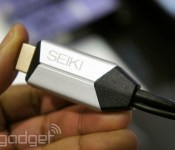
Seiki U-Vision HDMI cable promises to squeeze 4K upconversion out of 1080p video

Known for suddenly coming on the scene last year with some of the cheapest Ultra HD televisions around, Seiki is getting into the accessories game with its new U-Vision HDMI cable. The $40 HDMI cable packs Technicolor 4K-certified video processing that it claims promises the best edge restoration, noise reduction and other tweaks available, all performed by the USB-powered Marseille Networks VTV-1222 chip within. While we usually prefer that our signal pass to the TV unaltered, so far Seiki’s UHD TVs haven’t proven to pack the most sophisticated scalers within. Also helping its case are industry darlings like the Darbeevision Darblet that many are using to improve the quality of their HD video on passthrough. We saw the cable in action and while the demo seemed clean, the demo reel didn’t give us much of an opportunity to compare what it was actually doing. The cable will go on sale sometime in the first quarter of this year, and arrive as an adapter in Q2.
Dana Wollman contributed to this report.
Filed under: Displays, Home Entertainment, HD
Source: Seiki

NPR receiver gets closed-captioned radio emergency alerts for the hearing impaired

I’ll be the first to admit that I had a little trouble wrapping my brain around this one, but I think I’ve got it now. Sure the appeal of closed-captioned radio for the hearing impaired is clear, but what wasn’t immediately apparent was why, precisely, one would want a standalone box for such information if you could potentially get it just as easily through, say, the station’s website. This first iteration (which is very much still in the proof-of-concept phase) is intended for emergency relief organizations like FEMA and NPR and its partners are currently testing it out in the Gulf states. The box uses a tablet as a display, getting emergency information through the radio spectrum, so you can use it when the power is out and your WiFi isn’t working — assuming you’ve still got juice in your tablet, which powers the box.
At present, those emergency alerts are the only thing that are currently closed captioned, though NPR is aggressively looking at captioning most or all of its programming, so you could theoretically get the text narration through the box or through the public radio network’s site. Future iterations of the receiver will also be a fair bit smaller, perhaps eventually being built into radios with displays, so hearing-impaired public radio fans can still get their Terry Gross fix.
Nicole Lee contributed to this report.
Filed under: Portable Audio/Video
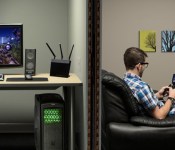
NVIDIA certifies PCs and routers that can stream games to its Shield handheld

If you’ve ever tried to stream a game from a PC (or PS4) to a mobile device over WiFi, then you’ll know the bandwidth requirements can be quite fussy. Attempt to remote play at 1080p and 60 frames per second, as NVIDIA promises with its Shield handheld and recently upgraded GameStream service, and things start to get seriously pinnikity. So, to help you pick the right hardware to go with your Shield (which is now going for $250 at Amazon, by the way), NVIDIA has started a certification program to label PCs and routers that are GameStream-ready. Expect to see the green logo on pre-built machines from the likes of Digital Storm and Maingear that have the necessary GeForce GTX graphical guts, as well as a number of dual-band and wireless-AC routers from ASUS, Buffalo, D-Link and Netgear. (You’ll find a full and current list of certified products over at the source link). Compatible routers will also support streaming from the cloud, via NVIDIA’s alternative GRID service, although of course you’ll also need a steady 10Mbps broadband connection before you even think about trying that.
Filed under: Desktops, Gaming, Handhelds, Mobile, NVIDIA
Via: IGN
Source: NVIDIA GameStream-ready products

SteelSeries ‘Stratus’ Wireless Gaming Controller Now Available for Pre-Order
Following the release of the Logitech Powershell and MOGA Ace Power, gaming peripheral company SteelSeries today announced its Stratus iOS 7 gaming controller. Unlike the other two controllers, the Stratus is a completely wireless accessory that connects through Bluetooth instead of using the Lightning port on an iOS device.

Featuring console-style controls such as a directional pad, two analog sticks and four pressure sensitive face buttons, the Stratus’ Bluetooth capabilities allows connectivity for up to four controllers. The device also includes a protective cover that doubles as an extended grip.
Our sister site TouchArcade had the opportunity to spend some extended time with the SteelSeries Stratus, and has provided a detailed review outlining the strengths and weaknesses of the controller. While the device was given high marks for being useable with any iOS 7 device and an impressive battery life of over ten hours, criticisms centered around the high price tag and the comfort issues that the controller’s small design creates. Despite those criticisms, TouchArcade stated that the SteelSeries Stratus is “without a doubt the best controller out there.“
Another positive aspect of the SteelSeries Stratus was its ability to work well with Apple’s Lighting Digital AV Adapter while gaming:
Also, obviously, this begins to open the door to the strange new world that is treating your iPhone like a portable game console hooked up to your TV. You could technically do this with the Moga Ace Power and Logitech Powershell, but it required beaming your video output via AirPlay, which arguably is the least ideal of all possible solutions given the significant amounts of nearly unplayable lag AirPlay introduces. Wiring your iPhone or iPad direct to your TV via the Lightning Digital AV Adapter significantly mitigates this.
Currently, games such as Dead Trigger 2, Asphalt 8: Airborne, and Bastion offer controller support, with additional developers pledging to build controller support into their apps now that the hardware is available to consumers.
The SteelSeries Stratus sells for $99.99 and is available now for pre-orders.
     |

Google to bring Android to cars with a little help from Audi, GM, Hyundai, Honda and NVIDIA

Already with more than one billion activations on mobile and media devices, Google’s Android is set to make an impact on another major industry: automobiles. Following rumors that the search giant was working with Audi to embed its open-source OS inside its cars, the company confirmed today it has teamed up with five automotive and technology companies (with more expected in the future) to form the Open Automotive Alliance. Alongside Audi, Google will be joined by General Motors, Hyundai, Honda and chip-maker NVIDIA, which will all work to bring Android to cars starting this year. The coalition aims to create a common platform that will drive innovation and in turn make cars “safer and more intuitive for everyone.” With Apple and Nokia already pushing hard to bring their own software to cars — Apple already counts Honda, GM and Hyundai as Siri Eyes Free partners — 2014 could be a big year for connected cars.
Filed under: Transportation, Software, Google
Source: Open Automotive Alliance
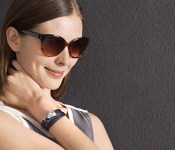
Netatmo reveals designer bracelet that helps to protect your skin from sun damage

Netatmo’s adding a dash of fanciness to this year’s parade of wearable announcements at CES. The firm, known for its thermostat and weather monitor, unveiled the June bracelet: a wrap around piece of arm candy with a gem stone-like sensor that measures sun exposure. Since it was designed by Louis Vuitton and Harry Winston collaborator Camille Toupet, it looks a lot chicer than most wearables out there. The downside, however, it that it doesn’t have its own display. Instead, it syncs with an iOS app, which not only displays how much sun you’re getting, but also tells you what SPF number your sunscreen should have and when to wear shades or a hat. When it starts shipping in the second quarter of the year (or so the firm hopes), it’ll come with a $99 price tag and will be available in platinum, gold or gunmetal. That sounds expensive for something that fills an extremely specific niche, but if you usually pay more than that for jewelry, we imagine it might be a worthy investment.
Filed under: Peripherals
Via: Mashable
Source: Netatmo
 AIVAnet