Google posts latest Q4 and full year 2014 earnings

Google has just posted their most recent Q4 and full year 2014 financial reports, following the likes of Samsung, LG and LG Display. The search giant managed to pull in $66 billion in 2014, up 19% year over year. In Q4 alone, the company made $18.1 billion, which is a 15% increase from Q4 2013. Net income for Q4 2014 is up $4.76 billion from $3.38 billion the year prior.
Sites owned by Google generated $12.43 billion in Q4, which is 69% of the company’s total revenue. Site revenue from Q4 2013 only came out to $10.54 billion, which makes is an 18% increase year over year. Google’s partner sites generated $3.72 billion, which is 20% of the company’s revenue in Q4. The vague ‘other revenues’ section made $1.95 billion in Q4, making up 11% of the company’s revenue. While the earnings report doesn’t give much information on the ‘other revenues’ section, this is the part that includes Google Play. This section saw a 19% increase year over year, and a 6% increase from Q4 2013. Last but not least, the company’s revenue from outside of the US brought in $10.23 billion, which represents 56% of their Q4 2014 earnings.
Google closed the sale of Motorola to Lenovo on October 29th, 2014. Not including taxes, that sale resulted in a gain of $740 million. Android is a huge part of what Google makes from year to year, and while we don’t have any financial statistics on that, we do have a report from earlier today explaining just how many Android phones we sold in 2014. Over one billion Android smartphones shipped last year, making up a massive 81% of all smartphone shipments. Also during the conference call, Google CFO Patrick Pichette admitted to the company not being able to keep up with stock for the Nexus 6.
Chrome Beta 41 for Android adds pull-to-refresh in pages
If you like running at the forefront of developments then no doubt you’re interested in the Beta channel for Chrome. An update just got pushed to the Play Store bringing the version to build 41.0.2272 that adds a nice little pull-to-refresh feature in webpages.
All you have to do is pull down the webpage and the animation will appear to refresh the page – very akin to what we’ve seen in apps like Twitter for a long time.
You can grab the new update and Chrome Beta from the Play Store below.
The post Chrome Beta 41 for Android adds pull-to-refresh in pages appeared first on AndroidGuys.

Exclusive: NASA recaps Project Tango-equipped Smart SPHERES, hints at next-generation of free-flying robots

Back in July of last year, crew members aboard the International Space Station (ISS) received a very special payload of devices from Google’s Advanced Technologies and Projects team. The prototype devices, codenamed Project Tango, were meant for NASA’s microsatellites, the SPHERES, that have been accompanying the astronauts on their voyage around the planet since 2006.
I recently had the incredible luxury of corresponding with Maria Alberty of the Ames Research Facility, the group inside of NASA in charge of overseeing the SPHERES and their experiments, with the goal of revisiting Project Tango’s involvement with the SPHERES and adding to the continuity of Talk Android’s reporting on this milestone.
Last year, Talk Android’s Jared Peters and Jeff Causey had reported on the events leading up to the Google prototypes being delivered to the ISS (which you can view here and here for some great back-story), with Brendan Lynch delivering the most recent article discussing Project Tango’s upcoming departure to the space station. It was from their work and my own personal interest that most of my knowledge of the whole Project Tango affair was derived.
It was not enough. Poor Maria really had to get me on the same page before we could even start discussing Project Tango…
Maria initially guided me, gently, through the background of what SPHERES are and what they are after a device, like the Project Tango prototype, is added (dubbed “Smart” SPHERES).

The microsatellites called SPHERES (an acronym for Synchronized Position Hold, Engage, Reorient, Experimental Satellites) are, as NASA describes them, bowling-ball sized instruments that provide a test-bed for research and development in the field of multi-body formations, flying, multi-spacecraft control algorithms, and free-flying physical and material science investigations. These satellites are used as a platform for these experiments inside the unique environment offered in the ISS.
These SPHERES are, as Maria says, self-contained. They each have their own units of power, propulsion systems, basic computers, navigation equipment, and adapters and ports that allow researchers to upgrade them to test specific investigations.
[SPHERES] are used inside the space station to test a set of well-defined instructions for spacecraft performing autonomous rendezvous and docking maneuvers. Basically SPHERES can act alone, or with the addition of other hardware mounted to SPHERES act as a free-flying platform that is capable of accommodating varying mounting features and mechanisms in order to test and examine the physical or mechanical properties of materials in microgravity.
It’s these adapters that allowed SPHERES to have their first taste of being “Smart”. In 2011, on the final flight of the Space Shuttle Atlantis, NASA rocketed up a Google Nexus S (designed by Samsung) to be plugged into the SPHERES. The Nexus S was the first commercial smartphone to be approved for use and to fly aboard the ISS.
D.W. Wheeler, lead engineer in Ames’ Intelligent Robotics Group, said at the time: “By connecting a smartphone, we can immediately make SPHERES more intelligent. With the smartphone, the SPHERES will have a built-in camera to take pictures and video, sensors to help conduct inspections, a powerful computing unit to make calculations, and a Wi-Fi connection that we will use to transfer data in real-time to the space station and mission control.”
Jumping ahead to the summer of 2014, the Ames Research Facility created a new breed of Smart SPHERES by upgrading them with the Google Project Tango prototype.

As was covered in the media, researchers for the Project Tango-equipped Smart SPHERES set out with the goal of investigating the effects of giving the SPHERES three-dimensional awareness via the prototype’s 3D sensor capable of creating a three-dimensional model of its environment.
Initially, NASA researchers had hoped that the upgraded Smart SPHERES would pave the way for a series of tasks that could be delegated out to the SPHERES. Mostly housekeeping-type tasks, the researchers envisioned video surveys for safety audits, noise level measurements, and air flow and quality assessments, all of which must be routinely performed by the ISS crew members.
While not divulging specific experimental results, both past or ongoing, of Project Tango’s involvement with the SPHERES, Maria did state that the current batch of Project Tango Smart SPHERES would be succeeded by next-generation free-flying robots.
The Project Tango experiment was the last test session of “Smart SPHERES”. During the past three years, “Smart SPHERES” has provided valuable engineering data regarding the use of a free-flying robot on the Space Station. Based on this data, NASA has started developing a next-generation free-flying robot, which will be deployed in 2017-2018.
She went on to reiterate that the next generation of robots are a new project of Ames, implementing the data and analyses garnered from Smart SPHERES. These robots are still in the preliminary research phase.
So what could the Ames Research Facility be cooking up next? We’ll have to wait and see, but Maria did indicate that, up until this point, Google has not had any involvement with Ames’ use of Project Tango.
For me, it’ll be a tough two years while I wait to see what Ames assembles with the Smart SPHERES data. In the meantime, I’ll just have to satisfy myself with all things related to the New Horizons spacecraft. What can I say, I love space-dwelling robots!
Come comment on this article: Exclusive: NASA recaps Project Tango-equipped Smart SPHERES, hints at next-generation of free-flying robots

Google Play is greater in downloads but the App Store is where the revenue is at

Given the fact that Android hold a whole lot of market share and the massive amount of Android phones there are, it shouldn’t shock anyone that Google Play sees a whole hell of a lot more download activity than that of the App Store. You would think that because of this massive amounts of downloads the revenue would be greater, that’s were we would be wrong. It appears that revenue generated from the App Store far exceeds that of Google Play by more than 60 percent.
According to analysis by App Annie, both experienced considerable growth last year with the App Store revenues growing by more than $10 billion overall. The analysis also suggested that most of these revenues came from the US, Japan and South Korea. It also found that men were more likely to download gaming apps while women downloaded more social networking and photo apps.
To come up with these numbers App Annie analyzed data from over 90 of the top 100 app publishers with that information coming from more than 700,000 apps.
source: TUAW
via: Phone Arena
Come comment on this article: Google Play is greater in downloads but the App Store is where the revenue is at

French law would make Google and Facebook ‘accomplices’ to hate speech

France is eying new laws that would make the likes of Facebook and Google accountable for hosting extremist messages. As Bloomberg tells it, the new talk is a direct response to terrorist attacks from earlier this month, and should the draft law pass, it’d make online entities “accomplices” for hosting hate speech or terrorism sites. French president François Hollande addressed the sharp increase in terrorist recruitment over the internet, saying:
“We must act at the European and international level to define a legal framework so that Internet platforms which manage social media be considered responsible and that sanctions can be taken.”
Speaking at an event marking the 70th anniversary of the Holocaust, President Hollande also called on social networks to stop the spread of anti-Semitism and other forms of hate speech. He asked, “how in 2015 can we accept the need for armed soldiers to protect the Jewish people of France?” Like Canada and other nations, France has strong laws against Holocaust denial, racist statements and other forms of hate speech.
French Interior Minister Bernard Cazeneuve will soon travel to the United States to meet with Facebook, Google, Microsoft and Twitter and get their help in the matter preemptively. As The Verge points out, however, France will reportedly also ask internet companies for greater cooperation with law enforcement, which some fear could curtail privacy and lead to a European version of the Patriot Act. That means it may prove a tricky act for the Gallic nation to balance security with the EU’s strong privacy rules.
Steve Dent contributed to this report.
[Image credit: Getty Images]
Filed under: Internet, Microsoft, Google, Facebook
Via: The Verge
Source: Bloomberg

News leaks that Google Fiber is speeding to four new cities

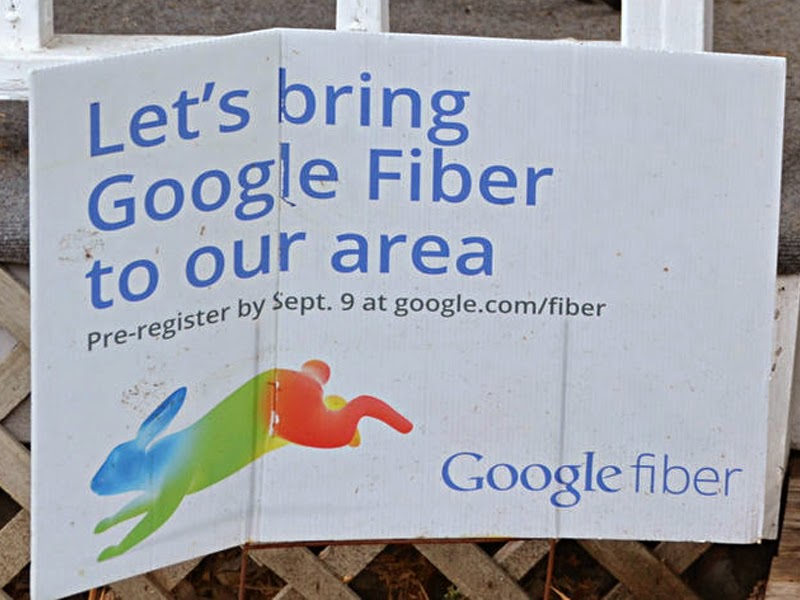
The Wall Street Journal has intercepted some news that Google is planning on announcing four new cities to receive its gigabit internet service, Fiber, this week. The lucky four? Well, if you’re a resident of Nashville, TN, Atlanta, GA, Charlotte, NC, or Raleigh, NC, the spotlight is on you!
When asked for a comment about Google Fiber spreading to these cities, Google declined to comment ahead of the official announcements. It has been confirmed through a variety of sources that the first of these announcements is expected to happen today.
It’s a sad fact that for all of the talk of the supremacy of capitalism in the United States, many areas are stuck in government supported monopolies. In fact, the United States is one of the slowest developed countries in internet speeds.
Google wants to end that with Fiber by providing one gigabyte per second of internet speed to consumers for a refreshing $80 per month. To put that in perspective, in my area, Comcast will let you suffer with 150 megabytes per second for $115/month and Cox offers 150 megabytes per second for $80/month.
It’s not entirely altruistic of Google, though. The Mountain View search giant needs you to have internet and it increasingly needs you to have it at breakneck speeds. Google’s products like the Chromebook lose a significant portion of their functionality without the internet. And no one would want a Chromecast if streaming high quality YouTube videos to their high-definition TVs landed users in perma-buffering.
Google hopes to inspire force these sluggish ISPs to up their game by offering consumers a far better alternative to the services these companies provide — services that would make Marie Antoinette proud — hitting the ISPs right in the pocketbook.
Google launched Fiber in Kansas City first. The service is now being provided to Austin and Provo as well. Other cities on the short-list include San Antonio, San Jose, Salt Lake City, Phoenix, and Portland.
Personally, I’d love to see Fiber come to Oklahoma City, but I don’t blame them for not wanting to visit the Quakenado state.
Source: Wall Street Journal
Come comment on this article: News leaks that Google Fiber is speeding to four new cities

OS X Yosemite update tackles ‘surprise’ Mac security flaws

You know those unpatched Mac security exploits that Google revealed a few days ago? You probably won’t have to worry about them any more. Apple has released OS X Yosemite 10.10.2, a hefty update that fixes those vulnerabilities, which let an intruder hijack your system in the right circumstances. There’s also a solution for Thunderstrike, a nasty (if unlikely) attack that would compromise your computer through a malicious Thunderbolt device. Most of the other 10.10.2 tweaks aren’t huge, although you’ll probably like having access to iCloud Drive storage in your Time Machine backups. You’ll definitely want to grab the upgrade, even if you don’t need some of the smaller perks — it should go quite some distance toward safeguarding your Mac.
Filed under: Desktops, Laptops, Software, Apple, Google
Source: MacRumors

Google Fiber is coming to four additional cities

According to an official announcement from Google, Google Fiber’s 1-gigabit fiber network will be coming to Atlanta, Charlotte, N.C., Raleigh-Durham, N.C. and Nashville, Tenn metro areas. Although Google is sending out invitations to local news organizations in those four metro areas (comprising 18 cities in total), Google is also letting other cities know that they are not done expanding.
A spokesman for San Jose, Portland and other cities all have stated that Google Fiber officials are telling them that Google will also be announcing additional cities in the next few weeks. Google Fiber first launched in Kansas City in 2012 and offers a gigabit service for $80 a month and $120 a month for Internet plus a cable-style TV package. Consumers can also have the option of a free 5 Mbps tier if they’re willing to pay a $300 installation fee.
Judging by their past actions, Google will take a little more than a year to survey and engineer how they will build out their service in the cities. Much like AT&T did when Google entered Austin, TX, don’t be surprised if current ISP’s in these cities do everything they can to stop Google from actually entering the areas. This move by Google follows the recent announcement that they would be trying to enter the wireless industry and are currently in talks with wireless carriers Sprint and T-Mobile to sell and manage mobile plans.

Google updates Chrome OS to version 40, most changes in the background

Google has started pushing out an update to the Chrome OS taking it up to version 40. As is usual for an update to a major system like the OS, Google has included a host of bug fixes, security updates and feature enhancements, most of which are under the hood or run in the background. However, users will see a few changes in the look of the desktop on Chrome OS.
The changes that will be most noticeable involve the default wallpaper, which has been updated to reflect a Material Design. If users happen to own more than one Chrome device, the wallpaper, including custom wallpapers, will now be synced across their devices. If users enjoy using emoji in their communications, they will find a new emoji palette has been added to give users quicker access.
If you have a Chrome OS powered device, be on the lookout for the update to be available to you soon.
sources: Chrome Releases Blog
Come comment on this article: Google updates Chrome OS to version 40, most changes in the background
Apple is the reason for no Fingerprint sensor on Nexus 6
It’s no big deal to expect a fingerprint sensor on a flagship device of this generation given that there are some previous generation devices already rocking one. But to my and many other’s surprise, the Nexus 6 didn’t come with one. On investigation, it was found that Motorola originally had an intent but stepped back at the last instant. The purported location of the fingerprint was inside the Motorola’s trademark dimple.
The plan was disturbed by Apple and was a result of the buyout of AuthenTec in 2012, a pioneer company in fingerprinting technology for use in Apple’s Touch ID sensor. Motorola was working closely with AuthenTec from way back in 2011 to integrate the technology in its smartphone like the one on Motorola Atrix 4G.
Former CEO of Motorola Mobility revealed in an interview with The Telegraph:
The secret behind that is that it was supposed to be fingerprint recognition, and Apple bought the best supplier. So the second best supplier was the only one available to everyone else in the industry and they weren’t there yet.
An in-depth look at the Nexus 6 firmware files suggests that fingerprint support was originally implemented but later removed because of the unintuitive “swipe” scanning type hardware. It was a right thing to do in my opinion. It’s better to leave something than fail badly at it.
Source: Android Central
The post Apple is the reason for no Fingerprint sensor on Nexus 6 appeared first on AndroidGuys.